

Welcome to my new subscribers (indeed, to all my subscribers!). This introductory blurb (in italics) at the beginning will remain much the same from post to post; please skip it if you’ve read previous posts!
This newsletter will remain free; I’ve no intention of converting it to a paid subscription. It’s aimed at readers who have a general interest in nature and natural history, but maybe don’t know much about moths. It’s not really aimed at people who regularly run their own moth traps, but of course they’re welcome to read it (even to criticise it if they wish!).
I run a light trap in my garden in Eastbourne (Sussex, UK) and the main objective of this newsletter is to post photos of some of the moths (and occasionally, other insects) that are attracted to the light. On average I run the trap about one night in three, and the plan is to write a post after each trapping night. In the morning I photograph any catches of special interest, then all moths and other insects caught in the trap are released (if they haven’t escaped already!).
This is my ninth year of running a garden moth trap, firstly three years in Eastbourne (2017-2019), then three in Hurstpierpoint (2020-2022), and then back in Eastbourne (2023 onwards). Hopefully, yet more house moves are off the cards for the foreseeable future!
Report for 28th June
The weather forecast for the night looked quite promising, the only potential problem being it was due to be a bit breezy during the first part of the night, and in the event it turned out to be a bit more windy than the forecast. By the time I checked the trap at about 04:30 though, the wind had died right down. Nonetheless, the count was reduced to 136 moths of 45 species; the three previous nights trapping had all had total counts in excess of 200 and species counts of around 60. Eight of the species were present for the first time this year.
I don’t know whether the wind actually stops the moths from flying, but for the smaller species and weaker fliers it obviously reduces the amount of control they have over where they actually go. So they get blown past the trap whether they want to stop there or not!
Dichrorampha alpinana
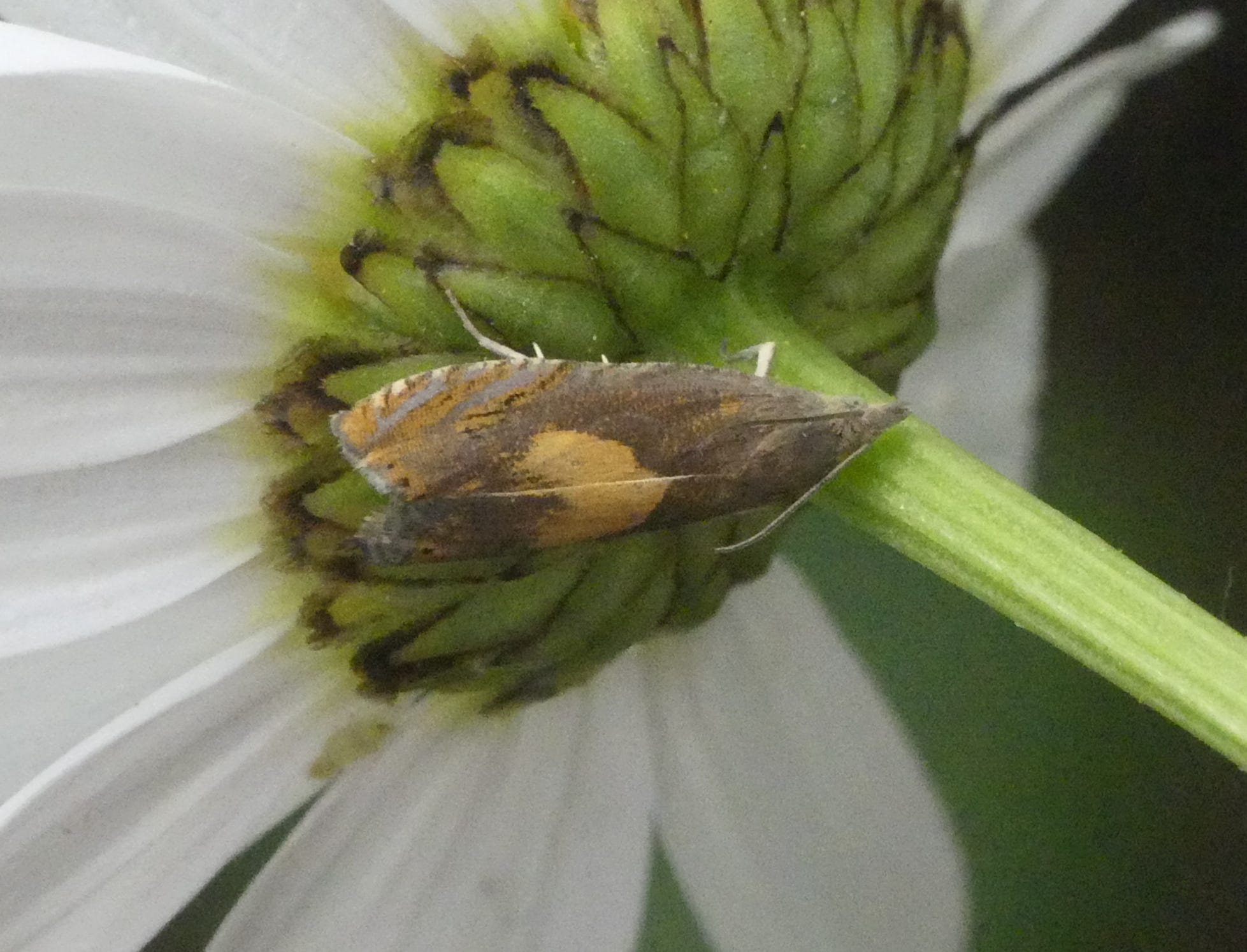
There are more than a dozen UK species in the genus Dichrorampha, several of which are very similar in appearance and have the pale orange crescent-shaped mark on the wings. They’re all quite small (what we moth-ers* call ‘micros’). When I get one in the moth trap, I can’t record it to species because it would need dissection to study its genitalia, and I don’t do that. But if I spot one flying in the garden (usually late afternoon or at dusk) it is often possible to narrow the identification down to species level on the basis of what plant the moth was flying around; they usually prefer to fly around their food plant. In this case, I found the moth at about 5 p.m. resting underneath an Ox-eye daisy, which enables me to identify it as D. alpinana.
*Many people who watch birds don’t like to call themselves ornithologists because it sounds too grand. So they call themselves ‘birders’ instead. But if you study moths, but don’t want to call yourself a lepidopterist (which might not be correct anyway because it include butterflies), we tend to say ‘moth-ers’. We can’t write it without the hyphen for obvious reasons! This reminds me of when I was still at school (1959 or 1960) and the physics master, who was aware of my growing interest in moths, pulled me aside one day and said “Ah, Chanter, I’ve found a book that will interest you - it’s called Hints for Young Mothers” (pronouncing it ‘moth-ers’ of course).
The Heart and Dart, Agrotis exclamationis
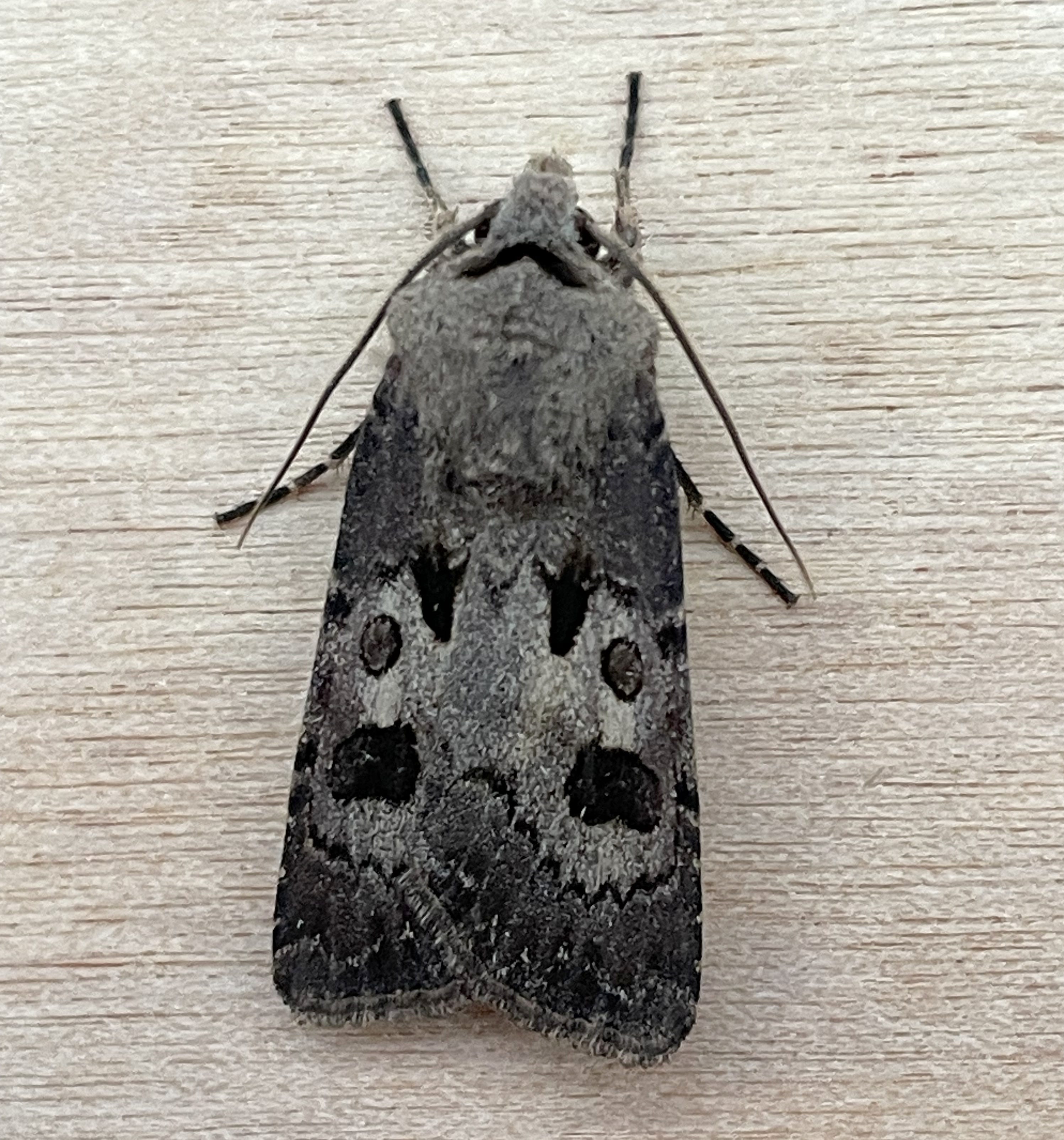
This medium-sized moth is one of the moths I get very frequently in the trap in May, June and July, often in quite large numbers. The most I’ve had on any one night was 67, one June night in 2019, and in that year I had a total of 586. It’s commoner here in Eastbourne than it was in Hurstpierpoint, and the total so far this year is 353 (including 21 from last night).
It’s not what you’d call a colourful moth! It’s brown with dark brown markings. Many moths from this family (Noctuidae) have three markings on the forewing, the one near the centre of the wing is called the claviform spot or mark (like a club or stick), the one nearer the leading edge of the wing is called the orbicular spot (round or oval), and the third, a bit further out from the body, is called the reniform spot (kidney-shaped). A helpful diagram can be found here.
The Heart and Dart moth is named after two of these marks, the claviform spot (the dart) and the reniform spot (the heart). The orbicular mark is present but is often quite faint. The easiest way to distinguish this moth from some others with quite similar marks is that the Heart and Dart nearly always has a black ‘collar’, a mark at the front of the thorax about the head. Although the ‘dart’ in this moth does not point directly towards the ‘heart’, if it did then the moth would look as though it had a big exclamation mark on its wing. Presumably, Linneaus (who gave the moth its Latin name) thought the alignment was good enough to choose the species name exclamationis!
The Light Arches, Apamea lithoxylaea
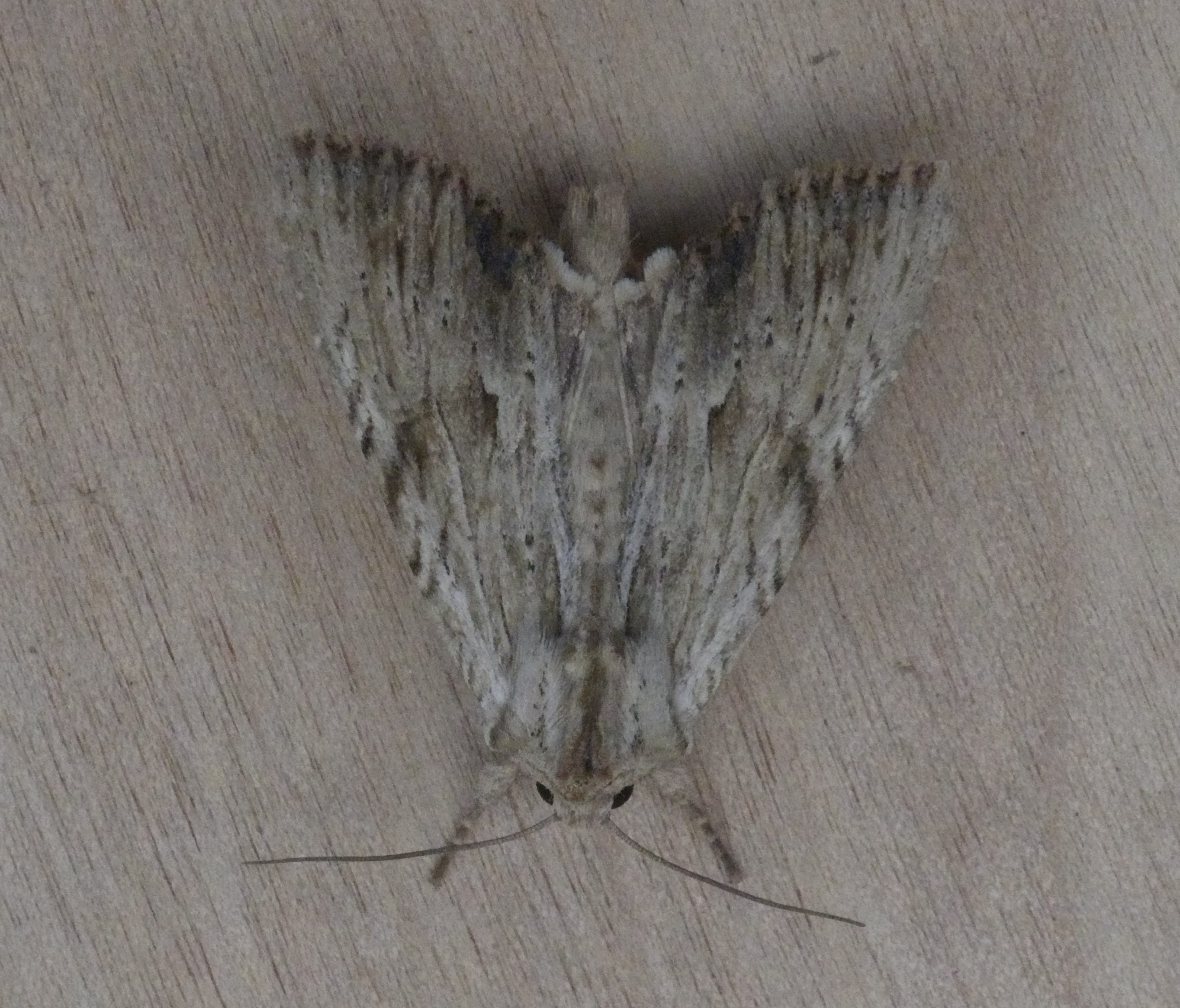
I think this moth is probably the ‘star of the show’ from last night. There is another species in the same genus, called the Dark Arches, which is much more common, but I’ve not seen a Light Arches for several years until last night. There are actually several species with the word ‘arches’ in their name, some from different families. The name is supposed to indicate that the markings on the wings suggest a pointed or curved arch above a pair of columns. It’s more obvious (but still requires a stretch of imagination) if you look from the head end, which is why I’ve put the photo upside down (although it’s just convention which dictates that the head is usually at the top of the photo; when they rest on walls or tree trunks many species prefer to point their head downwards). The scientific species name, lithoxylaea, appears (I’m no classicist!) to be based on the Greek words lithos (stone) and xylon (wood). It seems the authors (there were two) of this name couldn’t quite make up their minds!
This species is one of those that appears to be in decline at the moment. The Sussex Moth Group website shows only one record for the Eastbourne area between 2020 and 2024.
The trapping session reported here will the last one I do in June 2025. It brings the species total for the year so far to 232 - this is the highest count I’ve had at this time of year. My previous record for Eastbourne was 214, and for Hurstpierpoint 223. This marks a good recovery from a slow start; at the end of February I had had only one species, whereas I’m usually into double figures by then. However, it is too soon to conclude that species diversity is improving - the explanation is more likely that the seasons are a week or two ahead of where they usually are, and the figure is best compared with previous totals for mid-July! My recording system is based on months and I can’t easily see mid-month counts for previous years, so we’ll have to wait and see how the year unfolds. My best year was 2022 when I reached 398 at the end of the year - more usually my annual total is in the 350 to 370 region.
For June as a whole the species count was 168, and that is the highest count I’ve recorded for June (the next best was 165 in 2019). Previously the July species count has always been better than the June count, at an average of 178, so, fingers crossed for July!
That’s it for June then. Whilst I’m not a fan of collecting ‘like’s, if you’ve enjoyed reading this report please give it one, and/or make a comment, as I understand that that increases the chance that Substack will help promote the post. And the more subscribers/followers I have the more encouragement it will give me to continue the newsletter. Thanks for reading.