

(Welcome to my new subscribers (indeed, to all my subscribers!). This introductory blurb (in italics) will remain much the same from post to post; please skip it if you’ve read previous posts.
This newsletter will remain free, I’ve no intention of converting it to a paid subscription. It’s aimed at readers who have a general interest in nature and natural history, but maybe don’t know very much about moths. It’s not really aimed at people who regularly run their own moth traps, but of course they’re welcome to read it (even to criticise it if they wish!).
I run a light trap in my garden in Eastbourne (Sussex, UK) and the main objective of this newsletter is to post photos of some of the moths (and occasionally, other insects) that are attracted to the light, and to say a little about them. On average I run the trap about one night in three, and the plan is to write one post a week reporting on that week’s trapping sessions, and featuring two or three of the moths seen in the previous couple of weeks.
In the morning I photograph any catches of special interest, then all moths and other insects caught in the trap are released (if they haven’t escaped already!).
This is my ninth year of running a garden light trap, firstly three years in Eastbourne (2017-2019), then three in Hurstpierpoint (2020-2022), and then back in Eastbourne (2023 onwards). Hopefully, yet more house moves are off the cards for the foreseeable future!
Report for w/b 1st September
Just two trapping sessions in this period, one on the 4th and one on the 7th. The trap on the 4th yielded 85 moths of 23 species, indicating the usual fall off in numbers as we enter the beginning of autumn. However, three species were new records for the year. Two of these, the Cypress Pug and Clancy’s Rustic, are autumn species which I usually see a handful of each year. However, the third was a new record for me; the Pearly Underwing. It’s a migrant which can turn up at any time of year, but most usually in the autumn. Although not a rare moth, it’s one which has somehow managed to evade me until now. I’ll say a bit more about it in next week’s edition.
The session on the 7th was a bit disappointing, producing only 28 moths of 15 species, just one of which (Feathered Gothic) was a new record for the year. This is probably because it was a full moon (which creates competition for the light on the trap), even though the temperature was quite mild and the humidity was high. Perhaps the most interesting find in the trap was a dead bug, only about 5 or 6 mm long, which turned out to be Lamprotettix nitidulus, the first time I’ve recorded this insect. My own photos of it are not good enough to put on here, but the British Bugs website has some much better ones if you want to see what a live example looks like. The key identification feature is the markings on the scutellum (the triangular plate on the back of the thorax), which look like a head-on view of a sad frog. If you really want to see my own photos, they’re on my iNaturalist report (here).
Some individual species descriptions follow shortly, but before moving on to those, I’m just taking a moment to record having reached the milestone of 50 subscribers! In the early days, when I was struggling to get into double figures, this seemed only a remote possibility. But onwards and upwards, hopefully. 100 is the next target!
The Yellow Belle, Aspitates ochrearia
Year total to date: 1 (29th August)


This moth has a rather unusual UK geographical distribution; in the south of England and Wales it is confined to coastal areas from Pembrokeshire eastwards, but it is also recorded inland from the brecks of Norfolk and Suffolk, and along the Thames Estuary. Although some of its foodplants are coastal species, it also feeds on widespread species such as wild carrot.
On the coast itself it’s a moth of sand dunes and vegetated shingle, but it can also be found on grassland, heath and brownfield sites. While it flies at night and is attracted to light, it is also considered a day-flying moth, or at least one which is easily disturbed during the daytime. However, the two shown above are the only ones I’ve ever seen; I’ve never disturbed one during the day (well unless one was among the many that have flown off before I got a chance to get a good look at them!).
Both the specimens I’ve seen have been very pale yellow, but other photographs show that it can also be a deeper yellow. The species name ochrearia alludes to the ochre-yellow colour. The sexes can be identified according to whether the antennae are feathered (male) or not (female), as can be seen in the photos. According to the book, the male is usually a deeper yellow than the female, although that’s not the case with the two I’ve seen. The genus name Aspitates would seem to be derived from the Latin aspis, meaning shield. I suppose the moth is vaguely shield-shaped if you turn the photos upside down, but the same is true of many moths in the same family1.
The Orange Swift, Triodia sylvina
Year total to date: 2 (22nd and 27th August)
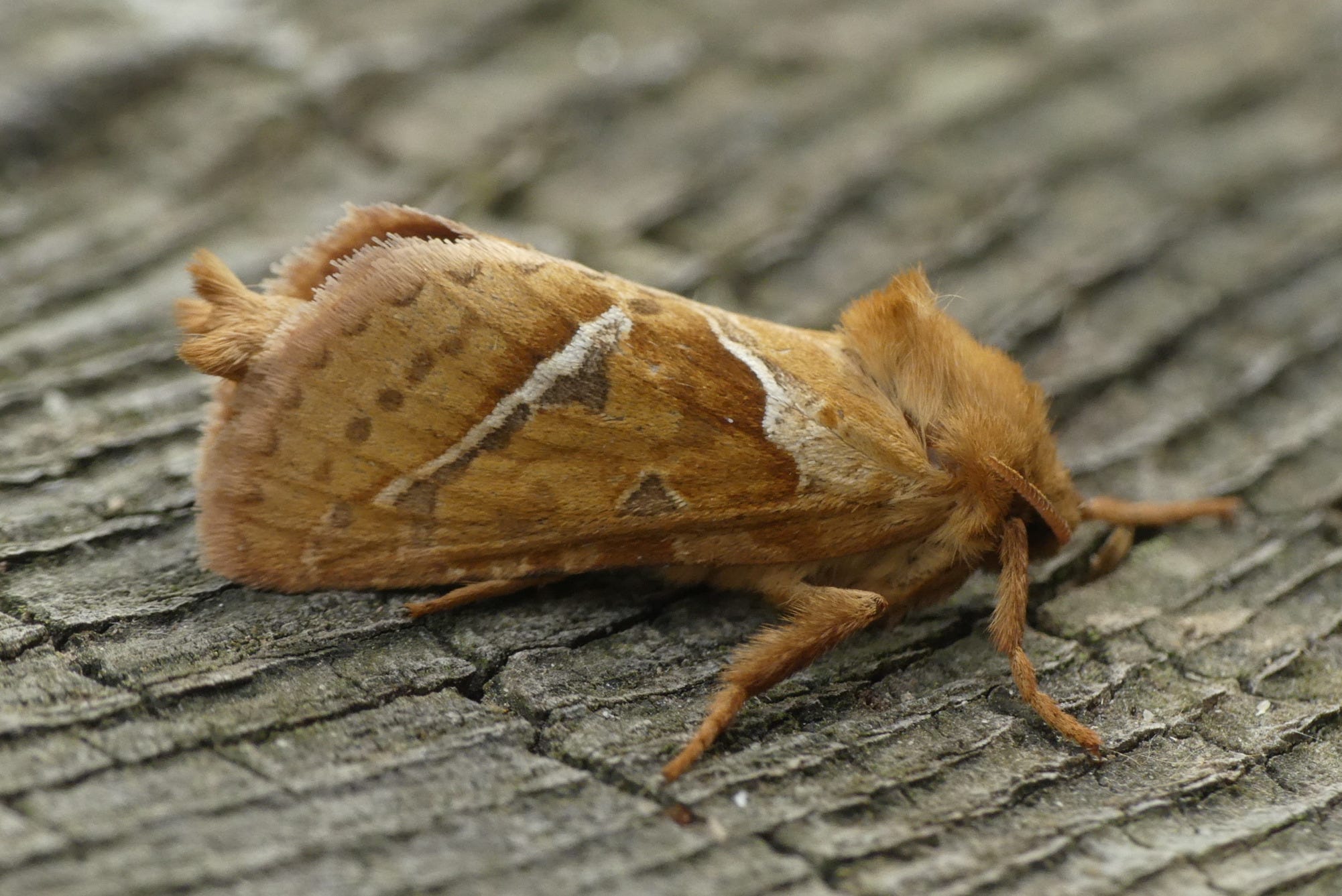
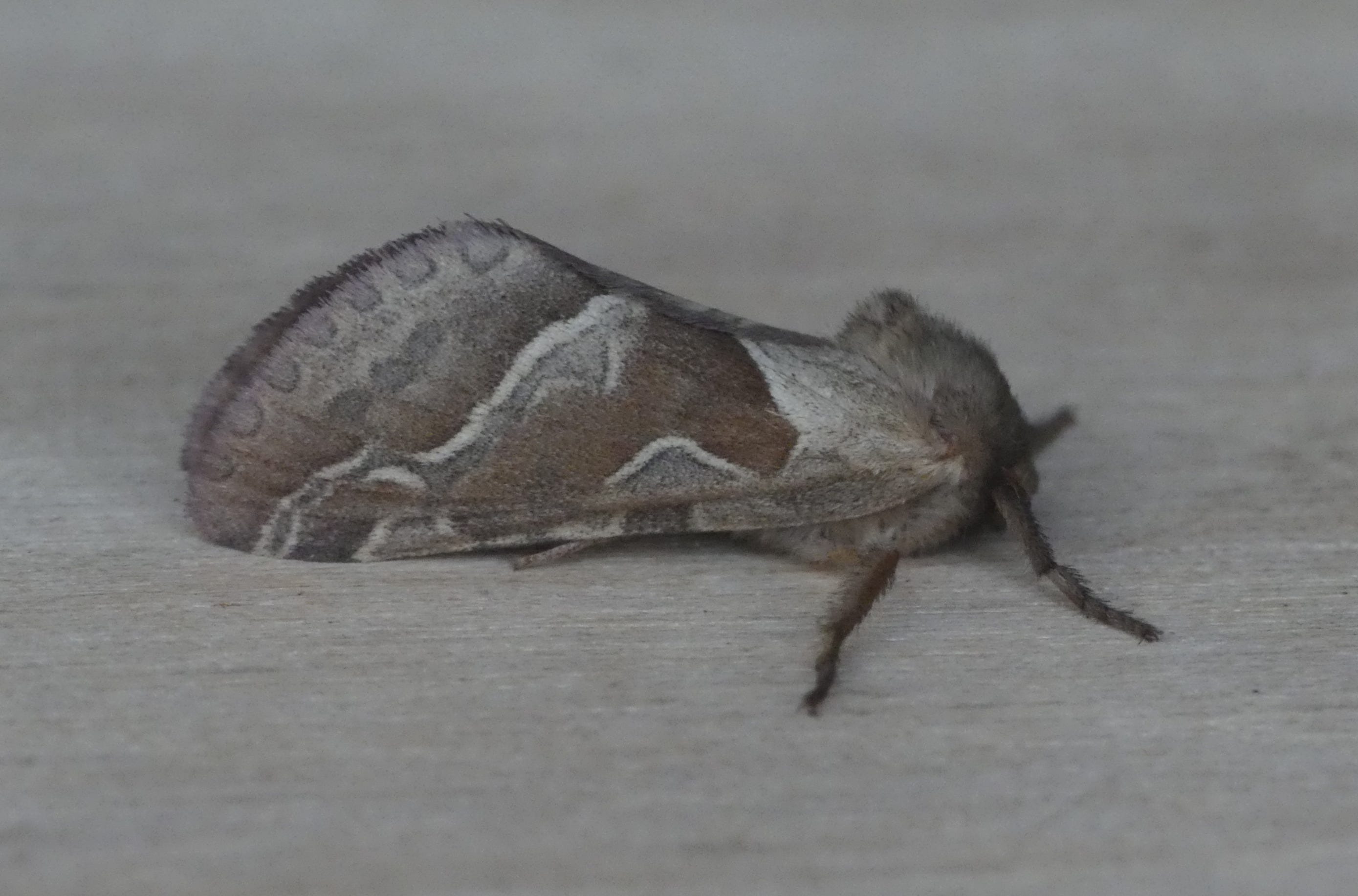
I briefly mentioned the family that includes the Swift moths (the Hepialidae) in an earlier post, remarking on the fact that they were considered less evolutionarily advanced than most other moths because (a) they had no functional mouth parts or proboscis and therefore didn’t feed as adults, and (b) they didn’t search out their foodplants in order to attach their eggs, instead the females just hover over the ground where their foodplants are likely to be and scatter their eggs in flight. Another feature which separates them from most other moths is that they have very short antennae (best seen in the picture of the male, above).
The Orange Swift is one of the more common members of this family - when I first started trapping in Eastbourne I used to see 8 or 10 of these a year. Now I’m back in Eastbourne, only about 600 yards as the moth flies from my previous house here, I only see one or two of these a year. The Sussex Moth Group webpage for this species2 does not suggest that it has suddenly become less common, so I guess that even that relatively short distance must be enough to have a marked effect on the frequency of occurrence.
The caterpillars of this moth feed on the roots of various grassland species; plants like bracken, burdock, dock, dandelion and viper’s bugloss3. Unusually among moths, the caterpillars overwinter twice before pupating. Few moth species have larval stages longer than one year, the other main exception being moths that live inside tree trunks feeding on wood (like the Goat moth4).
The Swift moths are believed to have got this name because they are quite fast fliers. The Orange Swift is distributed throughout Europe, and in most European languages the common name references the orange colour rather than the speed of flight. I particularly like its Italian name, the Spazzacamino Arancione, which translates as the orange chimneysweep. I’ve read several theories as to what the connection with chimneysweeps might be, but none of them sounds very convincing!
As well as being a fast flier, the female at least is also a somewhat erratic flyer, and that is where the family name, Hepialidae, originates from - it’s derived from the Greek hepialos, meaning ‘fever’ or ‘fit of trembling’, describing the somewhat feverish appearance of the flying moth as it darts hither and thither. This is also the root of the original genus name for this species, Hepialus, which some other members of the family still keep, but the genus was split in the latter part of the 20th Century and the Orange Swift was placed in a new genus, Triodia. Exactly what that means (well, apart from three of something) I haven’t been able to find out. The species name, sylvina, is easier to interpret and means ‘of the forest’; a strange choice because this moth is not particularly associated with woods and forests. The name derives from the Roman god Sylvanus, who was (among other things) the protector of uncultivated ground, trees and wild nature.
Oncocera semirubella
Year total to date: 2 (22nd and 27th August)
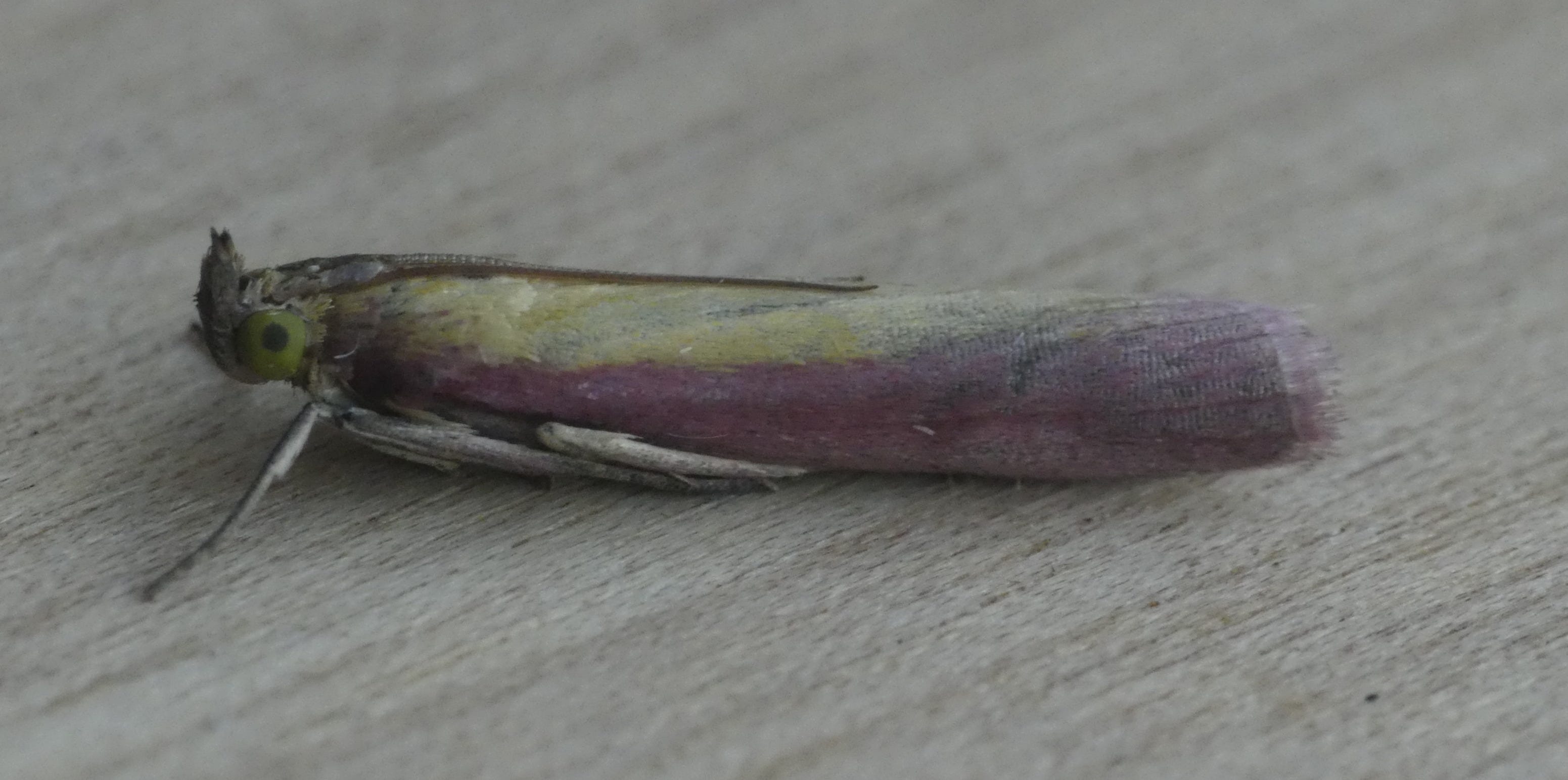
This is one of our larger ‘micro’ moths, being about 14mm long. It doesn’t have an official common English name (although there have been attempts to introduce the name ‘Ruby Knothorn’). However, unofficially, it’s usually referred to by moth-ers as the Rhubarb and Custard, for fairly obvious reasons.
In the UK this is quite a scarce moth, with a preference for chalk downlands and limestone cliffs in southern England. However, in continental Europe it is widespread and its range spreads as far east as Japan. The foodplants are mainly Bird’s-foot Trefoil and clover; I’ve got quite a bit of the former growing around my pond (and of the latter in my so-called lawn) so I’m hoping it might decide to breed here! These two (or maybe the same one twice) that I recorded recently are the only records I have for this moth. As well as flying at night it is also reported to fly in the late afternoon.
The genus name Oncocera is derived from two Greek words onkos (bulky, or swelling) and keras (horn). This most likely refers to the prominent palps that are visible in the picture, standing erect above the head. The palps are sense organs which are attached to a moth’s head near to the mouth parts. Depending on the exact point of attachment they are described as either maxillary palps (attached to the upper jaw structures) or labial palps (attached to labium, or lower lip). In moths, the visible palps are mostly labial palps, so we usually refer to them just as palps. Their size varies substantially between different moth families, and in some can be quite large (including the family of this moth, the Pyralidae). In some moths they protrude in front of the moth’s head to such an extent that the moths are called ‘snout moths’. I sometimes get these in the trap and will feature one or two of them next time I see them. The palps can fulfil various sensory functions; detecting smells, tastes, pheromones, touch and movement, and in some cases temperature and humidity.
The species name, semirubella, is fairly self-explanatory, since ‘rubella’ is a diminutive of ‘ruber’, meaning red.
Well, that’s it for this edition. The next one is scheduled for Tuesday, 16th September.
Also, if you’re a regular reader of this newsletter and know of other people who might enjoy reading it, please share it with them using the button below. The more regular readers I have, the more it will encourage me to continue writing it.
While we conventionally show moth photos with the head at the top, in the wild they are just as often seen the other way up. Sometimes, turning the picture upside down can be quite revealing. There’s a moth that’s very rare in the UK called the Passenger. Google it for a picture then try turning it upside down!
Go to the distribution map and compare the period ‘2010-2019’ with that for ‘2020 onwards’.
Such a strange name! Chantal Bourgonje writes a charming (and delightfully illustrated) Substack newsletter (called Flowerology) that explains how lots of wildflowers got their common names. This is a link to her post on Viper’s Bugloss.
The Goat moth is now absent from almost all of Sussex, just hanging on in a few localities in the far east of the county (around Rye). So it’s most unlikely to appear in this newsletter any time soon as for now I’m limiting it to moths I get in my garden trap. Maybe when I run out of those I’ll broaden the scope a bit!
The Orange Swift is a little cracker. I always enjoy catching them.
Thank you for the explanation re palps! Will look forward to your piece about snout moths having seen one myself. The orange swift is a beauty. And I love the rhubarb and custard moth!