
Welcome to my new subscribers (indeed, to all my subscribers!). This introductory blurb (in italics) will remain much the same from post to post; please skip it if you’ve read previous posts.
This newsletter will remain free, I’ve no intention of converting it to a paid subscription. It’s aimed at readers who have a general interest in nature and natural history, but maybe don’t know very much about moths. It’s not really aimed at people who regularly run their own moth traps, but of course they’re welcome to read it (even to criticise it if they wish!).
I run a light trap in my garden in Eastbourne (Sussex, UK) and the main objective of this newsletter is to post photos of some of the moths (and occasionally, other insects) that are attracted to the light, and to say a little about them. On average I run the trap about one night in three, and the plan is to write a post once a week, featuring two or three of the moths seen in the trap within the previous couple of weeks.
In the morning I photograph any catches of special interest, then all moths and other insects caught in the trap are released (if they haven’t escaped already!).
This is my ninth year of running a garden moth trap, firstly three years in Eastbourne (2017-2019), then three in Hurstpierpoint (2020-2022), and then back in Eastbourne (2023 onwards). Hopefully, yet more house moves are off the cards for the foreseeable future!
Report for w/b 8th September
Most nights in this week were too windy to make it worth putting the trap out, but there were two nights when the wind wasn’t a major problem. On both nights the moon was quite bright though, so conditions were never ideal. On the 9th the catch was 49 moths of 20 species, and on the 13th, 72 moths of 22 species. Neither night produced any species which were new records for the year. On the second night, more than half of the moths (40) were of the same species, the Large Yellow Underwing, which is often present in large numbers at this time of year; I’ll feature that in the next newsletter (scheduled for the 23rd).
One moth worthy of comment from the second night was Palpita vitrealis (first record so far this month). I wrote a bit about that moth in an earlier report. So far this year I’ve seen 16, so it looks like its total for the year will exceed last year’s record of 20. Special note for Cat at Clouded Silver: Tiny Island Life; on 13th I had my second Centre-barred Sallow of the year, but still waiting for any of the other sallows to put in an appearance! I’ll include that in next week’s newsletter too.
Anyway, let’s move on to look at a few more species seen recently.
Blair’s Mocha, Cyclophora puppillaria
Year total to date: 3 (latest, 7th September)
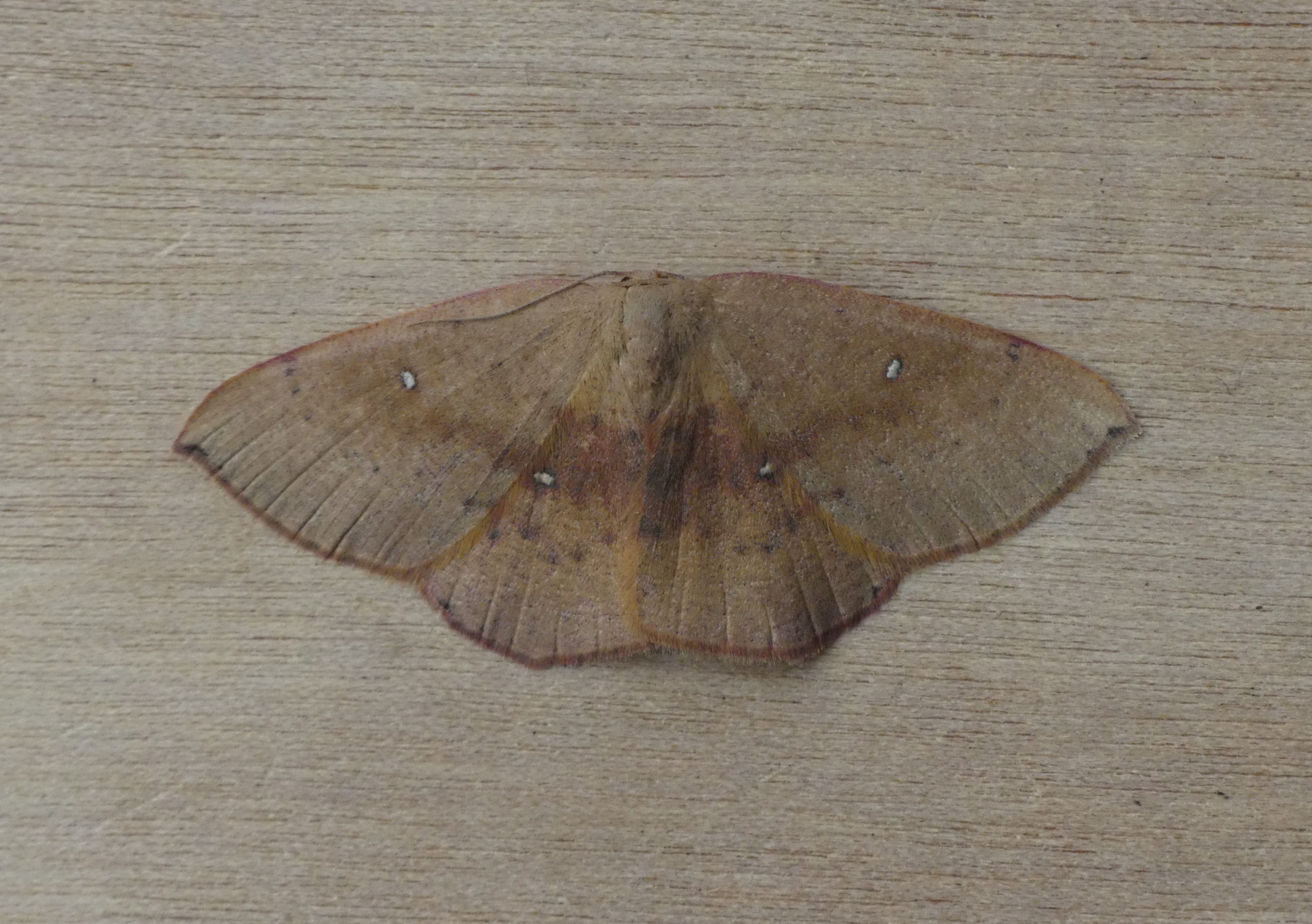
There are several UK moths which contain the word ‘mocha’, one of them is just simply ‘The Mocha’ (Cyclophora annularia) while the other 5 or so species have an adjective in front of the name, like the Blair’s Mocha shown here1 . It would seem to be the Mocha which first got the name, while the others acquired the ‘mocha’ part of the name because they are closely related (in the same genus).
These days of course the word ‘mocha’ immediately suggests coffee, and since these moths are basically coffee-coloured it is tempting to assume that’s the link. The term mocha originally referred to coffee beans exported from the Red Sea city of Al-Mukha (or Mokha) in Yemen. During the 15th to 18th centuries, Mocha was a major hub in the coffee trade. Beans grown in the Yemeni highlands were prized for their distinctive flavour, often described as having undertones of chocolate, spice, and smokiness.
During the 18th century the port of Mocha lost its dominance in the coffee trade. European powers (especially the Dutch and French) smuggled coffee plants out of Yemen and began cultivating them in their own colonies. The area around Mocha also became politically unstable; the Ottoman influence waned and local rulers fought for control of the trade routes (sound familiar?!). But there was another product (originating from India) shipped through there to which the name ‘mocha’ became attached - mocha stone. This is an old name for what today is called moss agate, a variety of chalcedony (a microcrystalline form a quartz) that features tree-like or fern-like inclusions—usually manganese or iron oxide. These make intricate patterns resembling natural landscapes, and mocha stones are popular in jewelry and in metaphysical circles where they are regarded as stones of friendship.
The ground colour of moss agate is typically milky white, but the inclusions can take a variety of colours; yellow, green or brown through to black. It’s probably more the patterning on the wings of the Mocha moth that link it to mocha stone, rather than the colours. We know the link is to the stone rather than to the coffee because the common name for the Mocha moth was originally the Mocha Stone! I’ve included a couple of photos of the Mocha moth from when I lived in Hurstpierpoint; I saw it quite often there but I’ve only seen it twice in Eastbourne. On the other hand, I hardly ever saw Blair’s Mocha in Hurstpierpoint (just once in three years) but I see about three a year on average in Eastbourne.


And then we come to the Blair part of the name. Not Tony of course. It actually honours Dr Kenneth G Blair (1886 - 1952) who was the first to record this moth in the UK - on 2nd October 1946 on the Isle of Wight. Blair was a distinguished British entomologist who was a curator at the Natural History Museum and who served as President of the Royal Entomological Society. He was a specialist in Lepidoptera (moths and butterflies) and Coleoptera (beetles).
It’s interesting that while the ‘mocha’ part of this moth’s name is not found in its common names in other European languages, the ‘Blair’ part often is (Spanish, Swedish, Finnish, Dutch and German). For example, in German it is known as Blairs Ringelfleckspanner, which translates as ‘Blair’s ring-spot looper’.
Blair’s Mocha is mainly an uncommon migrant from southern and eastern Europe, although a few colonies have become established in the UK. The first record from Eastbourne is from 1956. There are scattered records throughout southern England, but regular sightings seem restricted to coastal areas between Weymouth in Dorset and Eastbourne.
All the species in this group share the genus name Cyclophora. It has Greek roots; kyklos (‘circle’) and phoros (‘bearing’ or ‘carrying’). The circles in question are the black circles surrounding the four white (or whitish) spots on the wings. The species name puppillaria also refers to these spots, from the Latin pupilla (‘pupil of the eye’). Quite how the extra ‘p’ crept in is anyone’s guess!
The Cypress Pug, Eupithecia phoeniceata
Year total to date: 4 (latest 13th September)
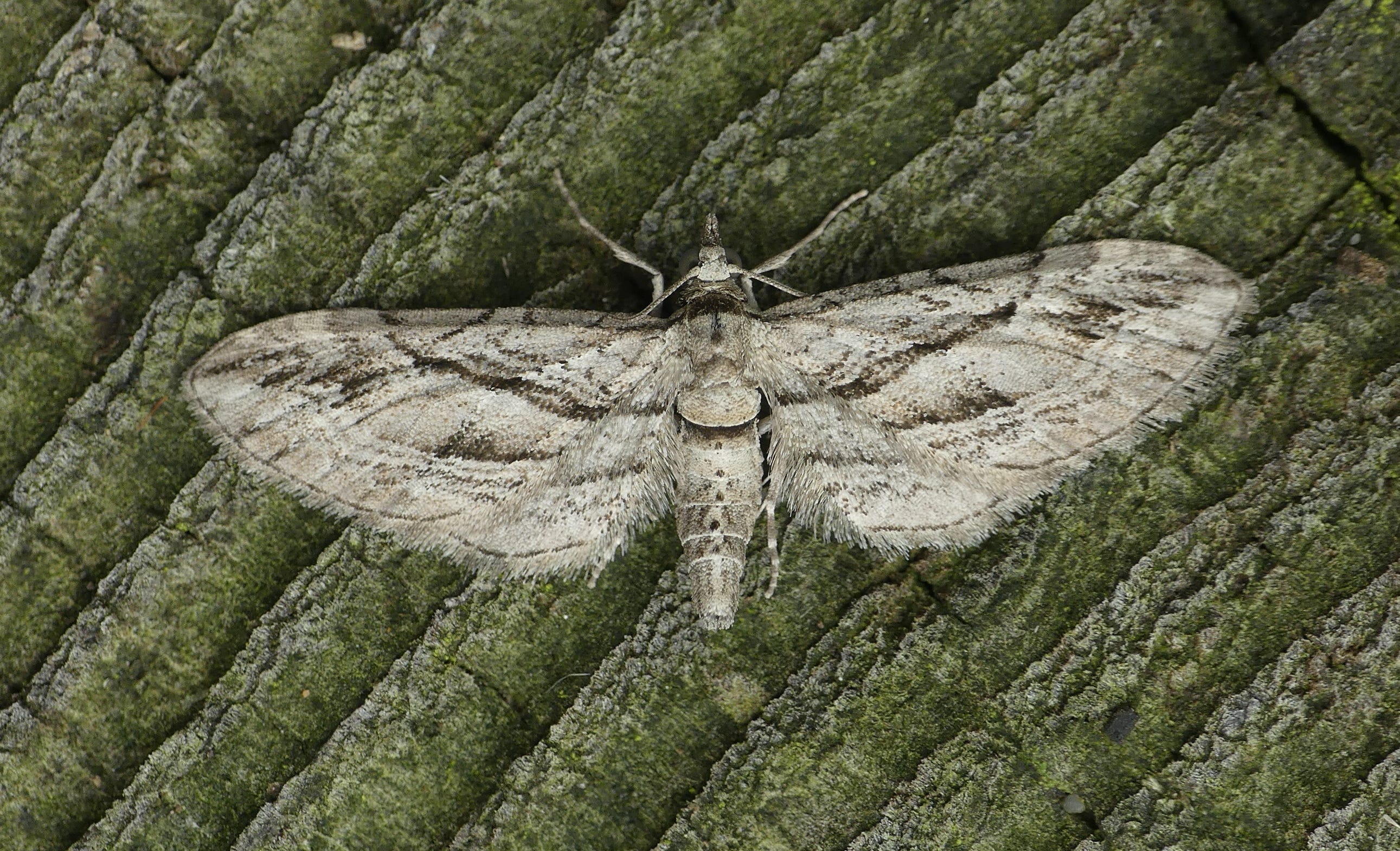
I discussed another of the pug moths, the Golden-rod Pug, in a recent moth report, saying that while many of them are very similar to one another, a few of them are quite distinctive and easy to identify. Well, this is one of those easy ones! It’s the only one to have that dark oblique cross-line and other black streaks. It has a wing span of 22 to 25 mm, so while it’s on the large side for a pug, it’s still a small moth. It’s also one of the harbingers of autumn, usually on the wing between mid-August and mid-September.
It’s not a native species to the UK, and it’s unusual in that it doesn’t have any native plants among its foodplants - as its name implies, it feeds on cypress trees. It seems that its preferred foodplant is the Monterey Cypress, native to California and not that widely planted in the UK. In captivity, the larvae will eat Lawson Cypress and Leyland Cypress (yes the dreaded leylandii!) and it seems likely that it uses these trees (which also originate from western USA) in the wild as well. The moth was first recorded in the UK in Cornwall in 1959, and since then has spread along the south coast to Kent, and to various inland areas in the south of England. Its distribution is still patchy though; here in Eastbourne I see an average of about six a year, but during the three years I was in Hurstpierpoint (which is about 7 miles from the coast) I didn’t see it once.
Although the moth’s foodplants originate from America, the moth itself does not; its geographical distribution is mainly southern Europe and the Mediterranean. Although we have no native cypress trees in the UK, in continental Europe there is Cupressus sempervirens, the Mediterranean Cypress. So it seems likely that was its original foodplant, and it switched to the Monterey Cypress when it became widely planted in Europe.
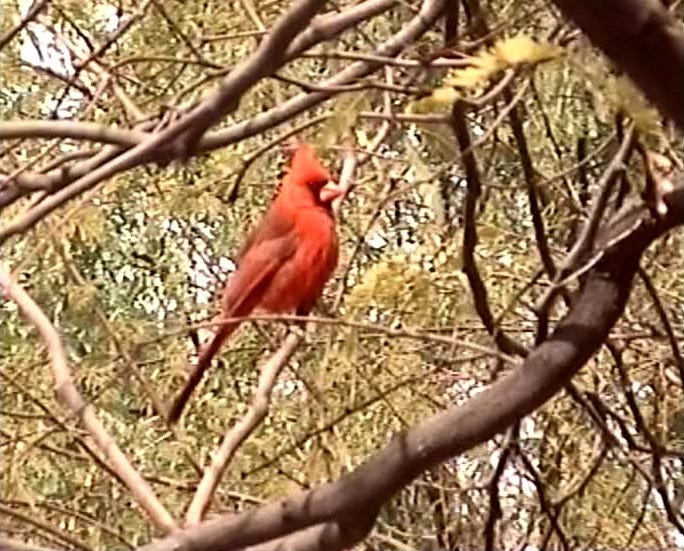
I already discussed the genus name Eupithecia (‘good-monkey’) in the report referenced above. The species name, phoeniceata, is a bit of a puzzle though. It would appear to go back via Latin to the Greek, meaning ‘Phoenician purple’. This is the colour, also known as Tyrian purple, that in Rome only emperors were allowed to wear. Its rarity and cost stemmed from the fact that it was made from sea snails of the genus Murex, and it took some 10,000 to 12,000 of the molluscs to produce 1 gram of the dye (using a laborious and smelly process). But the puzzle, of course, is why would this name be applied to a moth which is basically just black and (off-)white? I’ve read reports that say that the background colour of the moth can sometimes take on a reddish hue, but I’ve never noticed it either in photos or in real life. And in any case, why use the name of such a vivid colour if what you are describing is just a faint hue? I guess we’ll never know. Actually, this is not the only instance where this colour was used as the species name for something; Cardinalis phoeniceus is the name given to the Northern Cardinal, a common bird in the Eastern US; now that really is red, and fully deserving of the name! This is the only picture of my own I have of one, a still from an old video tape, but there are lots of pictures on the internet.
The Pearly Underwing, Peridroma saucia
Year total to date: 1 (4th September)
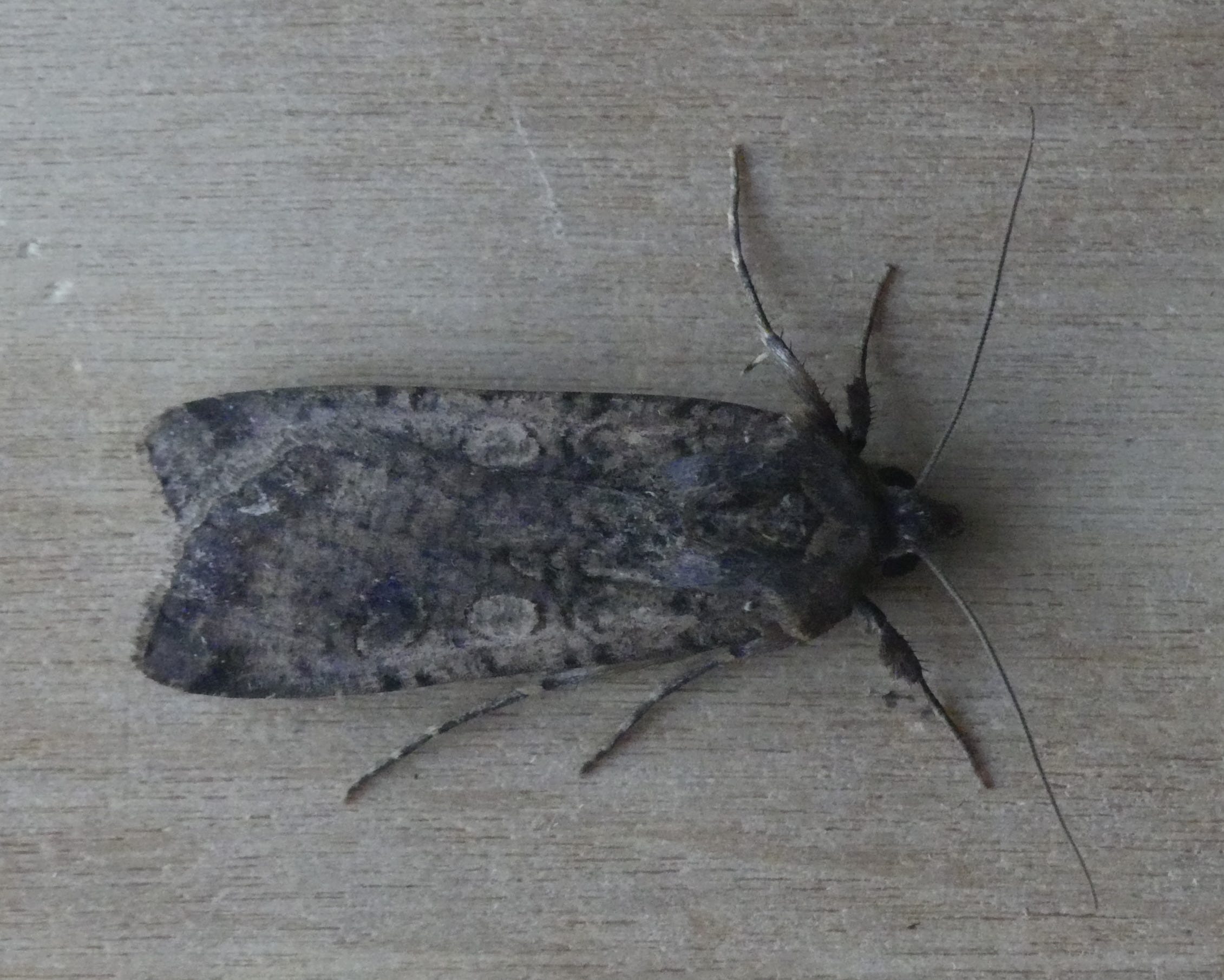
For something with such a romantic-sounding name, the picture above probably comes as something of a disappointment! It could be one of any number of boring brown moths that you might come across while rooting around in the undergrowth looking for something you’ve dropped. This particular moth keeps its best feature hidden most of the time, it’s quite tricky to get it to show a glimpse of its hindwings while it is sitting in this resting position. Here’s a photo from a German website where the photographer has managed it. Even so, the pearly sheen the hindwings have doesn’t show well in photographs.
For identification purposes, one of the most useful features is that there is often a grey crest on the thorax; this is only just visible in my photo above, but is clearer in the photo I’ve linked to a few lines above.
Geographically this moth has quite a wide distribution, occurring in North and South America, Europe, Asia and north Africa, including some islands located a long way from the nearest continent, such as Hawaii, the Azores and Iceland. This is at least partly because this moth is a migratory species which moves to the cooler parts of its range (mostly northwards) during the early part of the year, then retracts to its core range when the temperatures decrease again; it can squeeze in as many as four generations a year when the conditions are favourable. In the UK this is considered almost entirely a migratory species, appearing mainly in September and October (although it can appear at any time of the year). In Australia there is a close relative of this moth, the Bogong moth (Agrotis infusa) with a better-studied migratory habit, which in some ways is even more impressive than the better-known migrations in America of the Monarch butterfly. Check out Brian Ruckley’s podcast in The Wild Episode for more information about the Bogong moth.
In North America, this moth is commonly known by a different name, the Variegated Cutworm. In fact, many related species share the “cutworm” name there, which reflects their destructive behaviour as agricultural pests. By day, the caterpillars remain hidden in the soil; by night, they emerge to feed. The first part of the plant they encounter is typically the base of the stem, which they chew through, severing the plant at ground level. The Pearly Underwing is no exception to this and is considered an agricultural pest of an enormous range of vegetable and fruit crops; the Wikipedia page for the species gives a list of some of them. In addition to the ‘cutworm’ behaviour, the caterpillars will climb trees to feed on the leaves, and can defoliate a tree quite quickly. A variety of pest control methods is used, but one of the more environmentally friendly is to use turkeys or guinea fowl, which seem to have a particular liking for the caterpillars and pupae of this species!
In the UK though, this moth generally doesn’t arrive in sufficient numbers to cause any problems for vegetable or fruit growers. As a migrant species, most records are from near the south coast, although there are records throughout England, and for parts of Scotland as far north as the Shetlands. While this is my first record for this moth, it’s very similar to some other quite common moths and it’s possible I might have overlooked it previously.
The genus name, Peridroma, has Greek roots; peri-, ‘about’ or ‘around’, and dromos, ‘course’, ‘race’ or ‘running’. This most likely relates to the moth’s migratory behaviour; ‘running around’ or similar, although another possibility is it could be associated with the moth’s tendency to scuttle away when disturbed (a bit like the Mouse Moth I wrote about previously). The species name, saucia, is Latin for ‘wounded’ or ‘injured’. This is more difficult to interpret, and the best I can come up with is that after a long flight it could well look rather tatty. However, even non-migratory moths can get very tatty when they’ve been around for a while, so if that’s the explanation then it’s a rather odd choice. In his book on moth names, Peter Marren suggests that it could be linked to a reddish tinge on the forewings, but my specimen certainly didn’t have such a tinge, and I don’t see any suggestion of it in the various photographs I’ve looked at. The colour of the forewing, though, is quite variable and some sources suggest it can stretch to ‘russet-coloured’. Another suggestion Peter Marren makes is that the behaviour of scuttling away when disturbed could make the moth look as though it is injured and unable to fly.
That’s it for this week. The next issue is scheduled for Tuesday, 23rd September.
More strictly in this case a possessive proper noun, but it functions like an adjective!
I love the snippets covering the history of their names - theres so much to delve into, and not commonly information I come across. So interesting!