
Welcome to my new subscribers (indeed, to all my subscribers!). This introductory blurb (in italics) will remain much the same from post to post; please skip it if you’ve read previous posts.
This newsletter will remain free, I’ve no intention of converting it to a paid subscription. It’s aimed at readers who have a general interest in nature and natural history, but maybe don’t know very much about moths. It’s not really aimed at people who regularly run their own moth traps, but of course they’re welcome to read it (even to criticise it if they wish!).
I run a light trap in my garden in Eastbourne (Sussex, UK) and the main objective of this newsletter is to post photos of some of the moths (and occasionally, other insects) that are attracted to the light, and to say a little about them. On average I run the trap about one night in three, and the plan is to write a post once a week, featuring two or three of the moths seen in the trap within the previous couple of weeks.
In the morning I photograph any catches of special interest, then all moths and other insects caught in the trap are released (if they haven’t escaped already!).
This is my ninth year of running a garden moth trap, firstly three years in Eastbourne (2017-2019), then three in Hurstpierpoint (2020-2022), and then back in Eastbourne (2023 onwards). Hopefully, yet more house moves are off the cards for the foreseeable future!
Report for w/b 6th October
Two trapping sessions this week, in spite of quite similar weather conditions, produced quite different results. The first, on the 8th (Wednesday), produced just 10 moths of 8 species, while the second, on the 10th (Friday), produced 43 moths of 27 species. The main difference was that it was appreciably more overcast on the Friday, so the moon was much less visible.
Five species were recorded for the first time this year during the week; one of them (the Feathered Ranunculus) is included in my selection of species for this edition. The other four were Blair’s Shoulder-knot, the Barred Sallow, the Oak Nycteoline and the micro, Crocidosema plebejana. I’ll pick one or two of those for inclusion in next week’s Moth Report.
Let’s move on to look at some species seen recently.
The Yellow-tail, Euproctis similis
Year total to date: 1 (1st October)
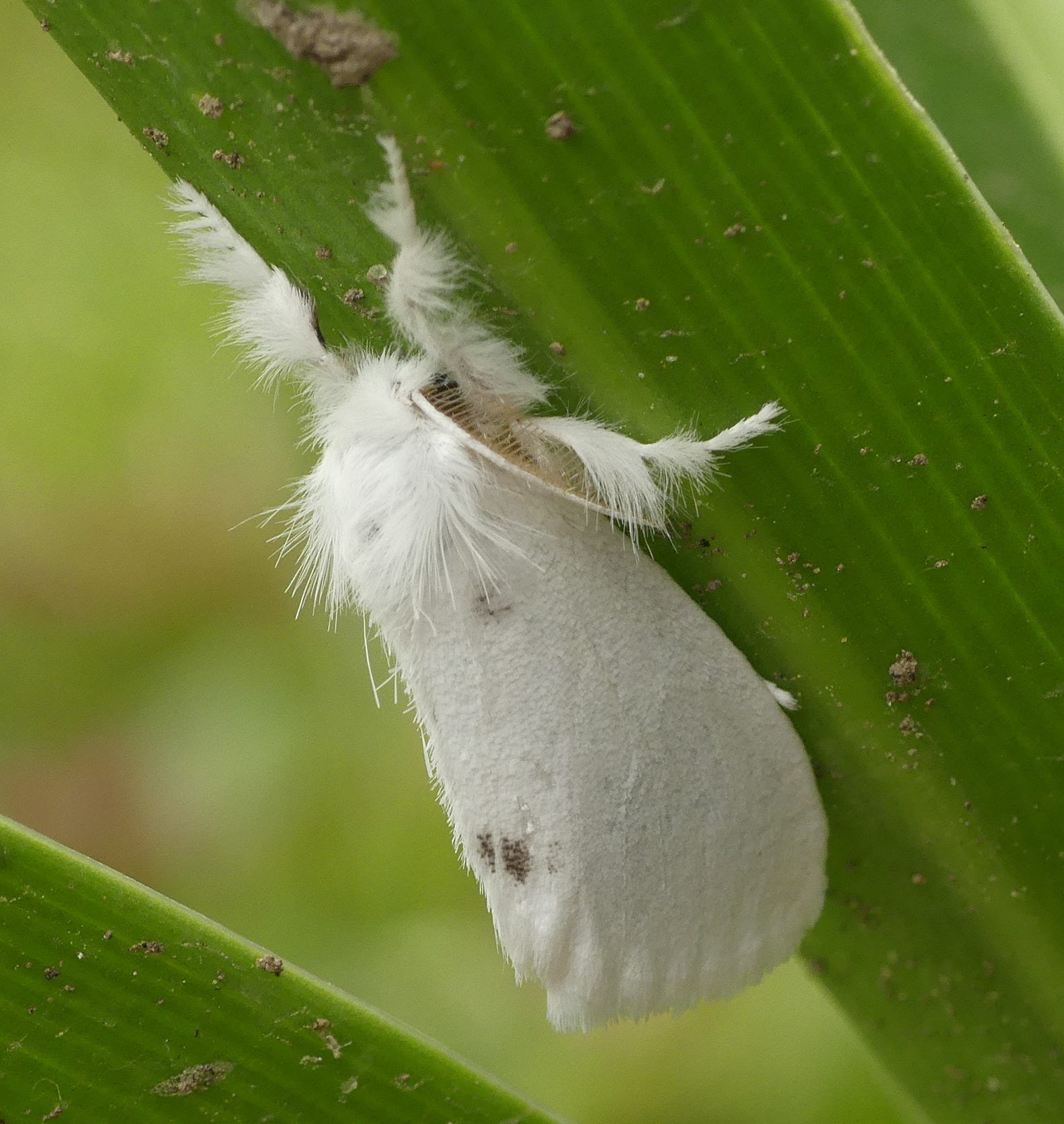
It was quite a surprise to find one of these in the trap on 1st October; most of those I’ve seen before have been in July, with the occasional sighting in August. Most years I see only a few - my maximum year total is 5 (in 2020) - but this is the first one I’ve seen since 2023. On investigation, some books and websites do mention that although the main flight season is July and August, there can be “an occasional smaller second generation later in the year” (for example, here). Usually the species overwinters as a small larva, but it would seem that on occasion larvae hatched from eggs laid in July and August will progress to pupation in the same year, and produce a few adults in October. I checked the websites for moth groups in counties near to me (Hampshire, Sussex, Kent); they all showed very few October records, so it seems this a quite unusual occurrence.
This moth is in the same genus as the somewhat more troublesome Brown-tail, which I’ve not yet written about in this newsletter. The Brown-tail is the one which has caterpillars which live in colonies, can occur in large numbers and whose hairs can be a severe skin irritant. But the Yellow-tail is much less of a problem; the larval hairs can still be an irritant if the caterpillars are handled, but they live individually rather than in colonies so they don’t give rise to clouds of hair when the wind blows.
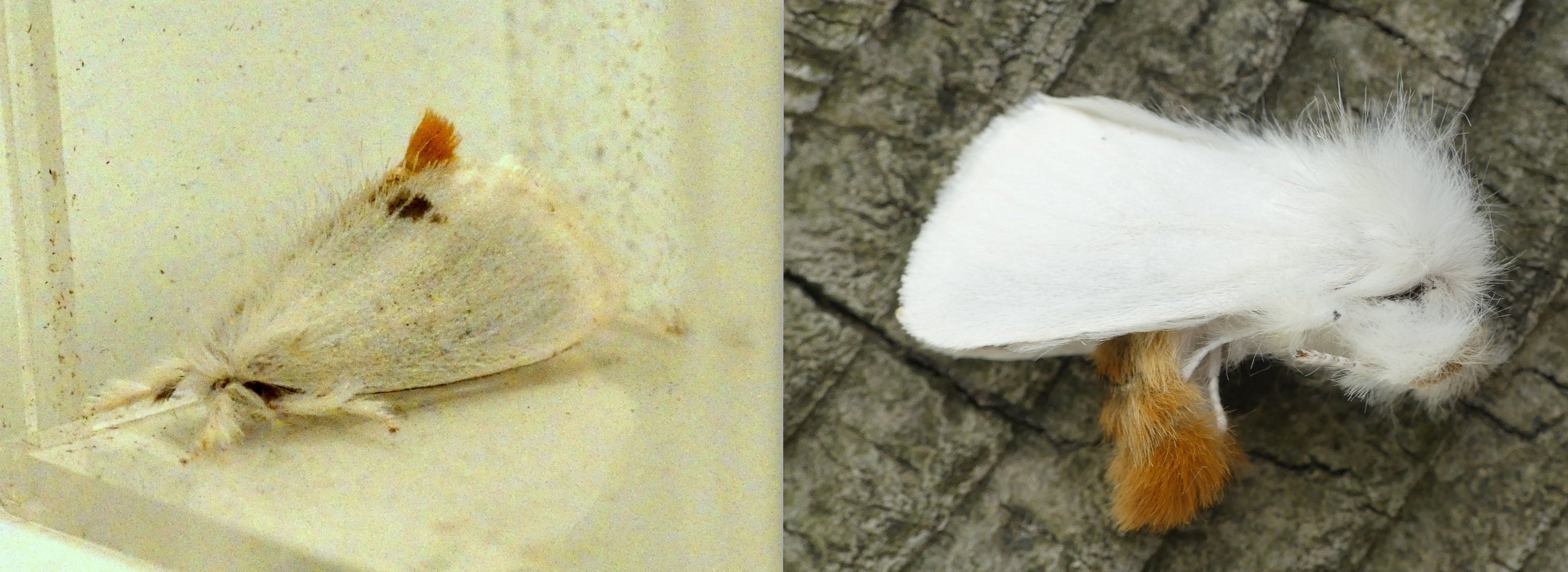
As their names imply, the adults of the two species can be told apart by the colour of the hairs on the tips of their abdomen. In the Yellow-tail these hairs are either golden-yellow or orange-brown (dark brown in the Brown-tail). In the main picture at the top the yellow tail is not visible, but the black dots on the wing edge confirm it as a Yellow-tail; the Brown-tail does not have these (and in the Yellow-tail they’re only present in the males).
The photos below show two examples where the tail is visible, both arising from natural behaviour in this species. The picture on the left (apologies for the poor photography!) shows a male with the tail raised between its wings; a position the moth sometimes adopts when disturbed. More serious disturbance can lead to the moth playing dead and curling its abdomen downwards; the picture on the right shows a female doing this.
The caterpillars can be found on a wide range of deciduous trees and shrubs; oak, hawthorn, blackthorn, willow etc.). They have also been found on Japanese Knotweed - one of the few insects that has been observed to use this invasive plant as a food source.
Now, I’m sure you all know what a proctoscope is, even if it’s not something you would want to come into contact with too often (or at all, most likely). And then there’s the proctologist (someone who uses a proctoscope!). These words are derived from the Greek word proktos (πρωκτός), meaning ‘anus’. So if we add the Greek prefix Eu-, meaning ‘good’, we get the genus name for this species (and the Brown-tail), Euproctis, which must be a reference to the yellow or brown ‘tail’ these moths have. So a polite translation of it might be ‘well-formed posterior’, although it’s hard to resist the temptation to interpret it as ‘nice arse’! [I’ll tell you in next week’s Moth Report how many subscribers this loses me!] Most other European languages have common names for this species which refer to the yellow ‘tail’. In German (as you might expect) the name is particularly direct; Goldafter … ‘After’ is one of the German nouns meaning anus.
The species name, similis, is a Latin word meaning ‘similar to’ or ‘resembling’, so it would seem that the Brown-tail (E. chrysorrhoea) was named first, and the author then suffered an attack of writer’s block and settled for something meaning ‘like the other one’!
Hypsopygia glaucinalis
Year total to date: 7 (latest 8th October)
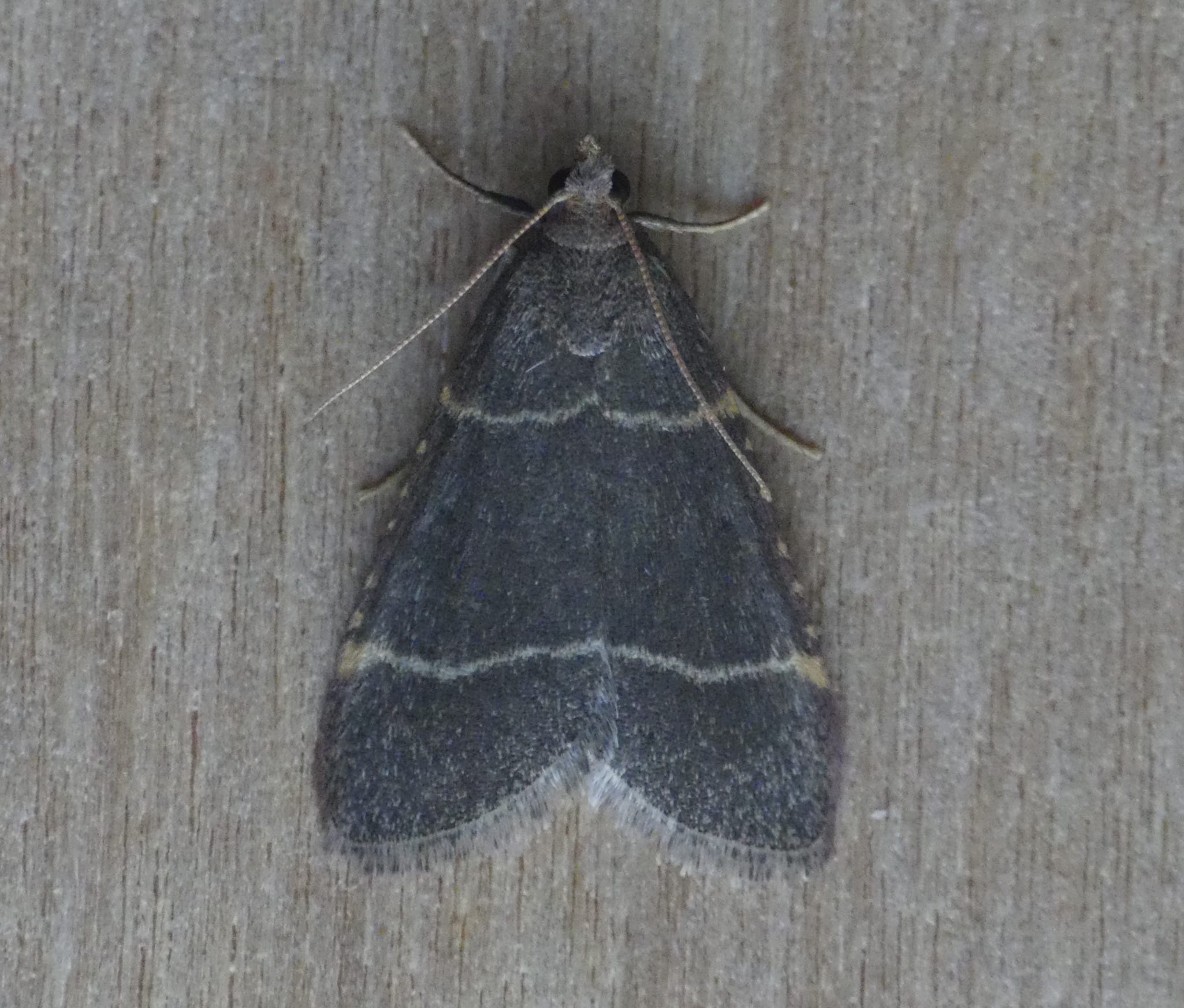
I see a few of these moths each year, varying in number from 1 (in 2021) to 8 (in 2023). Whilst its main flight season is July and August, I have occasionally seen it in October previously, so the three times I’ve seen it this month are not that unusual.
Although the Pyralidae, the family to which this moth belongs, contains some species which eat various plant species like most other moths, it also contains many which eat quite a wide range of other things (for example, the Wax Moth, which I wrote about previously, here). The caterpillar of glaucinalis is a specialist in eating dead or decaying plant material; it has been found in a variety of places such as haystacks, hedge trimmings, thatch, birds’ nests (including buzzards), dead raspberry canes, dead leaves, etc. The adult moth can sometimes be found by day hiding in similar places.
An old moth guide book I have (published in 1952) says the species might be an occasional migrant because it has been captured on a light-ship more than 30 miles off the English coast. Unfortunately it doesn’t say whether that was in the North Sea or the Atlantic Ocean!
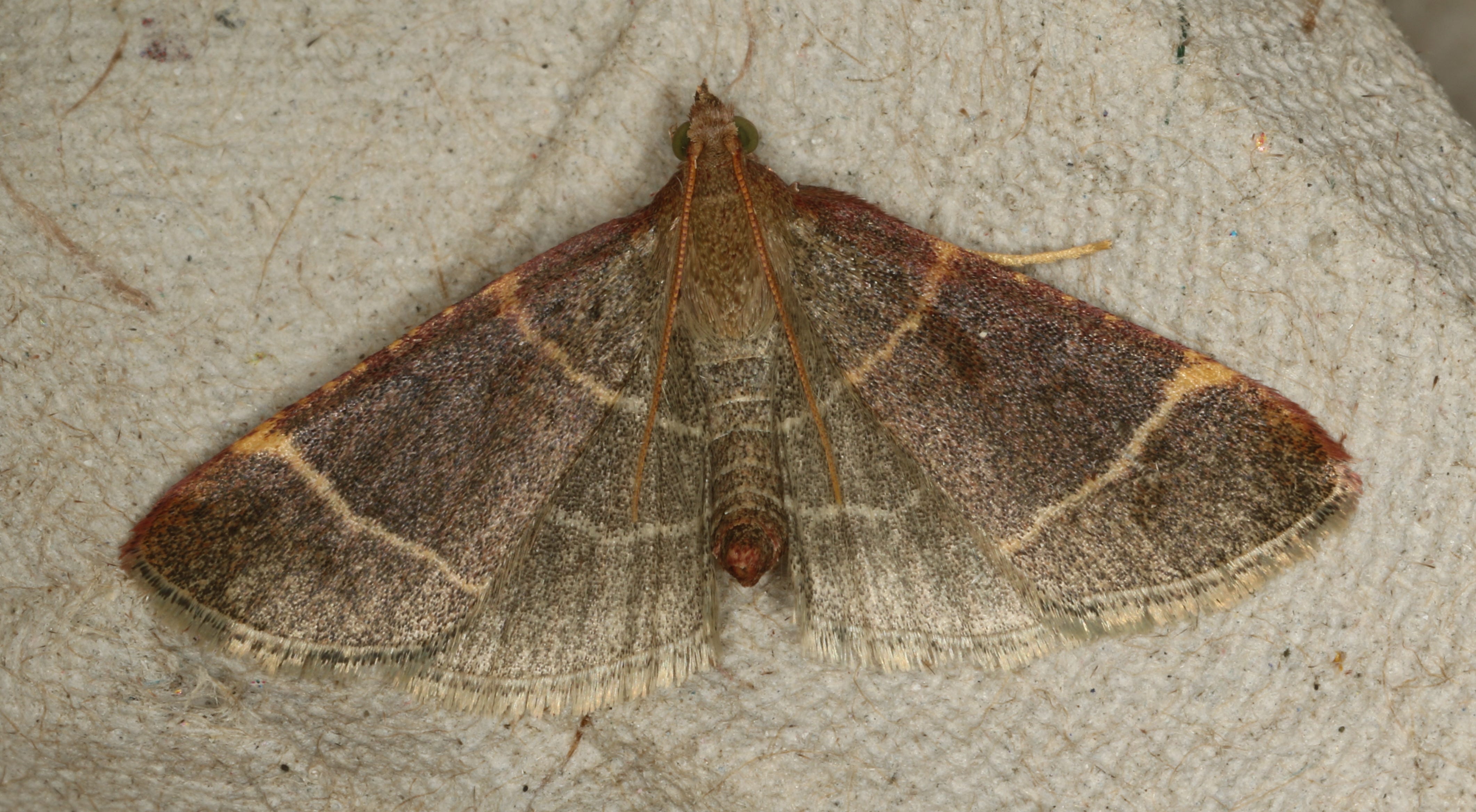
I learnt something about this moth when researching the genus name, Hypsopygia. It has Greek roots: from hypsos (ὕψος), meaning “height” or “loftiness,” and pyge (πυγή), meaning “rump” or “rear.” So it means ‘raised posterior’, and while there are indeed moths which habitually sit with their abdomen raised, I’ve never noticed this species doing this. But looking through the photos on Flickr, I noticed that about one in ten of them show it with a raised abdomen; here’s one of them, from Denmark (although the tip of the abdomen is raised directly towards the camera so it’s not that obvious):
The species name, glaucinalis, is from the Greek glaukos (γλαυκός), meaning “bluish-grey,” “gleaming,” or “sea-green.” So it’s a reference to the moth’s colour, even though in the photos it doesn’t look much like the colour as described. However, when the moth is fresh the wings have a coppery gloss which soon fades; this is most likely what the name is referring to.
The Feathered Ranunculus, Polymixis lichenea
Yeat total to date: 1 (8th October)
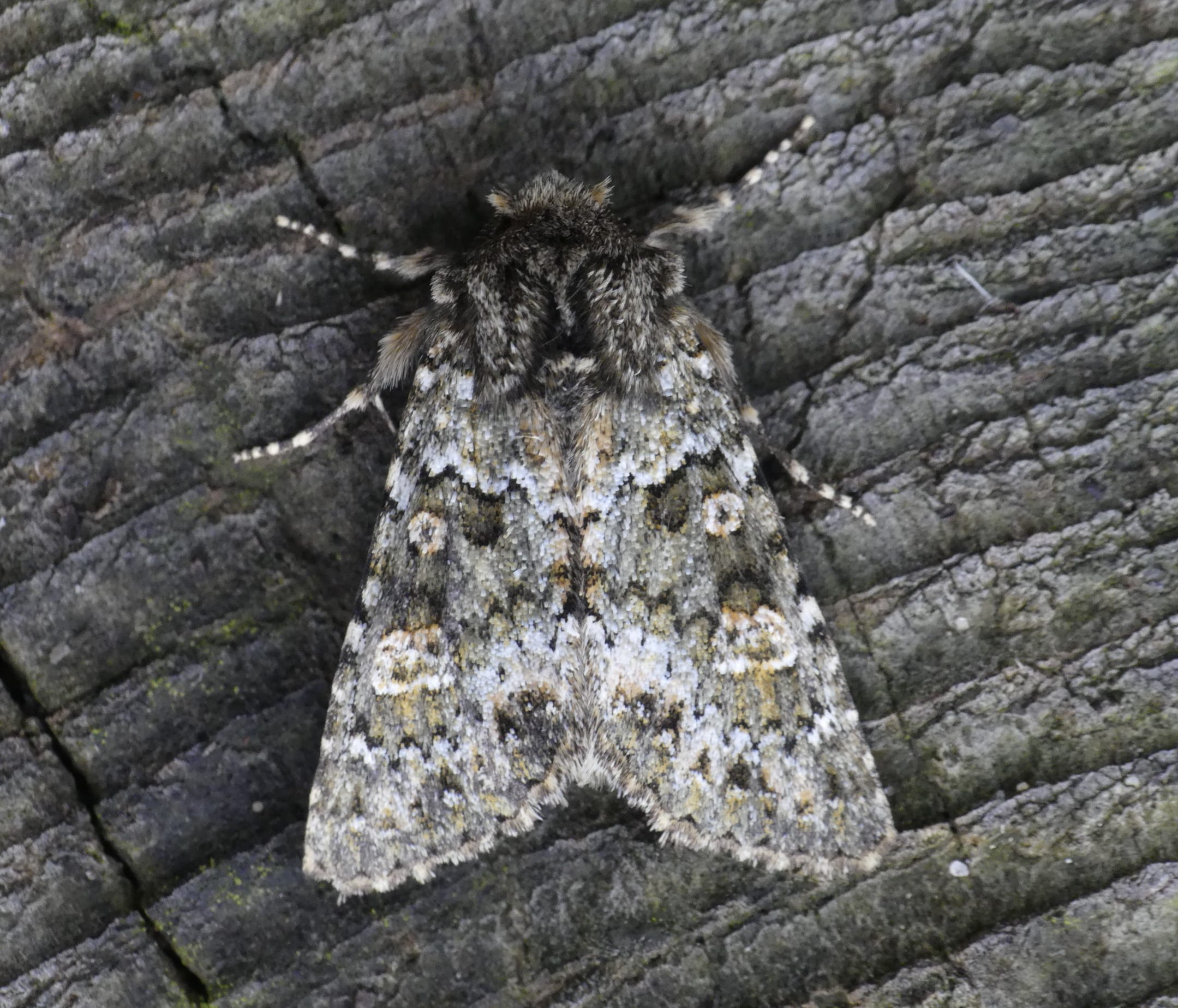
This is a moth I’ve seen every year when I’ve been in Eastbourne, but I didn’t see it at all during the three years I was in Hurstpierpoint. This is because the distribution of this moth is heavily biased towards the coast of England and Wales, with very few records more than a few miles inland. Its habitat is described as coastal cliffs, sand-dunes, vegetated shingle, and limestone and chalk slopes. It’s listed as feeding on a variety of plants, some of which are coastal species, e.g. Sea Plantain and Thrift. Biting Stonecrop is also recorded as one of its favourite foodplants, but while this is primarily a plant of similar habitats, it is also widespread inland. The Sussex Moth Group website lists Hoary Cress and daffodil flowers as foodplants, and these can also occur anywhere, so it’s not immediately clear why this moth is restricted to coastal areas.
The first record of this moth in Sussex is in fact from Eastbourne, on the (then) new sea wall, in 1881. From then until about 1950, Eastbourne and its near vicinity remained the only Sussex location for the moth. After 1950 the numbers and range increased, and in the 1990s the annual totals for a single light trap in Peacehaven (near Brighton) reached 300, but since then they have fallen back considerably.
I wrote about another (rarer) moth with the word ‘Ranunculus’ in its name, the Small Ranunculus, in an earlier Moth Report (here), pondering on what the link might be between these moths and buttercups. But the scientific name of this moth is much more directly relevant, focusing on the mottled pattern on the moth’s wings. The genus name, Polymixis, from the Greek, Poly- (‘many’) and mixis (‘mixing’ or ‘mingled’) clearly references the intricate patterning and mixing of colours on the wings, while the species name lichenea is also a reference to the patterning which mimics the texture and tone of lichen-covered surfaces in its coastal habitats. I don’t have any photos of this moth on such a surface, but you can see from this photo on a mottled stone background that the camouflage can be good:
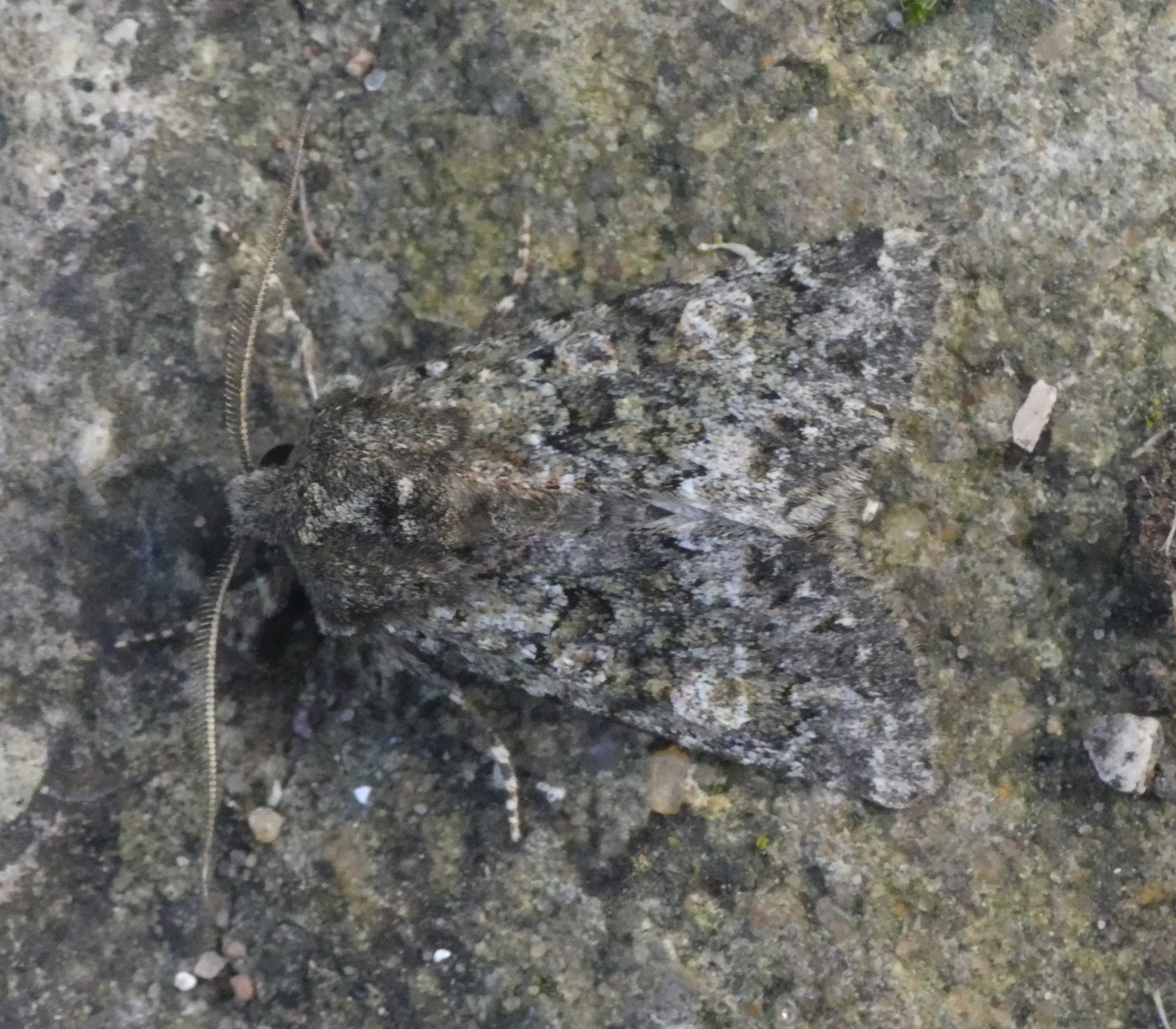
The exact shade of the colour-mix in this species is somewhat variable, and in the Isles of Scilly the ground colour of the forewing is a darker green and there is more black speckling; this has led to a separate sub-species being defined - ssp. scillonia. Copilot speculates that this difference in colouration evolved due to differences in the lichen species on Scilly compared with the rest of the UK, but it can’t provide any evidence!
That’s it for this week. The next issue is scheduled for Tuesday, 21st October.
i can't remember the last time I focused on moths! Seeing them in so much detailed makes me remember that they have a world of their own, and that there's always more than birds to a habitat.
The yellow-tail is rather gorgeous! Snowy white and fluffy. Nice arse indeed 🤣
Amazing camouflage re the Feathered Ranunculus! Does the moon have a significant influence on moth trap numbers?