

Welcome to my new subscribers (indeed, to all my subscribers!). This introductory blurb (in italics) will remain much the same from post to post; please skip it if you’ve read previous posts.
This newsletter will remain free, I’ve no intention of converting it to a paid subscription. It’s aimed at readers who have a general interest in nature and natural history, but maybe don’t know very much about moths. It’s not really aimed at people who regularly run their own moth traps, but of course they’re welcome to read it (even to criticise it if they wish!).
I run a light trap in my garden in Eastbourne (Sussex, UK) and the main objective of this newsletter is to post photos of some of the moths (and occasionally, other insects) that are attracted to the light, and to say a little about them. On average I run the trap about one night in three, and the plan is to write a post after each trapping night, featuring two or three of the moths seen in the trap within the previous couple of weeks.
In the morning I photograph any catches of special interest, then all moths and other insects caught in the trap are released (if they haven’t escaped already!).
This is my ninth year of running a garden moth trap, firstly three years in Eastbourne (2017-2019), then three in Hurstpierpoint (2020-2022), and then back in Eastbourne (2023 onwards). Hopefully, yet more house moves are off the cards for the foreseeable future!
Report for 11th August
It was a bit of a toss up whether to run the trap on Sunday night (10th) or Monday night. I eventually decided on Monday night because the forecast was for a degree or two warmer, and also because moonrise was a little later and the full moon had passed.
Well, as forecast it was a warm night, and there was less wind than forecast, so it turned out to be quite a good night for August, with 124 moths of 48 species. Three of these are worth a special mention: one dark brown micro which I’ve never seen before, Apolyelois bistriatella; one small macro I seldom see, of which there were two, the Small Rufous; and one of our more beautiful moths (which I’ve only seen once before), the Pretty Chalk Carpet. I’ll probably feature one or two of these in the next (or next but one) edition.
But the most memorable part of the catch was the number of Jersey Tigers; I counted 32, which is a record for me for a single night, and there might have been more. This brings my total for the year to 64, which is the same as last year’s total. Over the last couple of years my latest sighting of this moth has been around 20th August, so there’s still a bit of time for last year’s total to be beaten. I wrote about this moth in this report.
I’ve selected only two moths for a more detailed look this time. Neither of them would win any beauty contests, but they are both moths which have a greater impact on human activity than most.
The Wax Moth, Galleria mellonella
Year total to date: 2 (last sighting, 7th August)
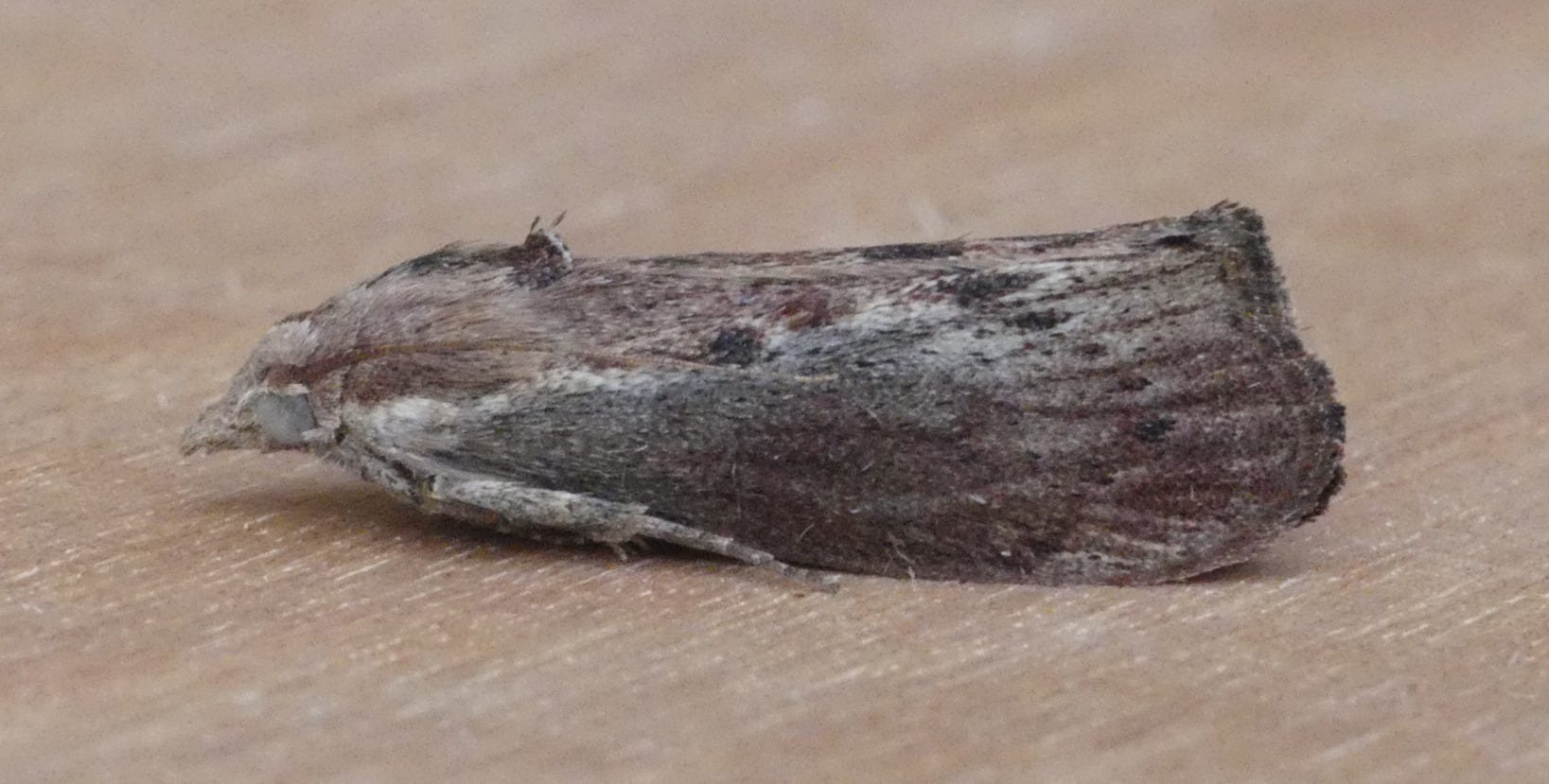
If you’re a beekeeper, you’ll have heard of this moth!
The somewhat hooked shape of the moth’s head is unusual, and the moth has atrophied mouth parts and does not feed as an adult. It is also unusual in that, whereas in most moths it is the female which releases pheromones to attract the males, in the Wax Moth it is the male which releases the pheromones to attract the females. When looking for a female, the males make ultrasonic sounds, and when they hear this the females start to vibrate their wings. When the males detect this vibration they then release their pheromones, enabling the females to locate them.
Once mated, the female lays her eggs inside a beehive or (sometimes) another kind of bee nest (eg bumblebee nest). She tends to have more success in breaking into weak or poorly defended hives, and sneaks in at night when the guard bees are less active. Once inside, the female lays up to 600 eggs on old brood comb, wax debris and crevices in the hive. The caterpillars are unusual in that they can digest wax, and when they hatch they tunnel through wax, pollen, and even bee cocoons, lining their tunnels with silk webbing. This webbing protects the larvae from the bees, which will kill them and remove them from the nest if they can. In severe cases these infestations can lead to colony collapse.
Incidentally, this is not the only moth that might be found inside a beehive; the (much more impressive) Death’s Head Hawk Moth has a weakness for the taste of honey and will raid hives in order to get its fill. It’s highly unlikely I will ever get one of these in the trap so I won’t be writing about it in any detail here, but there’s lots of fascinating information in The Wild Episode podcast.
Historically, references to what is assumed to be the Wax Moth go back as far as the 4th Century BC, when Aristotle mentions them in his Historia animalium. Virgil (1st Century BC) also mentions them in Georgics Book IV, but the most detailed advice from that period on how to protect hives from infestation is given by Columella (1st Century AD) in De Re Rustica.
In commercial terms today the cost to the beekeeping industry is measured in millions of dollars annually. Biological control with a version of Bacillus thuringiensis, especially developed to be non-toxic to the bees themselves, appears to be partially successful. In the southern United States in those areas which have been invaded by fire ants, which are predators of the Wax Moth, beekeepers are experimenting with ways to exploit the ants to control the moths (but no doubt they’d be happier on balance if the ants were not there at all!).
Most internet searches I’ve done report that this moth can be found throughout the world. However, the Global Biodiversity Information Facility (whose map can be seen here) shows few records for most of Africa and South America, although there are abundant records in most temperate and sub-tropical regions. Whether these gaps are genuine or due to under-recording is not clear. The moth is reportedly unable to withstand temperatures below zero (Centigrade).
I’ve seen low numbers of this moth every year except one since I started trapping, but never more than four in a single year. There is also a rarer moth, the Lesser Wax Moth (Achroia grisella) which is also a pest of honey production, but to a much lesser extent. In my first year of trapping (2017) I had one of these, but I’ve yet to see another.
The genus name Galleria was assigned to this moth in 1798 by Johan Christian Fabricius (1745-1808), who is considered one of the greatest insect taxonomists of his time, and who described about 10,000 insect genera and species. Born in Tønder, Denmark, he studied under Linnaeus in Uppsala and became a professor at the University of Kiel, where he taught economics as well as natural history. He published five major works on insect taxonomy. Fabricius was also interested in evolutionary processes. Just a year younger than Jean-Baptiste Lamarck (1744-1829), and although he never published his ideas about evolution, his thinking on the inheritance of acquired traits appears to have influenced Lamarck’s theories to the extent that Fabricius was nicknamed the “Father of Lamarckism” in some circles.
The name Galleria presumably relates to the larva’s habit of forming silken galleries inside bees’ nests, and possibly also to the way the larvae construct their cocoons, with the pupae lying more or less parallel to one another. The genus remained monotypic (i.e. containing just the one species) for over 200 years, but in 2020 another species from South Korea was added to the genus (G. similis).
The species name mellonella is even older than the genus name, having been coined by Linnaeus in 1758. This name also refers to the moth’s association with bees’ nests, since ‘mel’ is Latin for honey.
The good news
While this moth is a major problem for beekeepers, it does have its uses, some of which I’ve listed below:
In recent years the species has become a workhorse for scientific studies in immunology and biochemistry. This is because it meets most of the requirements for model organisms. These include (a) it is ubiquitous, (b) it can be bred easily and cheaply, (c) it can go through several generations in a year, (d) the larva is large enough to inject or to provide hemolymph (insect blood) samples, and (e) its entire genome has been sequenced.
It is beginning to take the place of rats and mice for the in vivo testing of new drugs.
In 2017 it was discovered that the larvae can degrade polyethelene. This is one of the most difficult plastics to break down, and work is underway to determine whether enzymes derived from this species can be used to biodegrade plastic.
The Brown House Moth, Hofmannophila pseudospretella
Year total to date: 10 (last record 7th August)
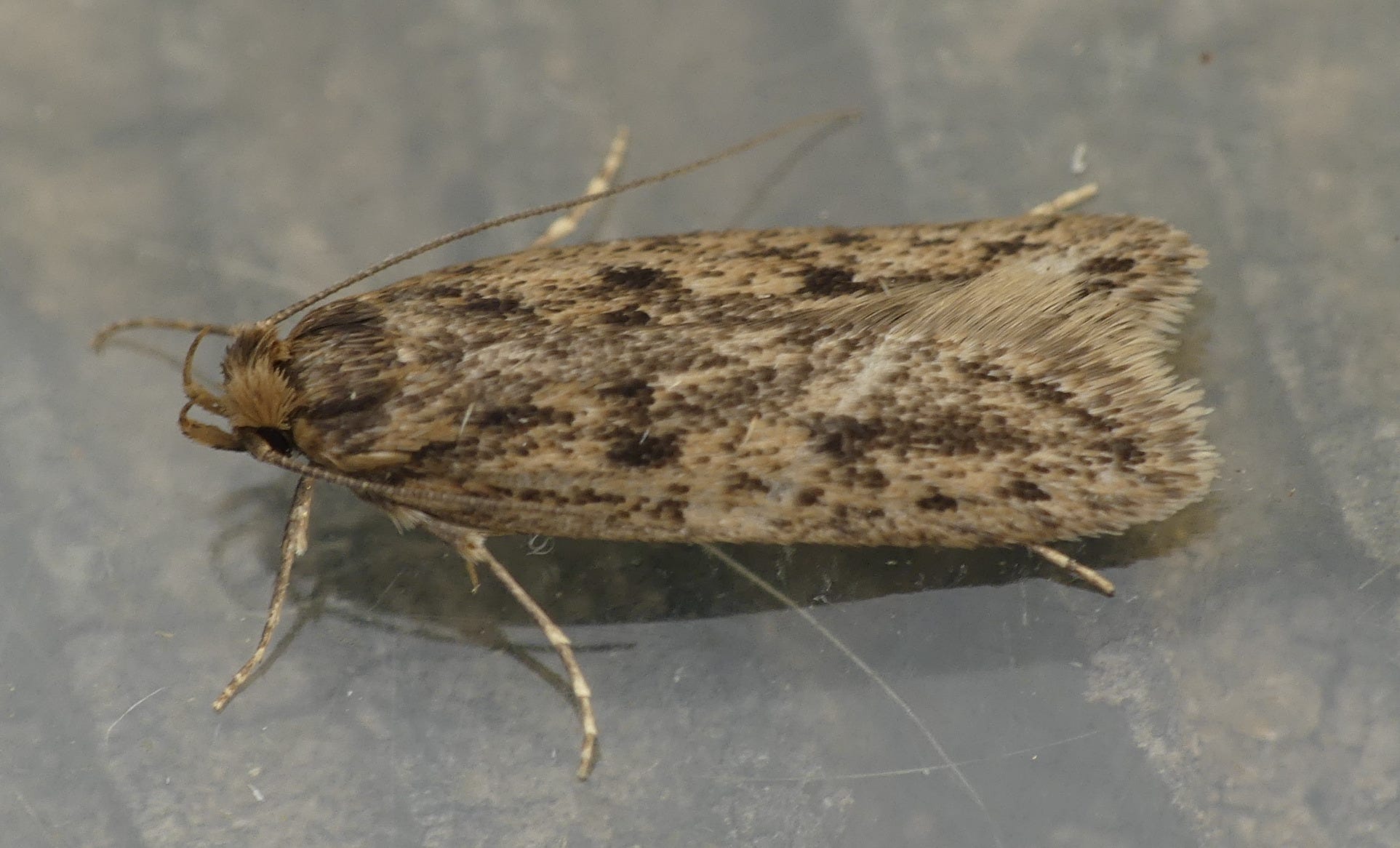
From time to time I encounter someone who kills any moth on sight, labouring under the mistaken belief that all moths devour clothing. While I trust that none of my readers are so misinformed, I—like most moth enthusiasts—keep a favourite statistic at the ready: of the approximately 2,500 moth species in the UK, only two have larvae that feed on clothes—the Common Clothes Moth and the Case-bearing Clothes Moth. It’s a handy fact to deploy whenever I meet someone in need of a gentle correction.
But strictly speaking, that’s not actually the case because there is also a small group of moths, loosely called House Moths, whose caterpillars are omnivorous scavengers - the subject of this section, the Brown House Moth, is one of them. The caterpillars will eat clothing if they come across it, particularly if it is wool or if it is dirty, but they eat a whole range of other things as well - dried fruits, cereals, flour, seeds, fur, leather, bookbinding and even corks in wine bottles (oenophiles beware!). In order to assist with their camouflage, the caterpillars can take on the colour of whatever it is they’re feeding on, although this is a slow process achieved through absorption of the colour from the food, rather than the lightning-fast changes that octopuses, cuttlefish and some other marine creatures exhibit.
As a child, I remember that every clothes drawer in our house had a little bag of camphor in it, which we called moth balls, because the smell was supposed to deter cothes moths and house moths. However it seems that this would no longer work well (if indeed it did then) because the moths have evolved to tolerate this smell, and if you are unlucky enough to experience an infestation it can end up being quite expensive. But you’d have to be really unlucky if it were to cost you as much as it did William Woodward-Fisher, who sold his house, Horbury Villa in Notting Hill, for £32.5 million only to have the sale rescinded (with £4 million in damages on top) when the buyers discovered a massive moth infestation within days of moving in1. The identity of the moth involved didn’t make it into the reports I read, but it could well have been the Brown House Moth. Some news reports describe it as a ‘clothes moth’, but then what do most reporters (or solicitors come to that) know about moths?!!
The scientific name of the Brown House Moth, Hofmannophila pseudospretella, contains something of a puzzle. The genus Hofmannophila was established in 1910 to honour the German entomologist Ernst Hofmann (1837–1892), a specialist in microlepidoptera. Although the suffix -phila might tempt one to interpret the name as “lover of Hofmann,” it more plausibly conveys “in fond remembrance” of him—a commemorative gesture rather than a literal affection.
The species pseudospretella is the sole member of this genus. Genus or species names prefixed with pseudo- typically imply resemblance to the term that follows—in this case, presumably a moth called spretella. And therein lies the puzzle: no such moth exists today. (Well, there is Hypatopa spretella, but it was named in 1910, whereas pseudospretella dates back to 1849.)
After some detective work, I discovered that the moth now known as Niditinea fuscella, originally named by Linnaeus in 1758, was referred to as spretella by another author in 1775. When it was later recognised that these were the same species, Linnaeus’s name took precedence, following the standard rule of chronological priority. Although N. fuscella belongs to a different family and holds its wings differently, its patterning closely resembles that of the Brown House Moth—so the mystery appears solved. (There’s a photo here.)
As for the name spretella, its meaning is rather unflattering and implies a degree of contempt. It derives from the Latin verb spernere (past participle spretus), meaning “to scorn” or “to reject.” N. fuscella is another omnivorous scavenger, often favouring food already infested by other species. Perhaps the author had suffered an infestation and chose the name as a form of revenge!
The only remaining question: should H. pseudospretella be renamed H. pseudofuscella?
Last night’s catch brings the total species count for the year to 340, which is about where I was at the end of September in the previous two years. So hopefully I’ll have broken a few more records by the time we get to the end of the year!
Well, that’s it for this edition. The next one will be in a few days’ time, depending on the weather (as usual). It’s forecast to stay warm for the next few days, so it will probably be later this week some time.
Also, if you’re a regular reader of this newsletter and know of other people who might enjoy reading it, please share it with them using the button below. The more regular readers I have, the more it will encourage me to continue writing it.
This hit the news in February this year.
So much interesting information. Fascinating to read that a moth is beginning to take the place of rats and mice for the in vivo testing of new drugs! I also didn’t know that clothes moths are no longer affected by the smell of camphor.