
Welcome to the Moth Report. If you’re a new reader of this newsletter, some background about my moth trapping can be found here, together with an index with links to all the species previously discussed.
Report for w/b 11th May
Tuesday (12th) was the first night for several days that looked promising enough to put the trap out, though in the event the catch proved modest: 21 moths (10 of them Heart and Dart, see here) of 8 species. Three were new for the season—nothing unexpected for mid‑May—but I was still pleased to see my first Spectacle of the year (in fact, two of them); last year I managed only three in total.
Then after a few quite cool nights, the forecast for Saturday (16th) showed a minimum of 11 Celsius with a light westerly breeze, with showers around and no moon. But the results were even worse than Tuesday; 13 moths of 6 species, just one of which (Vine’s Rustic) was a new record for the year (on the same date as last year!).
Let’s move on to look at some species seen recently.
The Chocolate-tip, Clostera curtula
Year total to date: 1 (7th May)
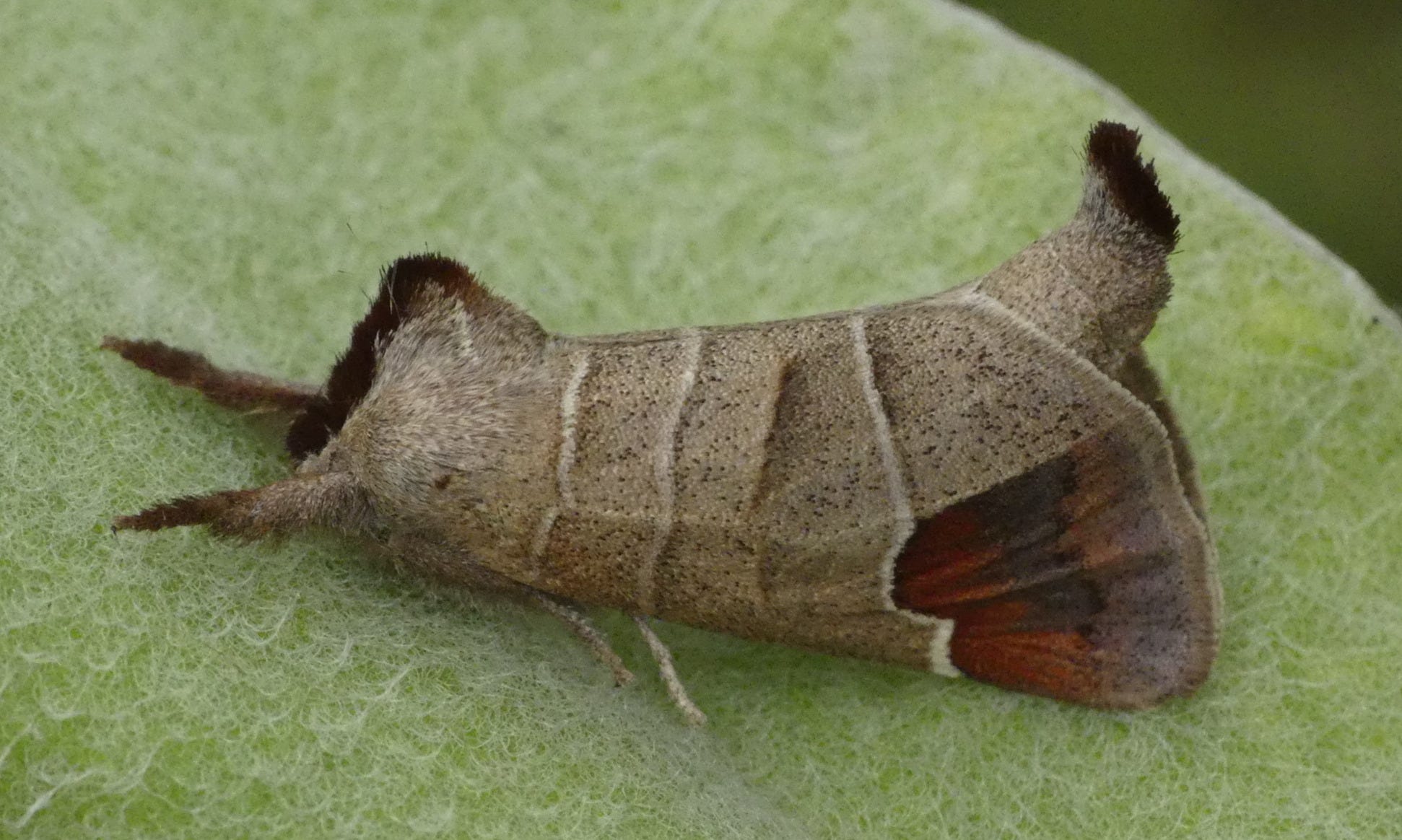
This is a moth I don’t see often; my first was in 2019 and second in 2021, then I didn’t see any more until last year when I had the grand total of three! So having another this year is a hopeful sign and maybe another one will turn up soon. Last week I looked at the Pebble Prominent, and the Chocolate-tip belongs to the same family and holds its wings in a similar tent-like position. I’ve always assumed that the name primarily attaches to the chocolate-coloured panels at the wing tip, but that’s not the only part of the moth that’s a chocolate colour, and James Lowen1 plausibly suggests otherwise, with his usual vividly descriptive flair:
… a raised abdomen tip dipped in molten dark chocolate that protrudes upwards through closed wings like a happy dog’s tail.
The moth is widespread (but rarely common) throughout southern England and parts of Wales, where it is double-brooded. But there is a small and entirely separate population in north-east Scotland, where it has only one brood a year.
There is another moth in the same genus, the Small Chocolate-tip (Clostera reclusa) which today is much rarer. However it seems this was not always the case. J.W. Tutt, in a book2 published in 1902, writes about the two species:
The SMALL CHOCOLATE-TIP (Clostera reclusa) is the next common species, but is rarely seen in the imago [adult] state. The larva, however, is not at all uncommon in many localities on sallow, and being in a state of confinement double-brooded, the little purplish-grey moth with its chocolate-tip is frequently bred3. The CHOCOLATE-TIP (C. curtula) is much rarer, but in British collections the species is not uncommon, largely owing to importation, and the ease with which it is then inbred.
So it would seem that whilst the Small Chocolate-tip has become rarer, the slightly larger Chocolate-tip has increased in abundance over the past century and a quarter.
The habit of the adult in resting with the tip of its abdomen raised is something it has in common with the caterpillar, which will raise its pale-coloured hind segments as a defensive move when threatened. I’ve looked at lots of online photos of the caterpillar but haven’t found one which shows it actually doing this. This photo, however, does show how the back half of the caterpillar is quite pale:
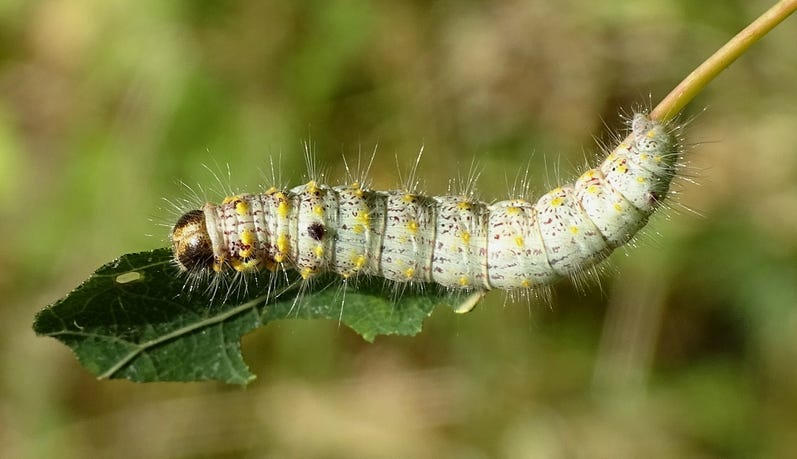
It’s this behaviour that gives rise to the French common name for the species, the Hausse-Queue Blanche (‘white tail-raiser’). It also features in Linnaeus’s description of the larva when he named the species in 1758: he simply wrote ‘Larva turrita’. The direct translation here is ‘turreted’ but it also implies the tower which carries the turrets. The adjective was commonly used of cities or walls equipped with towers: urbs turrita was a stock phrase for a fortified, tower-crowned city, so Linnaeus was describing that raised, stiffened posterior — held aloft like a tower above the leaf.
The common names in some other languages also reference the raised tail, but the German common name is probably the most imaginative: Erpelschwanz-Raufußspinner. ‘Erpel’ means ‘drake’ and ‘schwanz’ means ‘tail’, so the comparison is with the hind-end of a drake, although of which duck species is not clear. If it’s the mallard, the drake doesn’t actually raise its tail that much, but it does have a largish white flash on it, so it could actually be a reference to the larva rather than to the adult4. In full the name means something like "drake-tail rough-foot prominent".
And then we come to the species name itself, curtula. I’ve come across several different explantions of this. Here are three possible derivations:
Latin curtus — docked, shortened; the diminutive curtula meaning “the little truncated one”;
Latin curule (sella curulis, the magistrate’s chair) — alluding to the curved, seated posture;
Greek κυρτός (kurtos) — arched, humped, convex; referring to the characteristic raised posture.
Of course I don’t have the ability to read Linnaeus’s mind, but the first option is the one that appeals to me the most.
The Bright-line Brown-eye, Lacanobia oleracea
Year total to date: 2 (1st and 4th May)
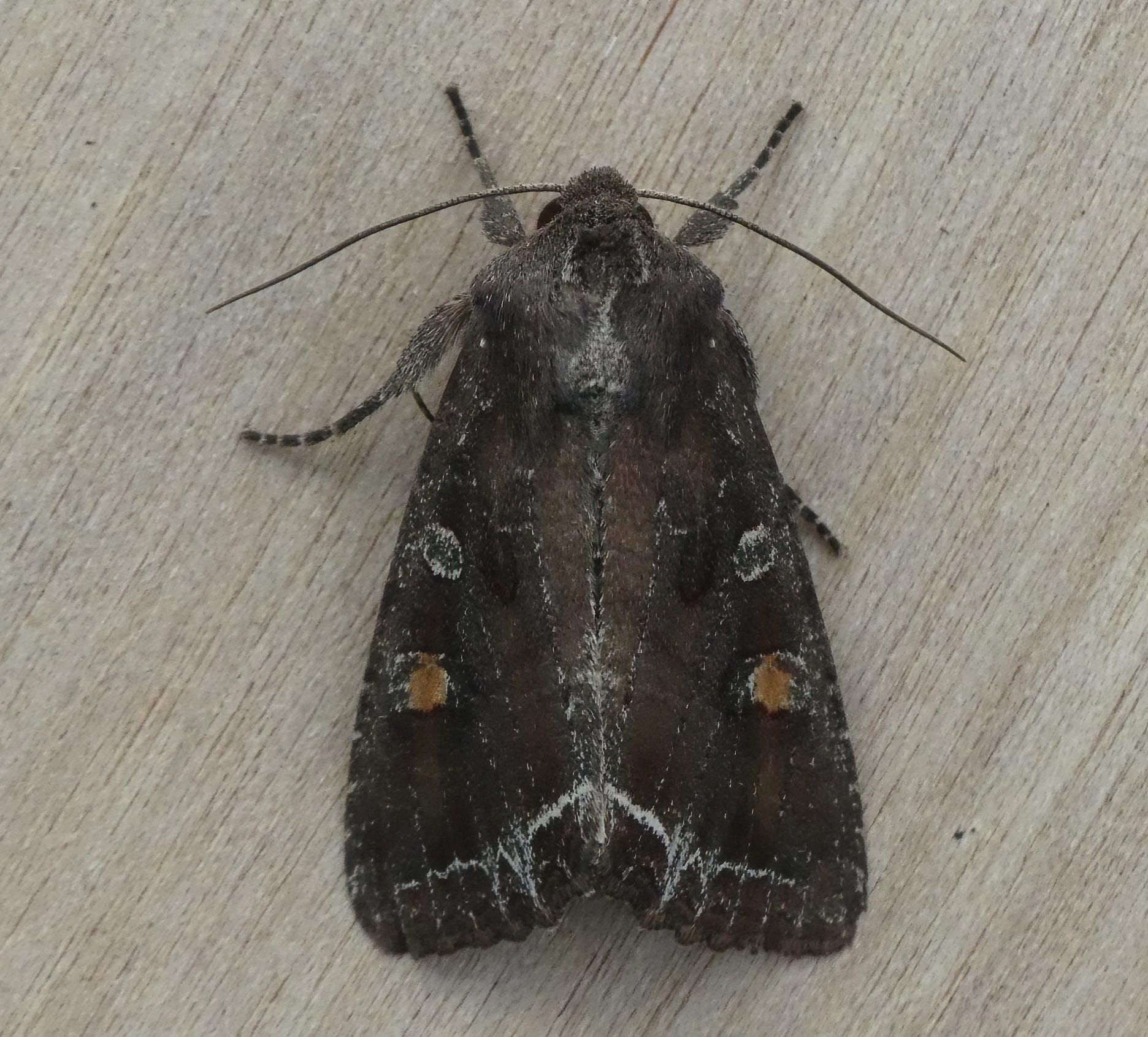
This is a moth whose English name describes exactly what you see … the bright white line (with a W mark in the middle) and a large brown spot (technically the reniform stigma). The intensity of the background colour is variable - the one in the photo is darker than usual and often it’s a lighter reddish-brown colour. The colour of the brown spot varies too, and can be nearer to orange.
One of the 18th‑ or 19th‑century Aurelians who bestowed English names on our moths must have had a somewhat waggish sense of humour, for there’s another species called the Brown‑line Bright‑eye! I had three of these in 2017 but I’ve never seen it since.
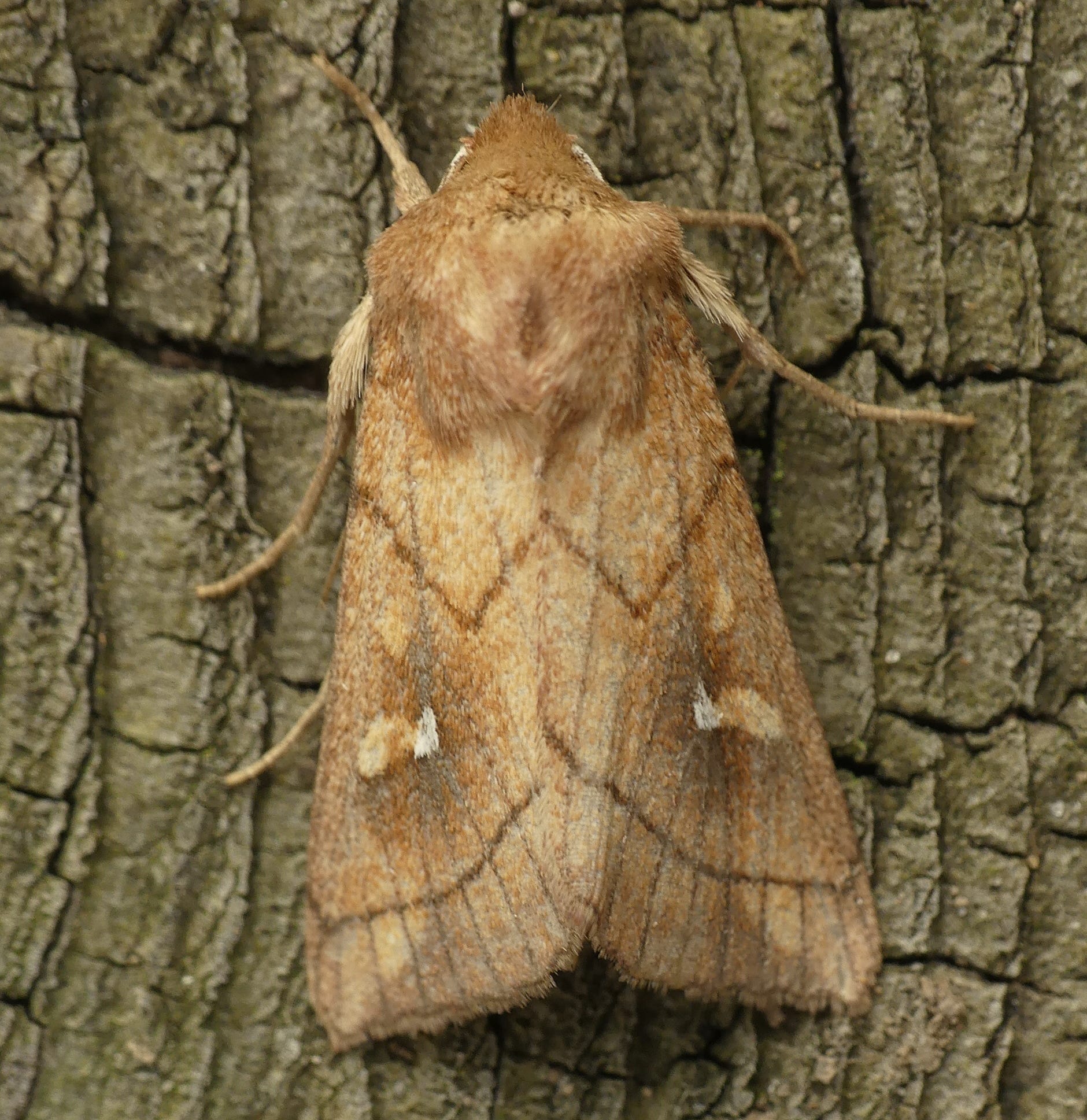
But back to the Bright-line Brown-eye. Most years my count for this species is in double figures, with the record being 36 in 2025. Although it’s widely distributed throughout Sussex (as it is throughout most of the UK), it’s commoner near the coast and my annual counts when I was further inland in Hurstpierpoint were always lower and in single figures. Apparently in some years it can be very common; Colin Pratt5 mentions that in 1939 thousands were seen at the neon lights in a covered promenade near Hastings (known locally as ‘Bottle Alley’ if I remember correctly). He also mentions that his annual trapping total in Peacehaven was over 1000 in 2014.
Caterpillars feed from June onwards and will eat a wide range of wild and cultivated herbacious and woody plants, including Common Nettle, Fat-hen, willowherbs, St John's-worts, Traveller's-joy, English Elm, Hazel, and Hop. But they also have a taste for tomatoes, and will eat through the skin of the fruit:
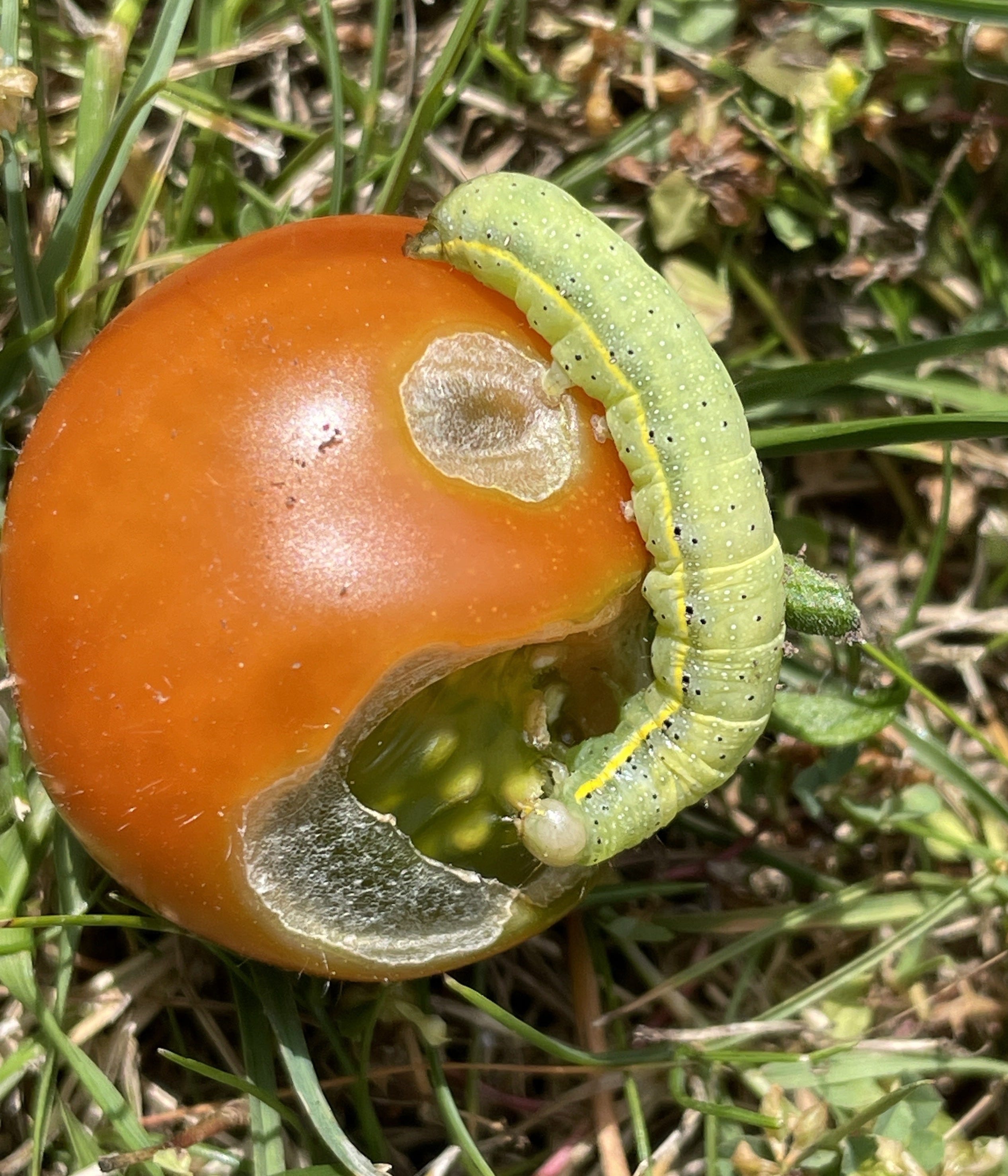
This habit has led to them acquiring the name “tomato moth” among gardeners and growers.
When it comes to the scientific name, it’s actually a bit tautological; both the genus (Lacanobia) and the species (oleracea) translate as having an association with vegetables. The genus is from the Greek λάχανον (láchanon), meaning "vegetable" or "pot-herb", while the species is from Latin and means "of the vegetable garden" (from olus, pot-herb). The species name dates from 1758 (Linnaeus) so this moth was clearly recognized as a pest as far back as that.
The Spectacle, Abrostola tripartita
Year total to date: 2 (12th May)
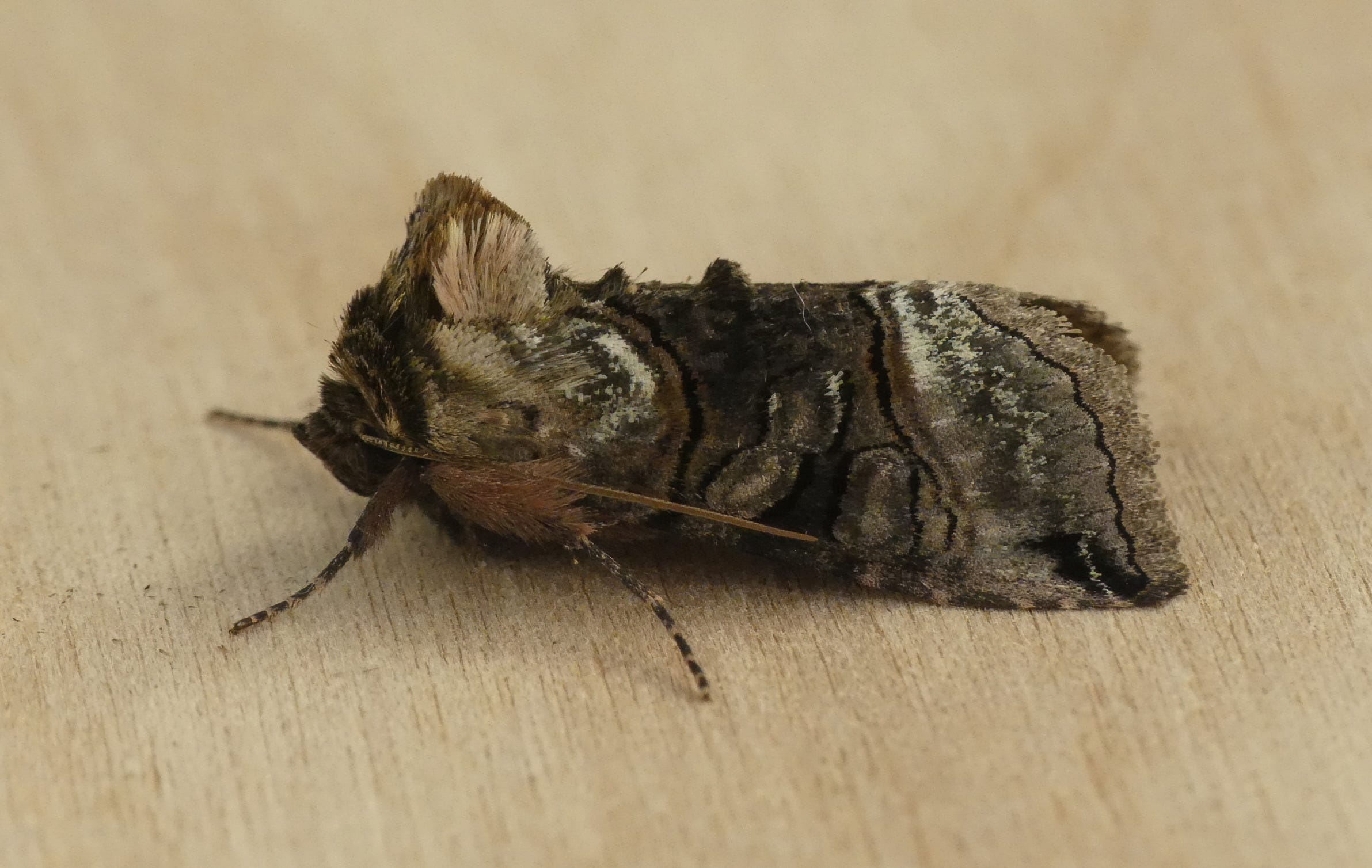
This is a moth that I’m always pleased to see in the trap - and if you’re wondering how it got its name, just take a look at if from the front:
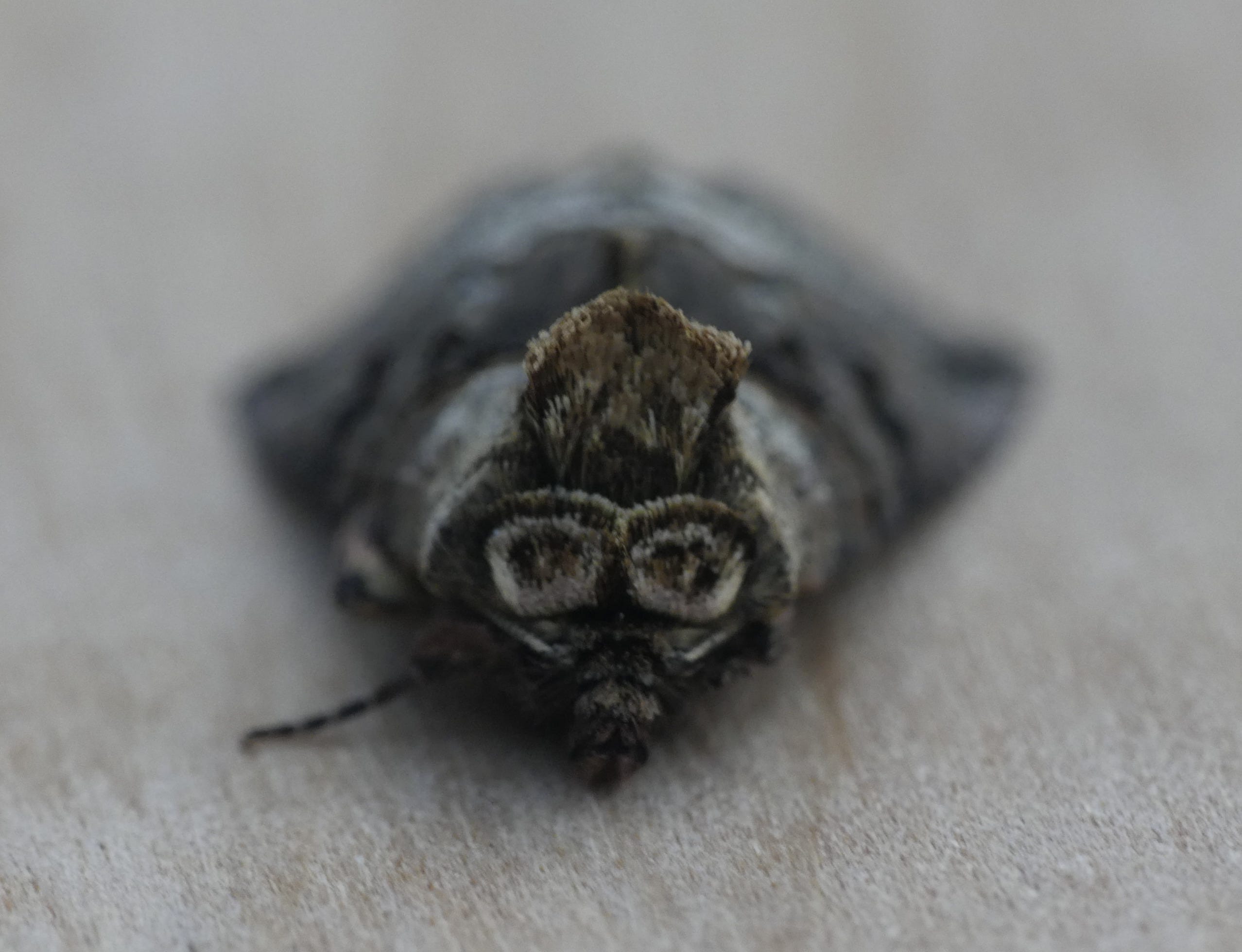
The ‘spectacles’ are actually two rings of grey hairs on the thorax giving the appearance of goggles — they sit on the thorax itself and are not associated with the head or eyes at all. James Lowen gets his literary paintbrush out again when he and his young daughter, Maya, open their trap one morning:
We gawp at Spectacle, an unexpectedly natty goth-moth arrayed in grey and black that has an upstanding gingery Mohican and, when regarded front on, wears John Lennon specs on what passes for its forehead. ‘That moth can’t be real, Dada’, Maya exclaims. ‘Those eyes are in the wrong place.’
Talking about false eyes, I’m hoping to get an Eyed Hawkmoth in the trap soon (I don’t see this species every year) as it will give me an opportunity to write about the role false eyespots play in protecting moths against potential predators. Thinking about this made me wonder whether these ‘eyes’ on the Spectacle are part of this story, i.e. whether they are capable of frightening off anything that might be looking for a meal; as well as the rings they also have a central spot which enhances the eye-like appearance.
This species is widespread throughout the UK and is said to be common wherever its foodplant, the common nettle, is found, and numbers are reported to have shown a modest increase since 1970. However I never see it in large numbers - I see a few most years but my highest annual count so far is just five.
The genus name Abrostola was coined by Ochsenheimer (see here) in 1816 and is derived from two Greek words, ἁβρός (habros) — graceful, beautiful, and στολή (stolē) — garment, robe. I had previously assumed that interest in the etymologies of moth names was largely a 20th-century phenomenon, culminating in works such as Maitland Emmet's The Scientific Names of the British Lepidoptera (1991). But in researching this particular name I came across what must surely be the first publication of this kind, dated 1837. It was written by a Latvian doctor and poet from Riga who was also a serious entomologist, Karl Heinrich Wilhelm Sodoffsky (1797–1858). It’s available online here (but it’s in German). In it, Sodoffsky points out that Ochsenheimer’s name Abrostola incorporates an error and should properly begin Habro- to reflect the aspirated ἁ- of ἁβρός. Some subsequent authors took up the revised spelling, but it didn’t stick and the rule of precedence held (but from now on I shall always think of it as being said in a Cockney accent - ’Abrostola!).
There are actually two UK moths in this genus, in addition to the Spectacle (A. tripartita) there’s the Dark Spectacle (A. triplasia); a very similar moth which I’ve seen only a couple of times. Both these species names refer to the three colour zones on the forewing (and also perhaps to the three blue-grey spots visible in the central zone). At one point it was thought that there was a third species, which was named A. trigemina - meaning one of a set of triplets (literally, the third twin). But it was later decided that this was in fact the same species as the Dark Spectacle. The existence of these three similar species names has led to quite a lot of confusion in the naming of these two species - the Dark Spectacle in particular has a much longer list of synonyms than is usual!
Update on the Met Gala
Apologies if you clicked the link to ‘The Knowledge’ in last week’s newsletter, but were then met with a paywall. The Knowedge produce a daily newsletter which is available on subscription, but a shortened version of it is available for free (which included the Met Gala item). I had thought the link on their website was to the free version, and that might be the case when it is first posted, but after a day or so it is the full version with the paywall in place … the link worked when I first put it in the draft of my newsletter!
That’s it for this week. The next issue is scheduled for Tuesday, 26th May.
This newsletter will always remain free. However, if you feel you want to show your appreciation by making a financial contribution you can use the button below to take you to a website where you can do so. I will donate any money I receive through this route to a charity, most likely Butterfly Conservation but other more local wildlife charities might also qualify. Absolutely no obligation, but many thanks if you do.
In his book Much Ado about Mothing.
British Moths.
Light traps were not available then … many collectors obtained most of their specimens by collecting caterpillars and breeding them through.
Comments from any of my German-speaking subscribers/followers would be very welcome!
In his book A Revised History of the Butterflies and Moths of Sussex.
It’s not been that warm at night either, but a bit of light rain doesn’t seem to affect the moths. Forecast is the nights (as well as the days) to warm up a bit now so hopefully some better catches soon!
Fascinating thank you. Whenever I see a Spectacle I can't help calling out "Chocks away!".