

Welcome to my new subscribers (indeed, to all my subscribers!). This introductory blurb (in italics) will remain much the same from post to post; please skip it if you’ve read previous posts.
This newsletter will remain free, I’ve no intention of converting it to a paid subscription. It’s aimed at readers who have a general interest in nature and natural history, but maybe don’t know very much about moths. It’s not really aimed at people who regularly run their own moth traps, but of course they’re welcome to read it (even to criticise it if they wish!).
I run a light trap in my garden in Eastbourne (Sussex, UK) and the main objective of this newsletter is to post photos of some of the moths (and occasionally, other insects) that are attracted to the light, and to say a little about them. On average I run the trap about one night in three, and the plan is to write a post after each trapping night, featuring two or three of the moths seen in the trap within the previous couple of weeks.
In the morning I photograph any catches of special interest, then all moths and other insects caught in the trap are released (if they haven’t escaped already!).
This is my ninth year of running a garden moth trap, firstly three years in Eastbourne (2017-2019), then three in Hurstpierpoint (2020-2022), and then back in Eastbourne (2023 onwards). Hopefully, yet more house moves are off the cards for the foreseeable future!
Report for 3rd August
It was a bit breezy when I put the trap on, but the forecast was for the wind to drop and for it stay quite mild (to no less than 17 degrees). So I was hoping for a good catch to get my August records off to a good start. In the event there was a good amount of cloud cover, and the catch totalled 92 moths of 45 species, which is about average for August.
But there’s always the possibility of a surprise when you open the trap in the morning, and I certainly got one today when I spotted a Striped Hawk moth in the trap, a species I’ve only seen once before. I took it out of the trap and tried to settle it on the fence to get a good photo, but it had other ideas and soon took off to try to find a safer place to rest up during the day. So I had to settle for the shot I took of it resting on an egg carton in the trap.
The Striped Hawk Moth, Hyles livornica
Year total to date: 1 (3rd August)
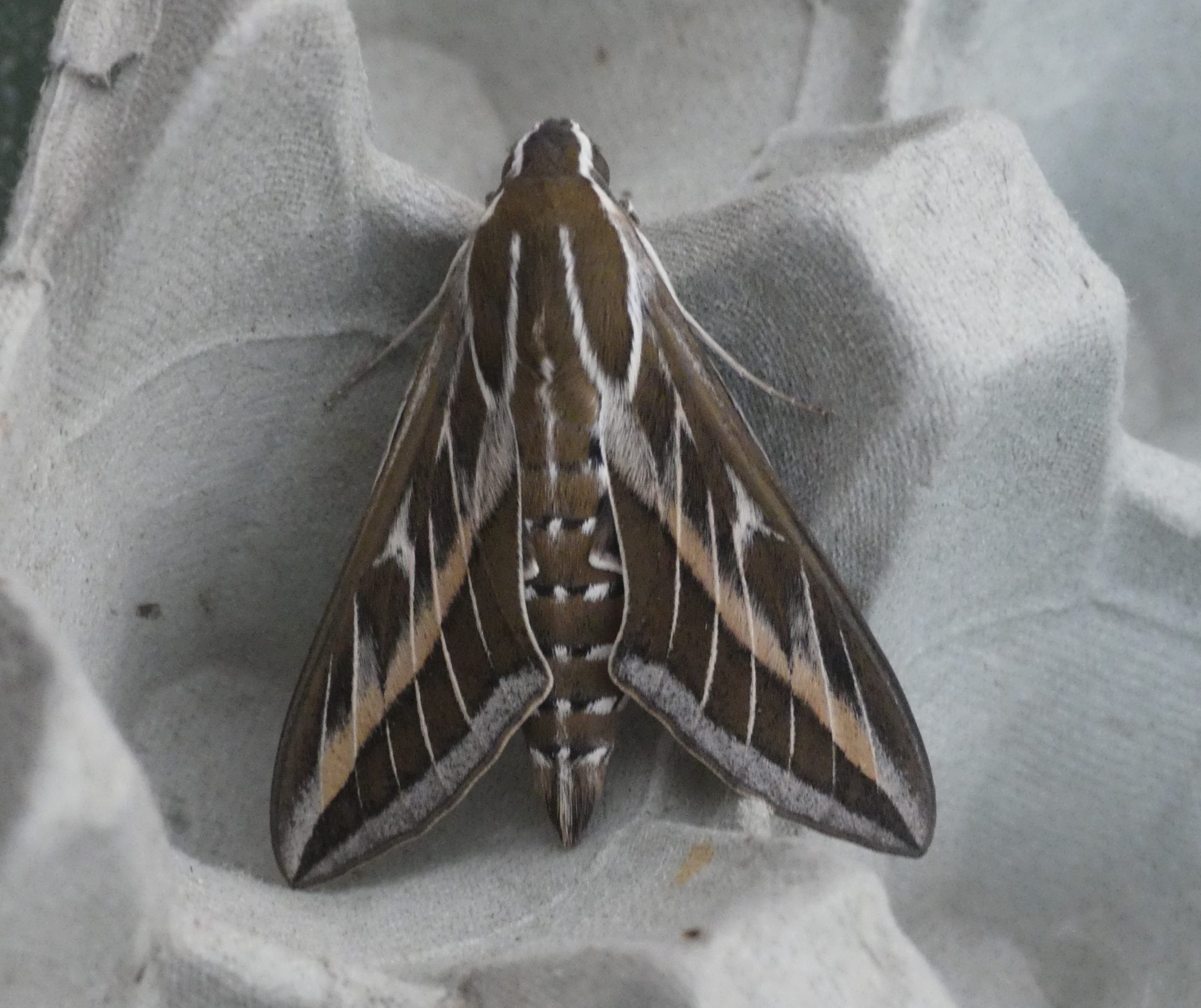
This is a migrant species from the continent, whose appearances in the past have been rather eposodic. It was seen about one year in five during the 20th century, but increased to one year in two since 2000. There are occasional years when sightings are fairly common; in 1943 over 500 were reported, and in 2006 there were 383 records. The species is resident around the Mediterranean coast, and in North Africa. Although the caterpillars have been found in the UK, there are no records of them having survived the winter. The peak arrival time is May/June, and it is possible that eggs laid by those arrivals could survive to maturity. Indeed, my specimen from last night looked very fresh and undamaged; if it had flown all the way from the Mediterranean it should have looked more worn and battered!
Most UK records are from the southwest of England, but there are scattered records throughout the UK as far north as Shetland, and also thinly scattered records from Ireland.
The species was described and named by the German lepidopterist Eugenius Johann Christoph Esper (1742-1810) based on a specimen from Livorno, Italy, hence his choice of the name livornica. Esper was best known for his beautifully illustrated volumes on European Lepidoptera.
The Peppered Moth, Biston betularia
Year total to date: 18 (last sighting, 22nd July)
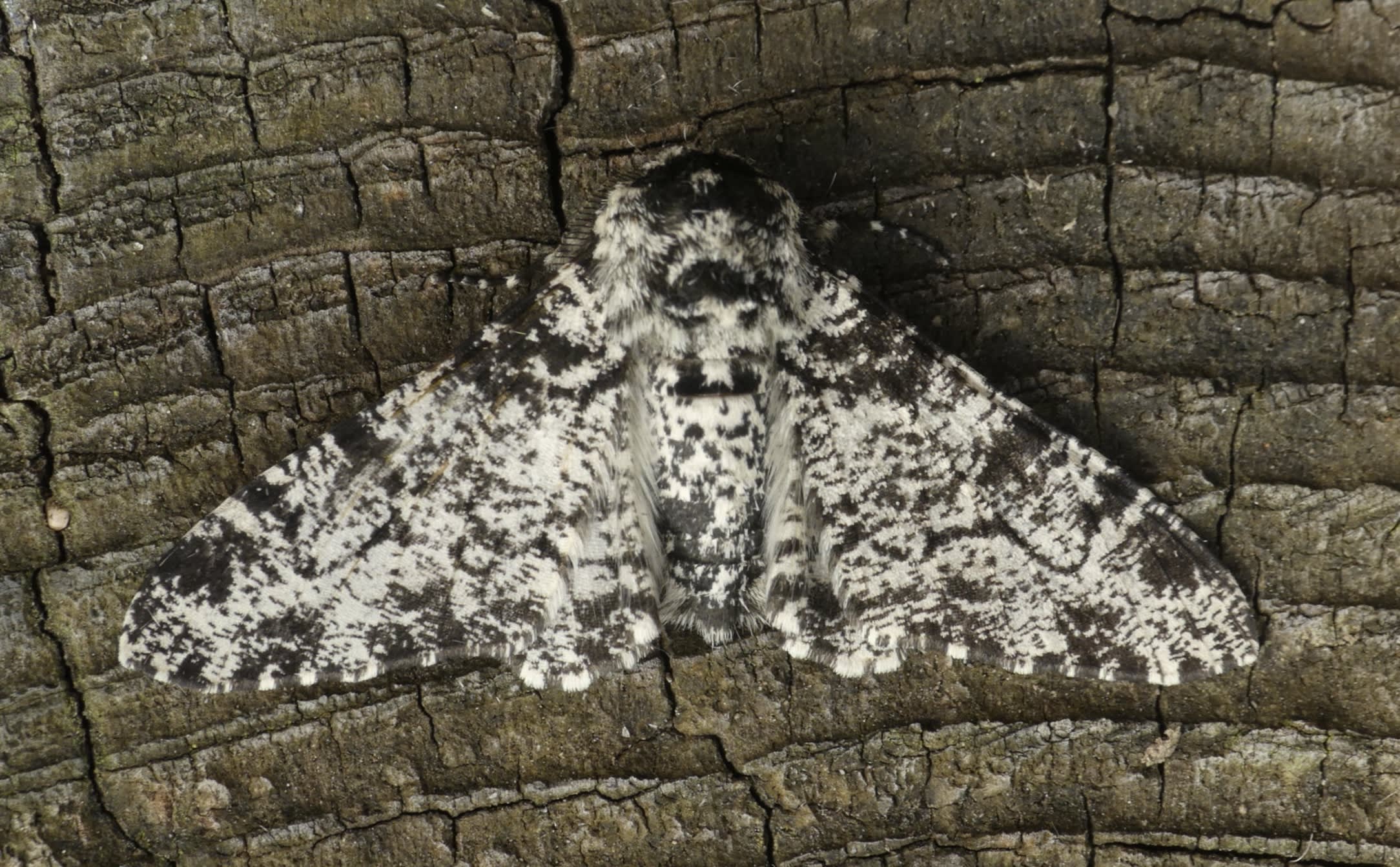
This is one of our better-known moths among biologists, particularly those interested in evolution, natural selection and ecological genetics. A lot has been written about it, but here’s a brief summary for those who haven’t come across it before.
During the daytime, when it sits in one of its favourite resting places, i.e. on a lichen-covered tree trunk, its spotted pattern gives it good camouflage and helps it avoid being found and eaten by foraging birds. However, come the industrial revolution most of the trees in some parts of Britain became covered in soot, and the camouflage no longer worked. However, like many moths, this species occasionally throws up a melanic individual, pretty much all black. Whereas before the industrial revolution these individuals would stand out on a tree trunk, and soon be eaten, once the trees became black the tables were turned and it was the melanic individuals who were camouflaged and the normal ones were not. Natural selection then took over and in the most polluted parts of the country the melanic form became much more common than the typical form. Then when atmospheric pollution was reduced and soot-covered tree bark was rare again, the reverse process took place, the melanic form became rare and the typical form dominated again.
This story was widely quoted by biologists and soon became the text-book example of evolution by natural selection in action.
Most of the work to establish and document this story was done by Bernard Kettlewell (1907-1979), who trained in medicine but shifted to zoology. He did lots of experiments comparing the predation rates of the two forms in different environments, and clearly demonstrated the main elements of the story. Some of his experimental work was filmed by the ethologist (animal behaviourist) Niko Tinbergen – some of my older readers might remember him! Kettlewell also did breeding work and established that the melanic form (carbonaria) was genetically dominant to the typical form (typica), meaning that the gene causing melanism need be present on only one of the two chromosomes in the relevant pair for the moth to show the melanic colouration. (The opposite would be a recessive gene, which would need to be present on both chromosomes in the pair for the effect to be present). This facilitates the rapid spread of the gene by natural selection. In the dominant case, half the offspring of a surviving melanic individual would be melanic, whereas if the gene were recessive, none of a melanic individual’s first generation offspring (if its partner were of the normal form) would be melanic, and melanic offspring would not appear until the following generation. So by being dominant, selective pressure on the gene is much quicker to lead to an increase in the frequency of melanic individuals.
In the 1990s some biologists (led by Michael Majerus) raised concerns about Kettlewell’s experimental methods, saying for example that actually these moths don’t rest on tree trunks during the day. Naturally, various anti-evolution groups and individuals were quick to jump on the bandwagon, declaring that Kettlewell’s results were invalid and that this wasn’t a valid example of natural selection in action1. Majerus then carried out a seven-year field study in order to check Kettlewell’s conclusions, but avoiding what he considered the weaknesses in Kettlewell’s experimental methods. His results conclusively confirmed that differential predation by birds did in fact drive changes in the frequency of the melanic form of the moth, and the place of this theory in evolutionary biology was once again generally accepted as correct.
An ‘intermediate’ form
A few years ago I was surprised to come across a reference to an ‘intermediate’ form of the moth, i.e. half way between the normal and melanic forms, and the picture I saw showed a moth in which the black spotting was much heavier than in the normal form, but the background colour was still white. The reason for my surprise was that with a dominant gene, you can’t have intermediate forms; either a moth has at least one copy of the melanic gene, in which case it is a melanic moth, or it has none, in which case it is typical. You can’t have a moth with half a copy of a gene.
On further investigation, it turned out that indeed this is not an intermediate form, rather it is a different form altogether, controlled by a different gene on a different chromosome. This form is named insularia, and shortly afterwards I got to see one for myself.


Both the melanic form (carbonaria) and the insularia form are now much rarer than the typical form (typica). I’ve looked back through my trapping records and pulled out the numbers of each form I’ve seen each year, shown in the following table:

Ypsolopha scabrella
Year total to date: 1 (29th July)
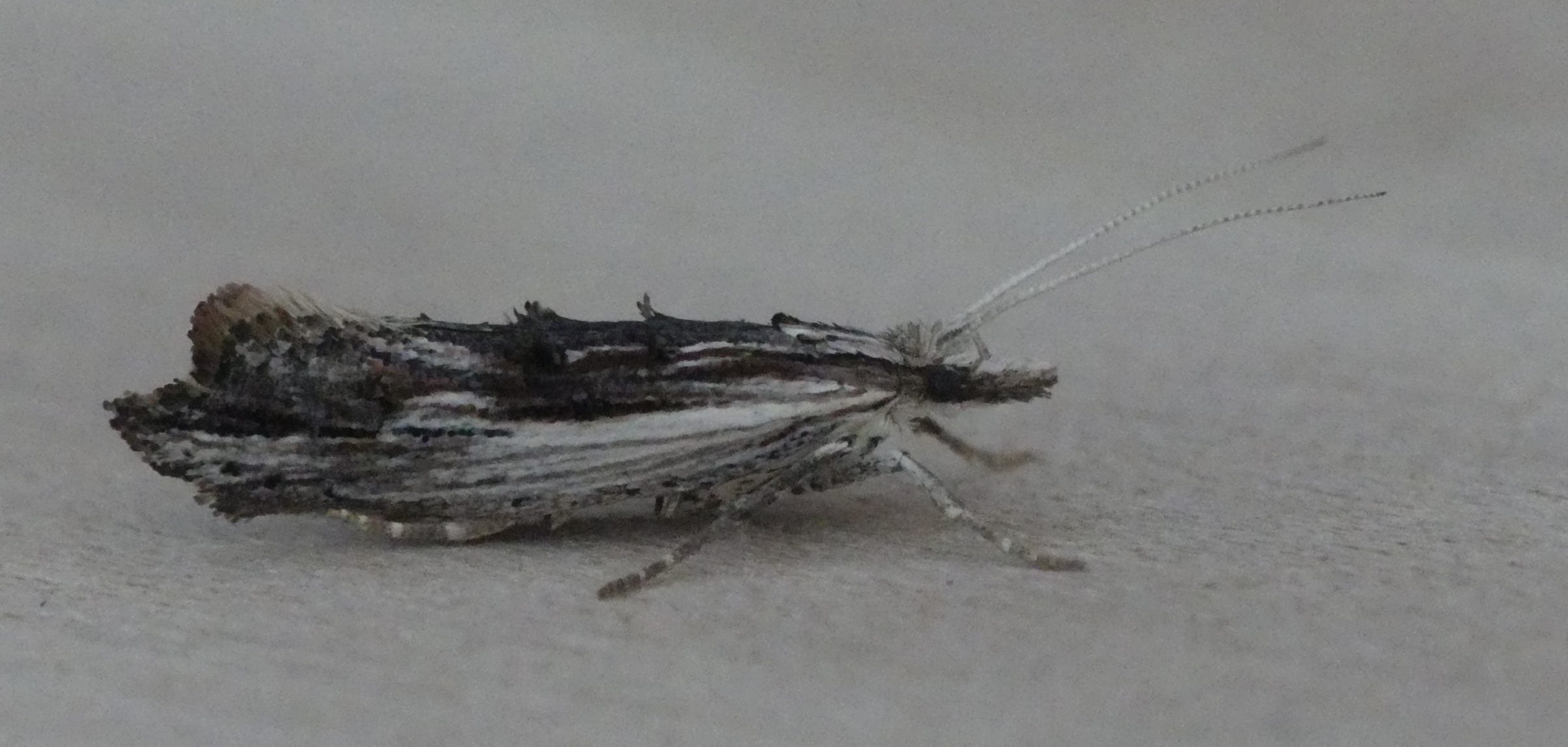
This is a small moth, maybe 11 to 12mm in length, which belongs to a small family, the Ypsolophidae, of micro moths. This is only the third example I’ve seen, and the first since 2021. It’s not a rare moth though, and is quite widely distributed in Sussex and can be sporadically common.
Whilst there are exceptions, most moths have a smooth appearance without any raised tufts. This moth is one of the exceptions, with raised tufts of blackish scales along the moth’s back when at rest, giving this insect a distinctive appearance but also breaking up the typical moth outline and potentially helping it to avoid detection by predators. Both the genus and species names make reference to this; Ypsolopha means elevated tufts or crests, while scabrella is a diminutive of a Greek word meaning ‘rough’ (same root as ‘scabby’).
Well, that’s it for this edition. The next one will be in a few days’ time, depending on the weather, and fingers crossed for another surprise like last nights!
Also, if you’re a regular reader of this newsletter and know of other people who might enjoy reading it, please share it with them using the button below. The more regular readers I have, the more it will encourage me to continue writing it.
The Discovery Institute, Young Earth Creationists, Jonathan Wells (in his book Icons of Evolution), Judith Hooper (in her book Of Moths and Men). It would appear that none of this criticism was ever retracted following Majerus’s publication of his conclusion that Kettlewell’s results were correct.
Fabulous moths! Love the striped hawk moth. What a beauty.
Your knowledge of moths is incredible. Have you studied them for many years?