
Welcome to the Moth Report. If you’re a new reader of this newsletter, some background about my moth trapping can be found here, together with an index with links to all the species previously discussed.
Report for w/b 27th April
The north-easterly wind had been putting me off putting the trap out for several days, but on Monday night (27th) it had eased off somewhat at least for the first part of the night, so I gave it a go (in spite of the moon being about 3/4 full). Some showers were forecast during the night too, but they didn’t actually materialize. The result was 20 moths of 15 species, so a reasonable catch for April. Four of the species were new records for the year - Pebble Prominent, Pale Tussock, Shuttle-shaped Dart and Heart and Dart. Pebble Prominent is one I don’t see many of - I’ve discussed it in more detail below - while the other three are just the first arrivals of what are usually common or very common moths (477 Heart and Darts last year!).
The remaining nights of the month didn’t look very promising, so I closed the book on April after the 27th, giving me a total of only 6 nights’ trapping during the month (in recent years I’ve been managing 8 or 9). Nonetheless, the total number of moths (137) and species (35) for the month are both slightly above the recent average. And the total number of species for the year to date is 51, the highest total I’ve achieved at this point in the year except for 2022 (when it was 58).
Then the first night in May (the Friday) was looking good except for a full moon, but the forecast was for about 80% cloud cover so I thought it would be OK. However the result was just 8 moths of 8 species, although three of them were new records for the year, two common species (Brown-line Bright-eye and Knot Grass) and a micro, Dichrorampha acuminatana.
Let’s move on to look at some species seen recently.
The Powdered Quaker, Orthosia gracilis
Year total to date: 1 (22nd April)
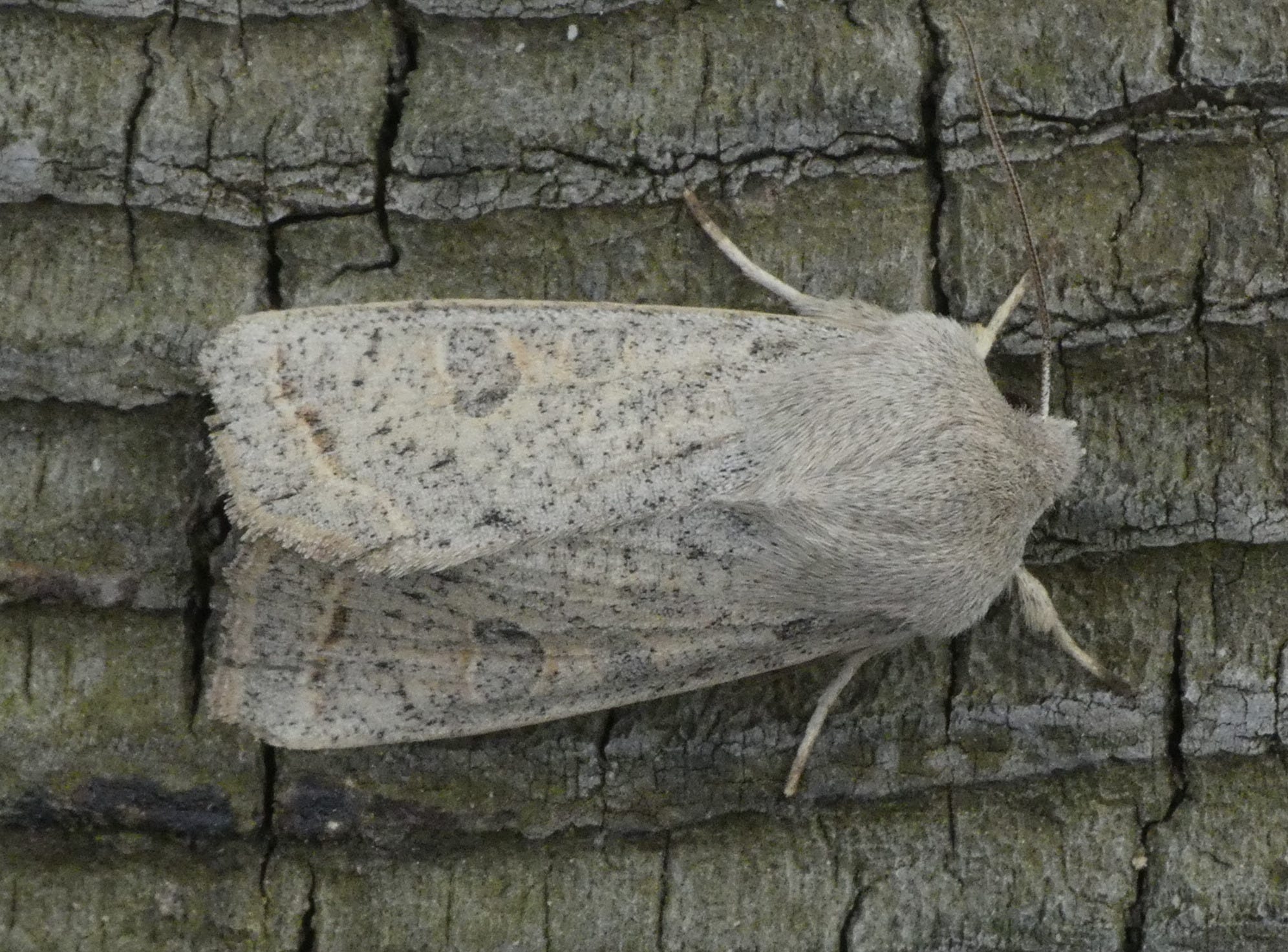
I mentioned this moth in my discussion of the Small Quaker (here); it’s one of the spring group of Quaker moths, mostly in the genus Orthosia, and although described as ‘common’ it’s one that I don’t see nearly as often as, eg, the Common Quaker or the Small Quaker. In fact the one from 22nd April is only the third I’ve seen in Eastbourne (the other two were in 2018 and 2019). It was marginally more common in the three years I was in Hurstpierpoint, when I saw a total of six. Possibly the reason I don’t see many is because it seems to prefer damp habitats like marshes and boggy woodland, and some of its foodplants are also from similar habitats, including Meadowsweet, Purple Loosestrife and Bog Myrtle.
As its name suggests, the moths have a powdered appearance, largely due to the scattering of black specks covering the wings. In addition to the black speckling though, fresh specimens of this moth don’t seem to have the smooth(ish) surface to the wings that other moths do, rather they look a bit rough, almost as though the scales have been dropped onto them with a pepper sprinkler, and I wonder whether this is also partly the reason it’s called the Powdered Quaker.
The ground colour of the wings can be quite variable; most of those I have seen have been the pale sandy-grey colour shown in the photo, but there is large geographical variation and in other parts of the country the background colour can be salmon pink, reddish-brown and dark grey-brown (this latter colour is associated with the Bog Myrtle foodplant).
The species name gracilis dates from 1775 and is due to our old friends Denis & Schiffermüller (see here). It’s a Latin adjective meaning ‘thin’, ‘slender’ or ‘unadorned’. The word is widely used as a species epithet across the whole range of living organisms; just a few examples:
Gazella gracilis (a gazelle from the fossil record);
Porzana gracilis (a bird (a crake));
Hyla gracilis (a tree frog);
Tipula gracilis (a crane fly);
Epilobium gracilis (a willowherb);
Coprinus gracilis (an inkcap fungus).
So it’s maybe a bit surprising that Denis & Schiffermüller chose it for the Powdered Quaker as this moth is neither slender nor unadorned when compared with other moths in the Orthosia genus; it’s actually one of the larger and broader species in the group.
In 1959 R.D. Macleod published a book called Key to the Names of British Butterflies and Moths in which he claimed that gracilis could also mean ‘graceful’, and to me that would make more sense for this species, since there’s just something about the patterning and markings on this moth that (to me) make it stand out as more elegant than other Orthosias. But in a later (1991) book The Scientific Names of the British Lepidoptera by A. Maitland Emmet, Colonel Emmet1 (a widely respected amateur entomologist who graduated in classics at Oxford) points out in the entry for this species that this is not the case and ‘graceful’ is in fact a wholly different word:
The adjective derived from the Latin grātia, grace, is grātiotus.
So I thought I’d found the explanation, but it seems not to be the case!
The Pebble Prominent, Notodonta ziczac
Year total to date: 1 (27th April)
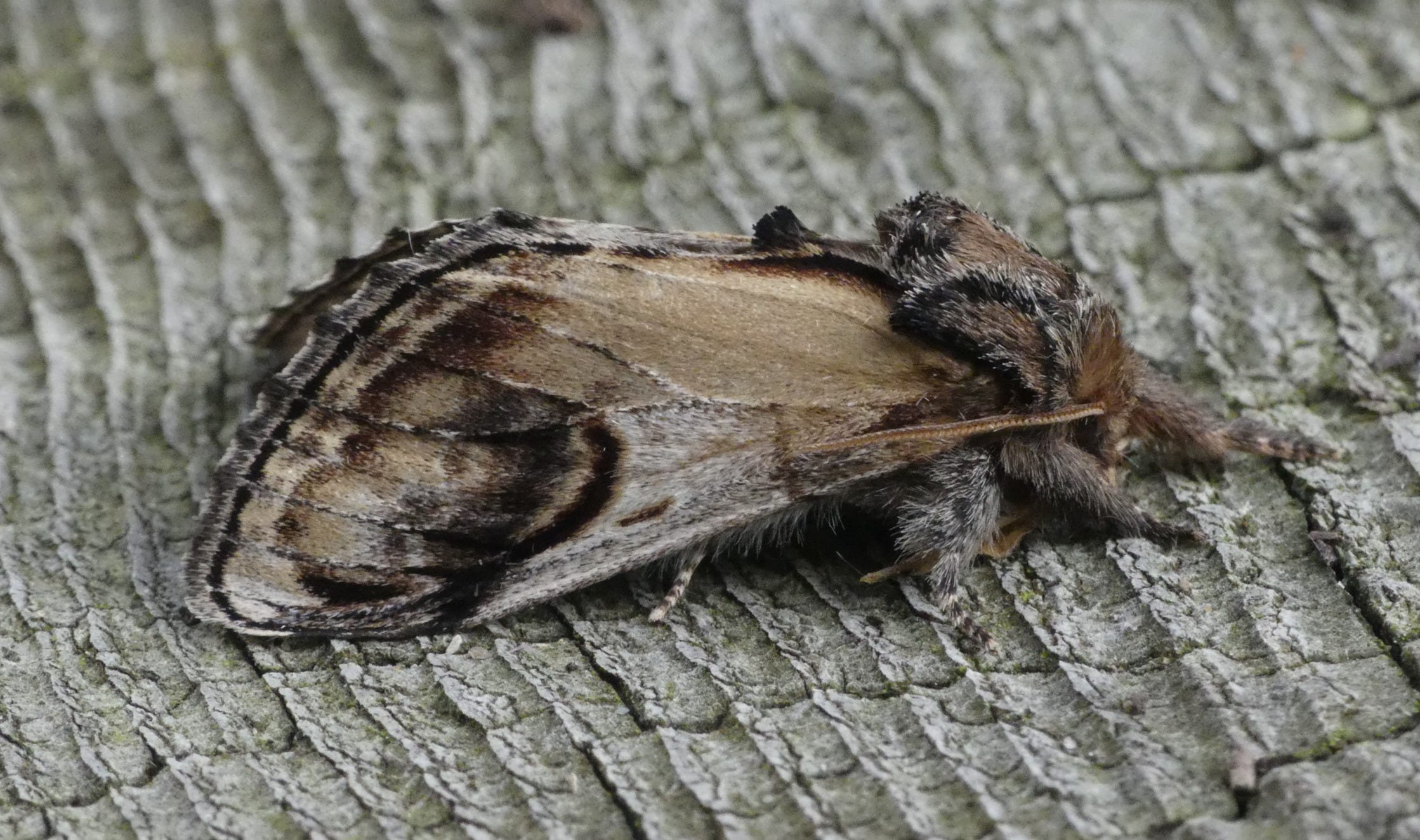
I’ve never seen more than two of these a year while living in Eastbourne, but when I was in the more rural location of Hurstpierpoint I saw about five a year on average. The Sussex Moth Group website reports it as quite widespread across the county, although only rarely found in large numbers in any particular locality, and nationally it is widely distributed throughout the UK.
The species name, ziczac, was given by Linnaeus in 1758. Typically Linnaeus wasn’t very informative about the reasons for his choices (alhough he does mention that the caterpillar has humps on its back), but in 1869 Edward Newman (who we met recently, see here) wrote2 a parenthetical note following his description of the species:
The scientific name is Notodonta ziczac, so called from the extraordinary appearance of the caterpillar when at rest.
A recent paper (available here) puts a bit more flesh on the bones:
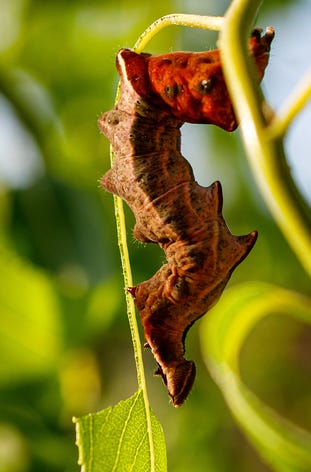
Its species name ziczac, from the German zickzack, meaning zigzag, comes from the humps on its caterpillars’ sixth, seventh and twelfth segments and the posture it assumes at rest, which creates a zigzag-like pattern.
(The earliest account I’ve found suggesting a German origin for the word is Colonel Emmet’s 1991 book which I mentioned under the Powdered Quaker entry above).
And this photo shows the zigzag line of the back of the caterpillar reasonably well:
I take with a pinch of salt, though, this suggestion that Linnaeus’s choice of ziczac was derived as a Latinised form of the German word ‘zickzack’. In the pan-European scholarly tradition in which Linnaeus worked, French was regarded as the prestige language. Although in standard French the word is ‘zigzag’ (i.e. the same as in English), in the Walloon language (native to what is now southern Belgium) the word is ziczac, exactly as Linnaeus used it. Linnaeus spent some three years in the Netherlands, based mainly around Leiden, completing his doctorate. The northern Netherlands had strong ties with the Walloon region, through trade and through religious migration - large numbers of Walloon protestants had migrated to Dutch cities, including Leiden, in the preceding decades. So Linnaeus was perhaps more likely to have been exposed to the ‘ziczac’ spelling than to the German spelling.
As far as the English common name goes, the ‘pebble’ part of it is clearly a reference to the oval marking on the forewing. In several other European languages though, the common names follow the zigzag route, e.g.:
Danish Siksakspinder;
Norwegian Siksaktannspinner;
German Zickzack-Zahnspinner.
The Least Black Arches, Nola confusalis
Year total to date: 2 (17th and 27th April)
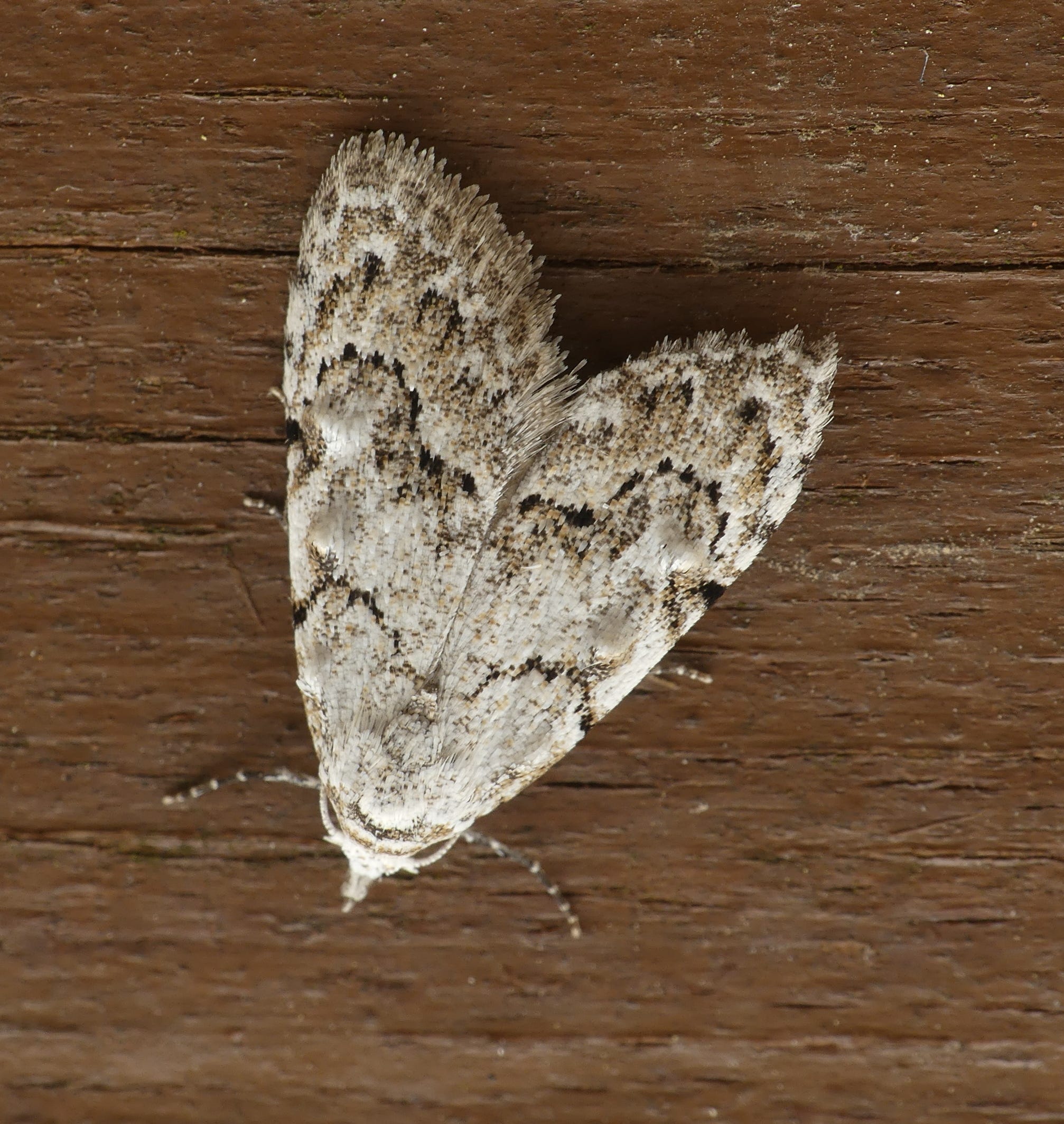
This is a very small moth; when I first saw one I assumed it must be a micro, but in fact it turns out to belong to a family (the Nolidae) which are traditionally considered macro moths. It’s quite a small family, but I find I’ve already featured four species from it in these posts! The key feature of the family is that when spinning a cocoon in which to pupate, the caterpillars leave an escape slit in the side of the cocoon to make it easier for the moth to crawl out when it emerges.
The Least Black Arches is the species from this family that I see most frequently, but even then not every year and the most I’ve recorded in any one year is five. In the photo above I’ve shown it against a plain background - however recently I saw one flying during the daytime and it settled on the bark of a silver birch tree, where it was so well camouflaged that it took me a while to locate it and by the time I’d got the phone ready to photograph it it had flown off again!
The genus name for this moth, Nola, is due to Elford Leach (whom I wrote about recently, here). Incidentally, Leach also placed this genus in one of the micro-moth families, so I’m not alone in my original assumption! It’s not entirely clear why Leach chose this name (he left us no explanation). The most likely connection seems to be that it’s named after a town near Naples. Not just any old town, though; Nola has genuine classical prestige which would have been well known among early nineteenth century academics; it is the town where the Roman Emperor Augustus died in AD14. And some four centuries later the wealthy Roman senator and poet St Paulinus became Bishop of Nola. He is the figure traditionally credited with introducing bells into Christian worship, those bells being known in Latin as nolae after his town. Nonetheless, Leach would have been acting atypically if this is indeed the correct explanation; it would be the only time he used a classical geographical reference as a name, and being from an 1815 publication it predates the main heyday of this fashion, led mainly by the actor Ochsenheimer (see here).
And then there’s the species name confusalis, attributed to Herrich-Schäffer in 1847, who I’ll say a bit more about shortly. But first, the name itself is from the Latin confusus, ‘confused’, and the confusion it refers to is the question of which family the moth should be assigned to. By choosing the ending -alis, Herrich-Schäffer indicates that his (erroneous) conclusion was that it belonged in the family Pyralidae, another family of micro-moths.
Gottlieb August Wilhelm Herrich-Schäffer (1799 – 1874) was a German entomologist and physician, who was born and died in Regensburg. He was a working doctor who pursued entomology with extraordinary productivity alongside his medical career. He wrote Systematische Bearbeitung der Schmetterlinge von Europa (Systematic Revision of the Butterflies and Moths of Europe) between 1843 and 1856, one of the most influential 19th century works on the higher classification of Lepidoptera. Many of the higher taxa recognized today were defined in this work for the first time. He based his classification mostly on wing venation.
That’s it for this week. The next issue is scheduled for Tuesday, 12th May.
This newsletter will always remain free. However, if you feel you want to show your appreciation by making a financial contribution you can use the button below to take you to a website where you can do so. I will donate any money I receive through this route to a charity, most likely Butterfly Conservation but other more local wildlife charities might also qualify. Absolutely no obligation, but many thanks if you do.
In his book An Illustrated Natural History of British Butterflies and Moths.
Thank you Dennis!😊
Fascinating as always. I’ve only ever had the odd Least Black Arches and then had 10 in one night in mid April this year which was a surprise.