
Welcome to the Moth Report. If you’re a new reader of this newsletter, some background about my moth trapping can be found here, together with an index with links to all the species previously discussed.
Report for w/b 4th May
The Monday night (4th) looked quite promising - even though the moon was only just past full it was an overcast night so quite dark, mild and not much wind. Total catch was 42 moths of 17 species, 6 of which were new records for the year. Of special note among these were the first Buff Tip of the year - I’ll no doubt feature this in a Moth Report soon - and the first Portland Ribbon Wave, which I wrote about before (here). Also the first Silver Y of the year - this is a common moth but its numbers were down last year so hopefully it’ll do better this year. And a micro moth which I’ve recorded only once before - Prays ruficeps.
On Thursday night (7th) the forecast conditions were quite similar; slightly cooler and less overcast, but also with less moon (75%). However, numbers were down to 21 moths but still a respectable number of species (16) with 7 new species for the year. These included a Chocolate-tip, a moth I don’t see every year.
On both nights reported above, for the first time this year there were one or two mayflies in the trap (right on cue!). The photos below are just phone snaps, I didn’t take any better ones. There are 51 species of mayfly recorded from the British Isles (Wikipedia has a list, here). The adults are very short-lived; usually they mate, lay eggs and die all within a single day, so many of them don’t live long enough to be caught in a moth trap!


Let’s move on to look at some species seen recently. Just two species this week, but for some stunning Australian moths, do follow the Met Gala link at the end of the newsletter!
The Pale Tussock, Calliteara pudibunda
Year total to date: 2 (27th April and 1st May)
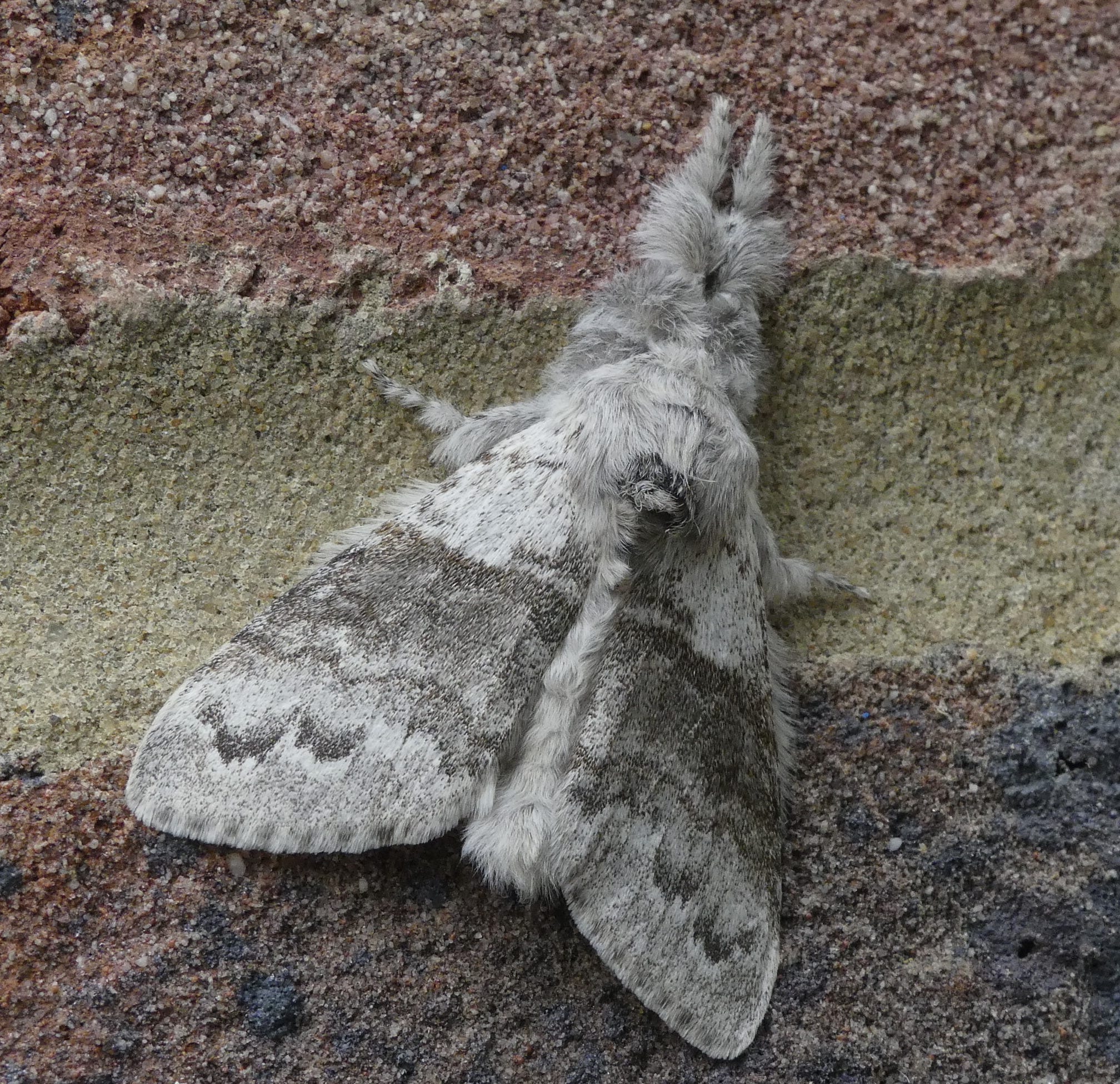
The resting position of the adult Pale Tussock moth is very distinctive, with its long hairy front legs stretched as far as possible in front of its head; only a few other closely related species rest in a similar pose. I see a handful of these each year, mostly during May. The adult female is noticeably larger than the male.
A dark coloured form of this moth, named f. concolor, is quite common:
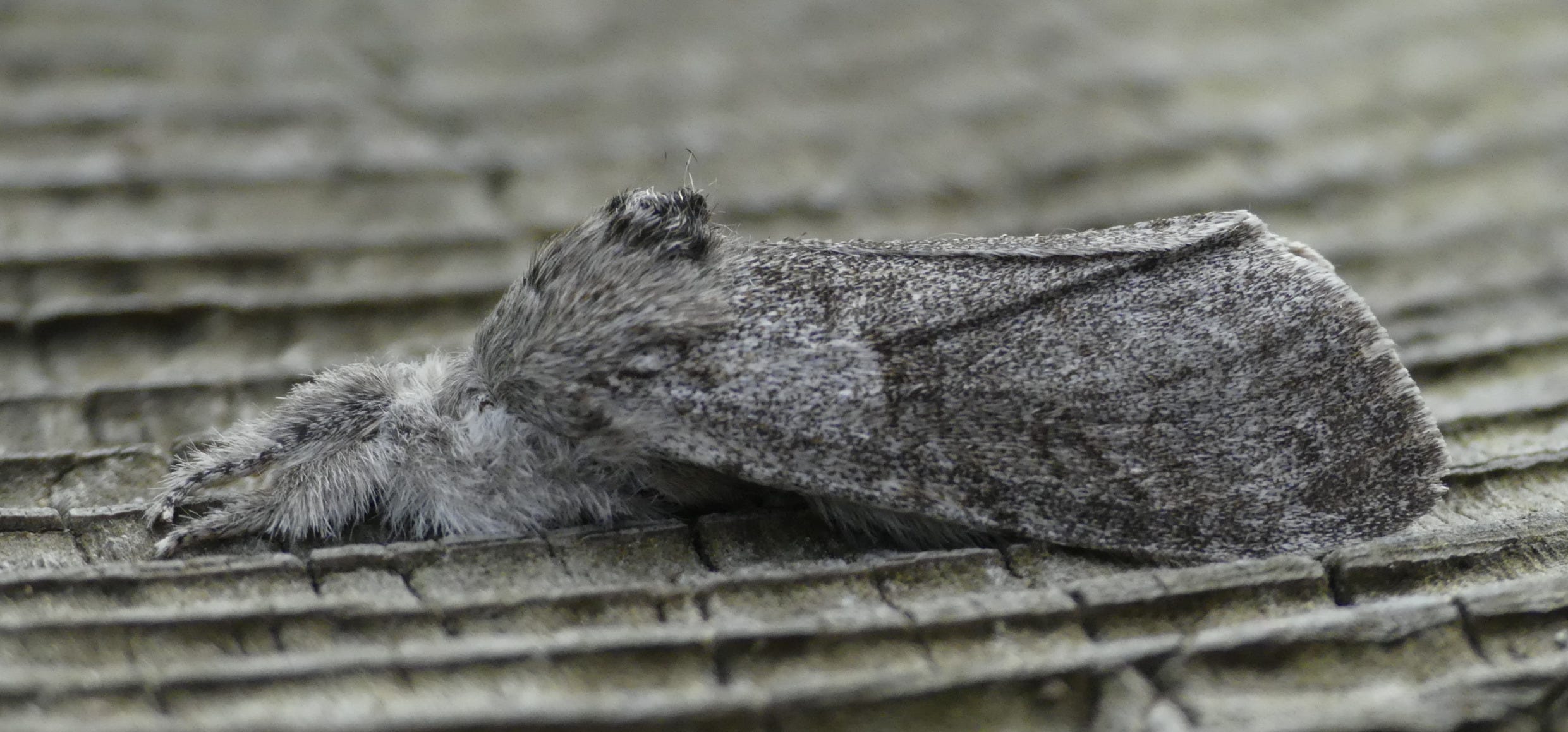
This form is sometimes referred to as melanic, although it’s nowhere near a black colour. In around the middle of the twentieth century this form made up about 1% of records, but these days its frequency has risen (in Sussex at least) to around 30%. This change in frequency is in marked contrast to that seen with the Peppered Moth (see here), where the melanic form was common when trees were covered with soot, but is now much less so. So whatever the explanation, it’s probably not correct to consider the Pale Tussock as exhibiting industrial melanism.
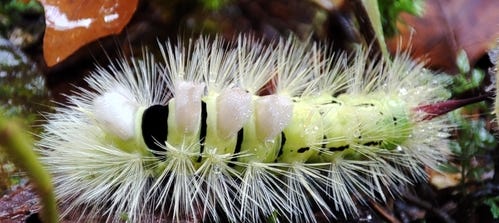
The caterpillar of the Pale Tussock is what gives the moth its common name; it has four white tufts of hair, or tussocks, on its pale green back, plus a red tuft at its rear end. These make the caterpillar highly visible, and this is clearly a case of aposematic colouration. Such warning colouration is usually an indication either that the caterpillar is distasteful, having absorbed toxins from its foodplant, or that it has some other form of defence. The caterpillar of the Pale Tussock can be found on a wide range of broadleaved trees and shrubs; before the widespread use of insecticides it used to be abundant in hop fields, so much so that it was known as the ‘Hop-dog’. But this wide range of foodplants means it hasn’t specialized in storing the toxins from specific plants, and so the colouration suggests that the caterpillar has some other form of defence, most likely that a potential predator would find that its hairs act as an irritant. Or, of course, it could all be a bluff - and the caterpillar is mimicking others in which the hairs really are irritating!
As far as the scientific name goes, the genus name Calliteara is somewhat obscure but possibly means something like ‘spring beauty’. But the species name pudibunda, due to Linnaeus (1758), stands out as a rather unusual name for him to have used. It’s from the Latin pudibundus (‘modest’), which is in turn derived from pudere, ‘to feel shame’ or ‘to be ashamed’. It seems that the meaning of the adjective pudibundus can also tend towards ‘that which ought to cause shame’ (hence ‘pudendum’?!). As Colonel Emmet1 comments:
Pudibundus can also mean immodest, disgraceful, descriptive of a thing of which one should be ashamed; no well-bred lady would flaunt her legs as this moth does.
I rather like this interpretation of the species name; Linnaeus was not above a degree of taxonomic wit.
Dichrorampha acuminatana
Year total to date: 1 (1st May)
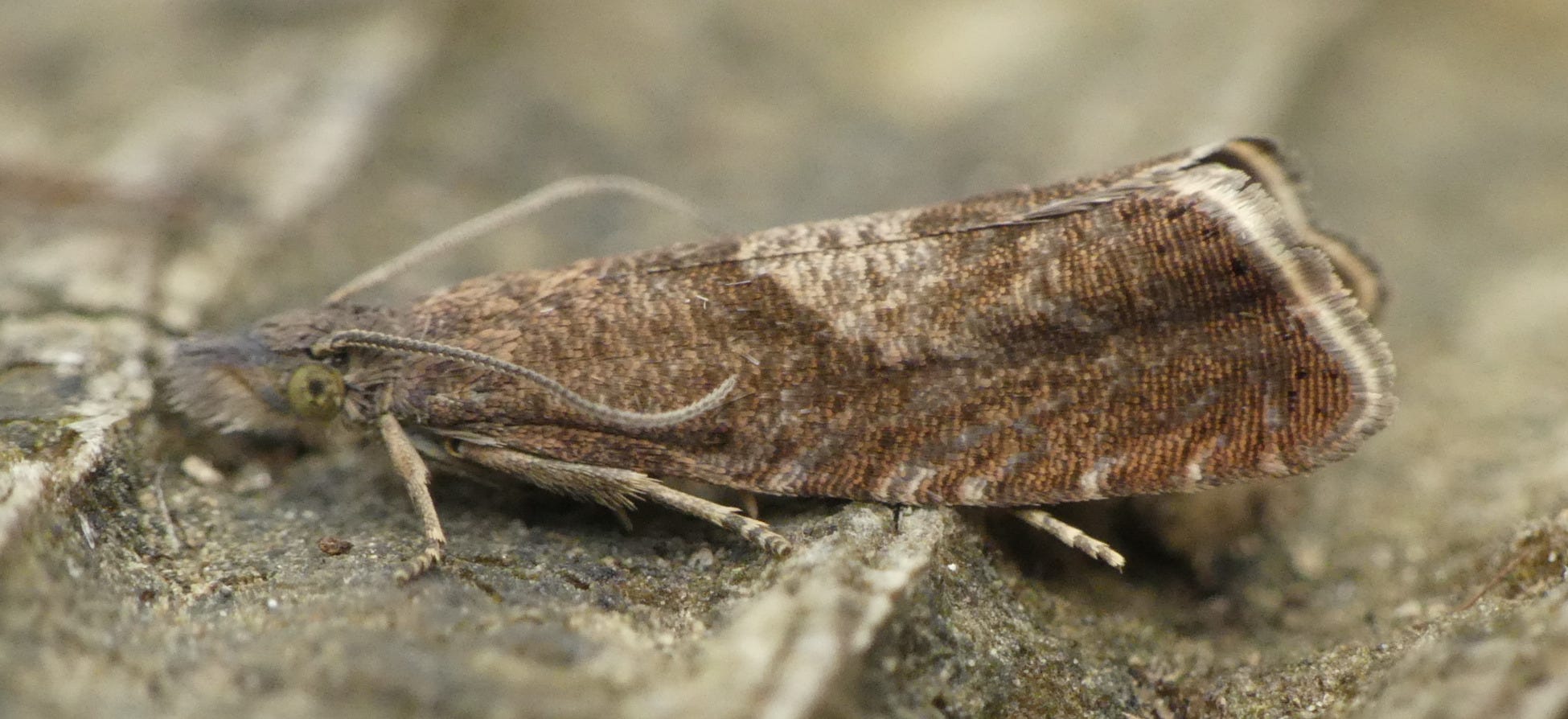
Perhaps the first thing I should say about this moth is that the identification is not 100% certain! There are several very similar species and it’s easy to get them mixed up. Actually this photo isn’t of the moth from 1st May, that one got away before I could get a decent shot, but both moths are certainly in the correct genus.
This is a small moth (a micro), with a wing length of about 7mm. The larvae feed on the roots of Ox-eye Daisy, boring their way into them. I have lots of this plant growing in my garden, so at least that makes it a plausible guess at the species. It has two generations a year, the first on the wing in April and May, so that fits as well.
The males of this moth have a costal fold on the forewing; a fold on the leading edge of wing, from the base to about a third of way along it, and I think this is just about visible in the photo above. The fold contains cells which release sex pheromones, although I haven’t been able to find out exactly how these are used in this species. In the first Moth Report this year (here) I did an update on the Light Brown Apple Moth, discussing the costal fold in that species; both moths are in the same family (Tortricidae) and probably have much in common in way the fold is used.
The genus Dichrorampha has quite a lot of species in it, most if not all of which have caterpillars which feed on the roots of plants in the Daisy family. The name was coined in 1845 by Achille Guenée (1809-1880) (more about him in a bit). The word is derived from two Greek words, δίχροος (díkhroos) — two-coloured, itself from δί- (dí-, two) + χρόος/χρώς (khróos/khrós, colour, complexion, skin), and ῥάμφος (rhamphos) — beak, bill, or hooked snout or knife. This all refers to the two-tone colouration of the palps (the sense organs that stick out in front of the head in some moth species, including this one); the dual nature of this colouration can just about be made out in the photo above. Unlike many of the nomenclators2 who went before him, Guenée was quite explicit about why he chose this name. He wrote the explanation in Latin; here is Colonel Emmet’s translation:
In this name, which I unsuccessfully tried to make less of a mouthful and easier on the ear, I wanted to draw attention to the palpi, which are nearly always basally yellow and laterally fuscous.
As for Guenée, he’s another of those ‘amateur’ entomologists who contributed so much to the 19th century development of the science. He was born in Chartres and by profession was a lawyer. But he wrote lots of scientific papers, mainly about moths, and also wrote a six-volume work called Spécies des nocturnes3, about moths of the family Noctuidae from around the world, and was also a co-author of five of the volumes of another important work, Histoire naturelle des Insectes: Spécies général des Lépidoptères.
At some point he moved, together with his extensive collection of specimens, to the Loire town of Châteaudun. In 1870 this town came under attack in the Franco-Prussian war, and a substantial part of it was burnt to the ground by the Prussians as a reprisal for guerilla attacks by French franc-tireurs (a sort of informal resistance movement operating outside of the regular French army, which had more or less collapsed). Miraculously though, Guenée’s collection survived intact.
And then we come to the species name, acuminatana. It’s from the Latin word acuminatus (‘sharpened’), and relates to the relatively sharp angle of the apex (the tip of the forewing) in relation to other closely related species. What’s of particular interest here are the nomenclators — the attribution is ‘Lienig and Zeller, 1846’. Philipp Zeller is the more famous of the two, and I wrote a bit about him in a previous Moth Report (here). But the lead author is Friederike (also known as Jeanette) Lienig, née Berg, (1790-1855). For a woman to be the primary author of a major scientific paper (naming several new species) in the mid-19th century was highly unusual.
Lienig was born in Latvia (then under Russian control) and her mother tongue was probably German. Initially self-taught, it seems that she corresponded regularly with Zeller, who was a teacher at the technical high school in Meseritz (now Międzyrzecz in western Poland). The 1846 paper in which this species is named was a lepidopteral fauna of the Latvian regions of Livland and Curland (Vidzeme and Kurzeme, both near Riga), its title page describing it as "bearbeitet von Friederike Lienig, geb. Berg, mit Anmerkungen von P. C. Zeller" — ‘worked by Friederike Lienig, née Berg, with annotations by P. C. Zeller’. It was published in Isis von Oken, a German scientific journal of the period in which Zeller himself published much of his work. It is clear from this paper that Lienig was a field naturalist and collector of real ability — biological information and descriptions of larvae in the species descriptions usually appear to have been written by her, which suggests she was doing original observational work, not merely cataloguing dead specimens. She has four moths named in her honour, so was evidently highly regarded in entomological circles.
As is often the case, this species was also described in the mistaken belief it was a new species by a different author; in this case in 1931. What caught my eye about this was that this second description was based on two specimens from the collection of King Boris III of Bulgaria (who died in mysterious circumstances in 1943 shortly after visiting Hitler). It seems that the bulk of this collection was actually assembled by Boris’s father, King Ferdinand I, and the collection is now housed in the National Museum of Natural History in Sofia. So this is a moth with a claim to some royal connections!
Moths and the Met Gala
If you subscribe to ‘The Knowledge’ you will have seen that in the edition for 8th May (which you can read here (then scroll down to the ‘Fashion’ section)) they included a feature on CSIRO’s take on the recent Met Gala, where they compare several of the costumes with various moths from the Australian fauna, asking ‘who wore it better?’ (some impressive moths there, no contest in my view!). There are more pictures on CSIRO’s Instagram account, which I think you can view if you have your own Instagram account (by clicking on one of the photos in The Knowledge report) - I don’t (and I have no intention of creating one) so I haven’t seen any more photos than those selected by The Knowledge.
That’s it for this week. The next issue is scheduled for Tuesday, 19th May
This newsletter will always remain free. However, if you feel you want to show your appreciation by making a financial contribution you can use the button below to take you to a website where you can do so. I will donate any money I receive through this route to a charity, most likely Butterfly Conservation but other more local wildlife charities might also qualify. Absolutely no obligation, but many thanks if you do.
In his 1991 book The Scientific Names of the British Lepidoptera.
I learnt a new word! It means the person who gives something a name.
The literal translation Species of the night doesn’t really do this title justice. ‘Spécies’ is used here in a taxonomic sense, meaning something like "a systematic account of the species of", and ‘nocturnes’ has poetic overtones (cf the piano Nocturnes by John Field and by Chopin).
Hi Dennis lovely article thank you for the depth you go into on each moth. I came across my first Sliver Y of the year on Sunday so maybe numbers will be better this year.
Very interesting Dennis. Your research impresses me.