
Welcome to my new subscribers (indeed, to all my subscribers!). This introductory blurb (in italics) will remain much the same from post to post; please skip it if you’ve read previous posts.
This newsletter will remain free, I’ve no intention of converting it to a paid subscription. It’s aimed at readers who have a general interest in nature and natural history, but maybe don’t know very much about moths. It’s not really aimed at people who regularly run their own moth traps, but of course they’re welcome to read it (even to criticise it if they wish!).
I run a light trap in my garden in Eastbourne (Sussex, UK) and the main objective of this newsletter is to post photos of some of the moths (and occasionally, other insects) that are attracted to the light, and to say a little about them. On average I run the trap about one night in three, and the plan is to write a post once a week, featuring two or three of the moths seen in the trap within the previous couple of weeks.
In the morning I photograph any catches of special interest, then all moths and other insects caught in the trap are released (if they haven’t escaped already!).
This is my ninth year of running a garden moth trap, firstly three years in Eastbourne (2017-2019), then three in Hurstpierpoint (2020-2022), and then back in Eastbourne (2023 onwards). Hopefully, yet more house moves are off the cards for the foreseeable future!
Report for w/b 3rd November
Two trapping sessions this week, on the 4th (Tuesday) and the 6th (Thursday). Although mostly mild, nights have been quite breezy for several days on end - so I had a few nights off! The Tuesday night was still quite breezy, but by the Thursday night the wind had dropped and it was relatively still. Although the moon was near full, both nights were overcast and so there wasn’t much competition from the moon.
Numbers from the two nights were quite similar - 12 moths of 9 species on the Tuesday and 17 moths of 9 species on the Thursday. However, the make up of the catches was rather different, with only four species common to the two nights. On the Tuesday, most of the species were larger moths, including three Large Yellow Underwings (probably the last ones I’ll see this year), whereas with one exception all the moths from the Thursday were small ones, including one each of Udea ferrugalis (Rusty-dot Pearl), Nomophila noctuella (Rush Veneer), my latest ever Cydalima perspectalis (Box Tree Moth) and Palpita vitrealis.
Both nights produced one species which was new for the year; a Yellow-line Quaker on the Tuesday and a Feathered Thorn (the exception mentioned above) on the Thursday, one of which might make it into next week’s report.
In passing, I’d just like to mention that by subscriber total nudged past 300 during the weekend, and currently stands at 349. Many thanks to all of you (and my followers), it will keep me inspired to keep writing during the winter months when there are not so many moths about!
Anyway, let’s move on to look at some species seen recently.
The Gold Spot, Plusia festucae
Year total to date: 1 (21st October)
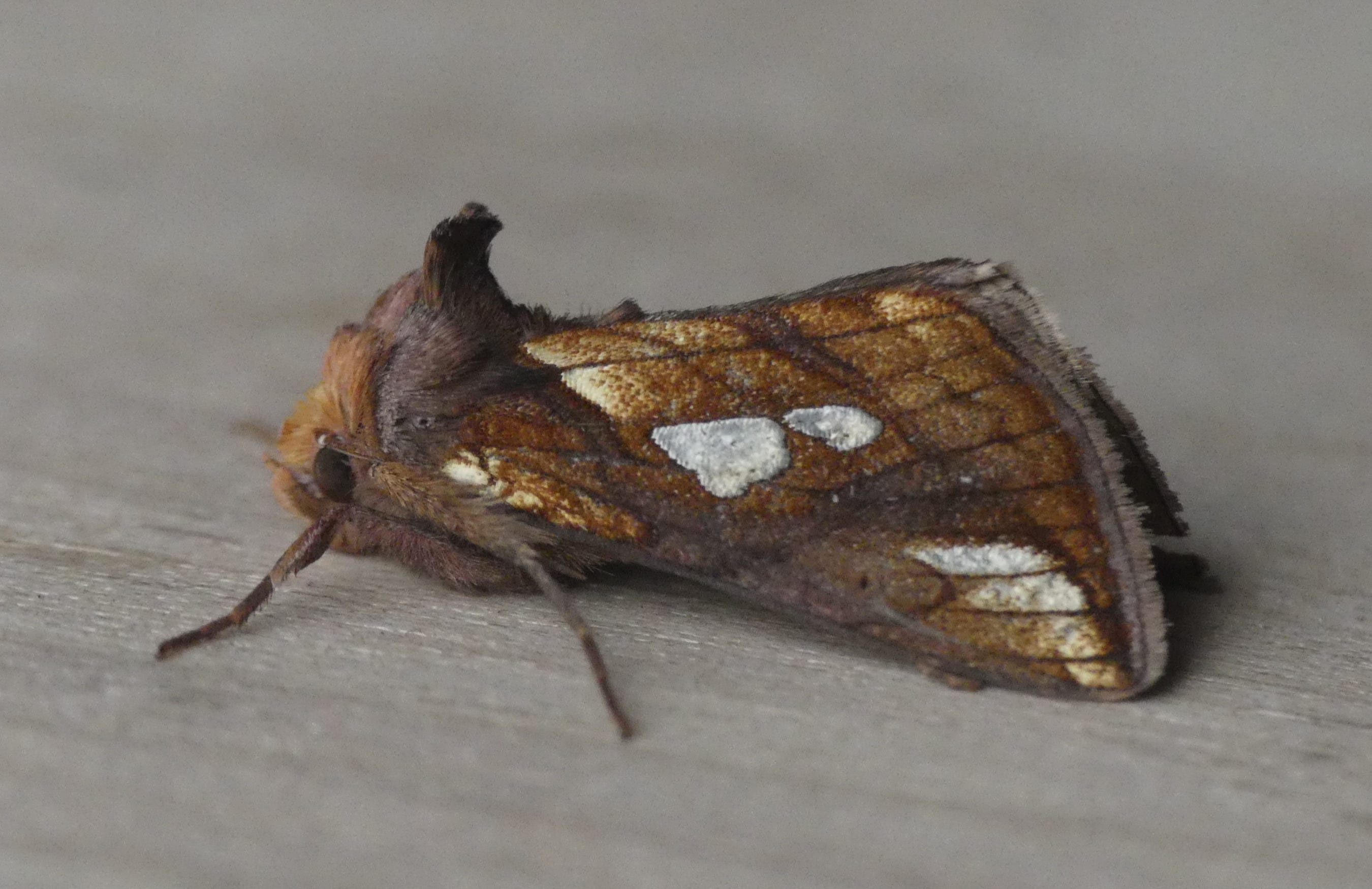
Although described in the books as ‘common’, I usually see only one or two of these a year. The one I had last year was the first I’d seen since 2020. Probably the reason for this discrepancy is that it prefers damp habitats like fens and riverbanks, so perhaps if I ran my trap near a river or marsh I’d see them more frequently.
The genus name, Plusia, comes from the Greek plousios (πλούσιος) meaning ‘rich’ or ‘ornate’, and several of the moths in this genus have gold or silver spots on them. This is the first moth from this genus that I’ve covered in the Moth Report, and hopefully I’ll get round to some of the others in due course. But J.W. Tutt, in his 1902 book British Moths, says:
In my opinion the palm for beauty must be given to this species with its golden-brown ground colour, its metallic blotches of silver near the base and apex…
Whilst the silver spots on the moth’s forewings are its most distinctive feature, the moth also has a marked thoracic tuft, or crest, rising from the thorax. This shows particularly well in a side shot; in the more conventional views from straight above it is usually not so evident. It’s not entirely clear what purpose this tuft serves (several other moths in the genus also have one). It doesn’t seem likely that it has a role in flying. Maybe it just helps to disguise the moth’s outine, to make it look less like something edible. The silver spots are also believed to have this effect.
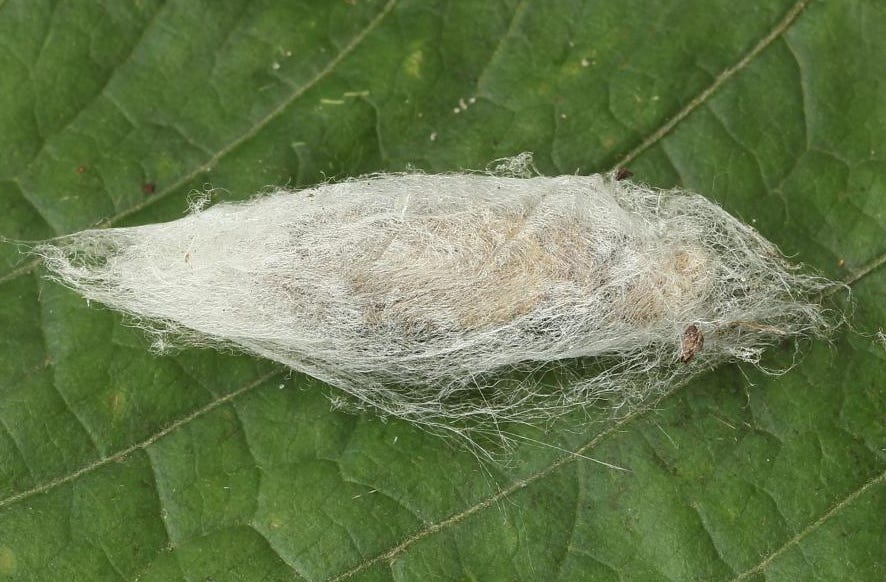
The caterpillars’ foodplants include various sedges, Yellow Iris, Great Bur-reed and some wetland grasses; the species name festucae relates to one of these, fescue grass. When the caterpillars pupate they spin semi-transparent cocoons which can be quite difficult to spot (even though it’s quite obvious in this photo!):
Caloptilia hemidactylella/honoratella
Year total to date: 1 (28th October)
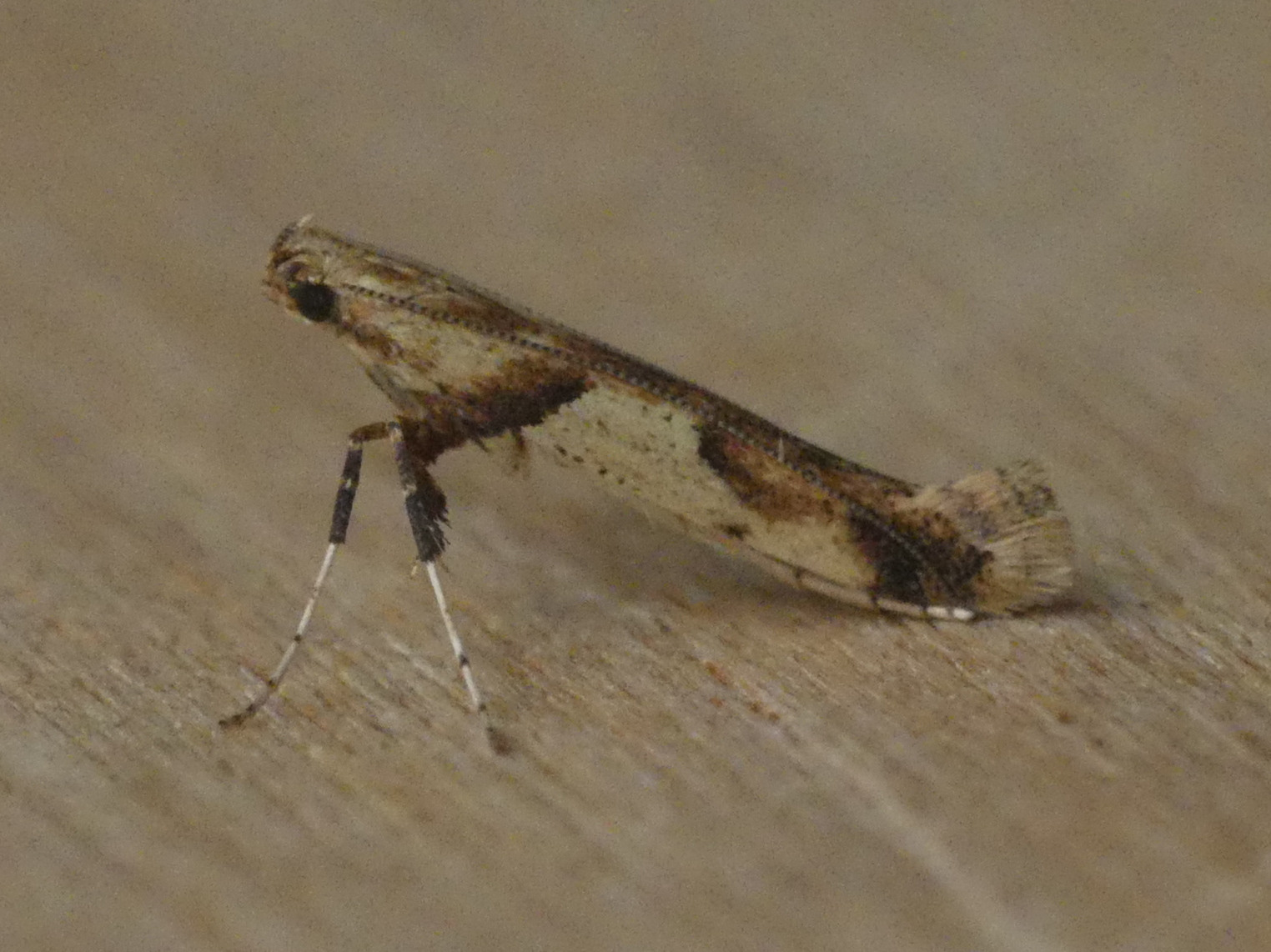
This is a tiny little moth with a wing length of about 7mm (making it quite difficult to photograph!). Caloptilia is a large genus of leaf-mining moths which all stand in this characteristic pose, with their heads raised. Some of them are fairly common, but others, like this one, are rare in the UK. There are actually two possibilities for this moth, Caloptilia hemidactylella and C. honoratella. Both species have very similar life histories and the adults cannot be reliably told apart just from a photo - the only way of being certain which species it is is to kill the moth and look at its genitalia under a microscope. However I’m not keen on the idea of doing this and prefer to release the moth alive, and just record it as a member of the aggregation of the two species. Whichever species it is, it’s a good record; the County Moth Recorder tells me that for both species there are fewer than half a dozen Sussex records in the past 150 years.
Both species have two generations a year, with the second generation overwintering as an adult and re-emerging in the spring, so this is a second generation adult and will be looking for somewhere safe to hibernate. In their early stages the caterpillars are leaf miners in sycamore or field maple, but after their second or third moult they come out of their mines and fold a corner of the leaf over to make a shelter in which they can live.
The genus name Caloptilia has Greek origins, from kalos (καλός), meaning ‘beautiful’ or ‘graceful’, and ptilon (πτίλον), meaning ‘wing’. The species name hemidactylella was assigned in 1775, and the first part hemidactyl is also from Greek and means ‘half-fingered’; the -ella suffix is Latin and is just a diminutive. It’s not clear why the moth merits the ‘half-fingered’ description, especially as there is another group of moths whose forewings are split into two (the Plume moths), many of which have species names built around ‘dactyl’ (‘finger’).
The other species, honoratella, was not named until 1914, by Hans Rebel (1861-1940). It is not clear whether this name was intended as a tribute to someone named ‘Honorat’, or is based on the Latin honora (‘honour’). However it might be worth saying something about Rebel himself, who was honoured with a mention by Vladimir Nabokov in his 1930 short story ‘The Aurelian’ (which can be read here):
“Dr. Rebel of Vienna had named a certain rare moth Agrotis pilgrami …”
(The genus Agrotis is genuine, while the species name is made up, to honour the protagonist of the story, Paul Pilgram).
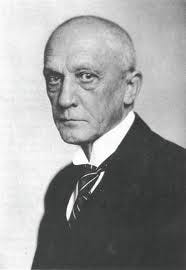
Born near Vienna, Rebel first studied law and gained a doctorate in jurisprudence from the University of Vienna in 1886. His interest in butterflies and moths led to him abandoning the law as a profession (can’t say I blame him!) and in 1893 he joined the Naturhistorisches Museum in Vienna as a scientific assistant. He gradually rose through the ranks, becoming curator of the Lepidoptera collection in 1897 and eventually Director General of the museum in 1925. Rebel transformed the museum’s Lepidoptera holdings into one of the largest and most significant in Europe, a position which it retains to this day (containing around 10,000 drawers of butterflies and moths).
The Brick, Agrochola circellaris
Year total to date: 1 (21st October)
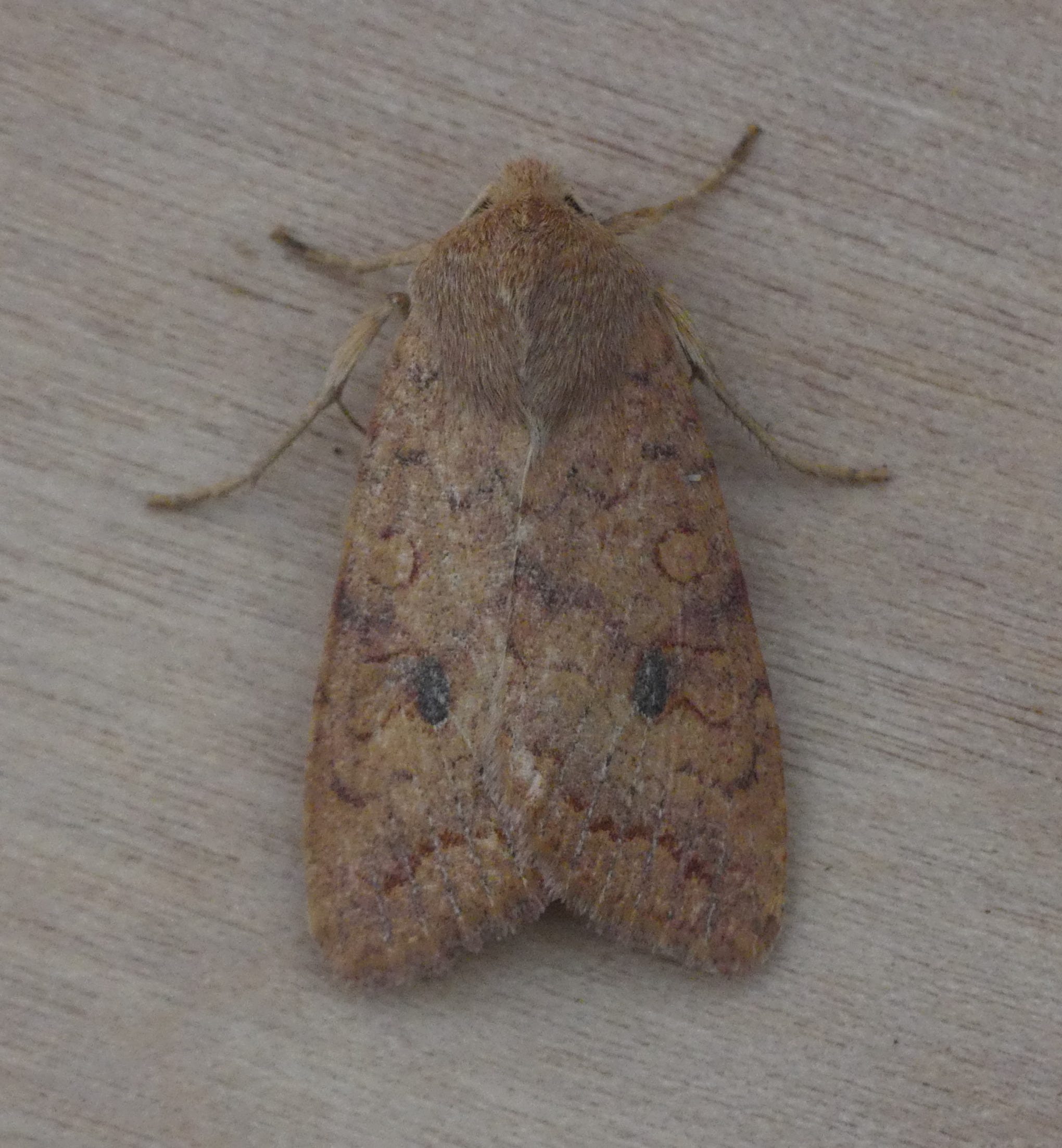
Another moth with a strange name! The name relates to the brick-like colouration, although the colour does vary a bit from moth to moth (but then, so do bricks!). Some idea of the range of variation can be seen in its gallery on the Sussex Moth Group’s website (here).
The Brick is another autumnal moth, flying from mid-September and sometimes still on the wing in early December. However, in spite of it being described as frequenting woodlands, parks and gardens, I don’t see it very often. This is only the sixth one I’ve seen, and the first since 2022. It’s favourite foodplants are the Wych-elm and the Ash, and the young larvae feed on the flowers and unripe seeds. As the caterpillars develop, they switch to feeding on the leaves. Other deciduous trees such as Poplar, Aspen and Sallow are also used.
The species name circellaris is based on circellus, a diminutive of the Latin circulus and which means ‘small circle’; this relates to the circular mark visible on the forewings. This name was given to the moth in 1766 by Johann Hufnagel (1724-1795), who I mentioned briefly in an earlier report (here) in connection with another moth, the Buff Arches, and who I described as ‘a theologian and entomologist’. I’ve since been reading more about Hufnagel, whose legacy includes 87 species names still accepted in modern taxonomy. Until the late 20th century we knew little about J.S. Hufnagel - even his forenames were unknown. His papers in the Berlinisches Magazin, in which he described many moth species, were all that entomologists knew about him. The story of how we now know more about him and his life is rather intriguing.
It starts with the work of one Adolf Otto Fischer (1869-1946), a protestant pastor with an interest in genealogy. In 1941 (after dropping the ‘Adolf’ part of his name!) he published a work called Evangelisches Pfarrerbuch für die Mark Brandenburg seit der Reformation (‘Protestant Clergy Directory for the March of Brandenburg since the Reformation’).
In 1987 two entomologists, M. Gerstberger and L. Stiesy, published the results of their investigations using Fischer’s work, in which they identified Hufnagel as one of the protestant clergymen whose careers (as clergy) were summarized in Fischer’s publication.
Hence we now know that Hufnagel’s father and grandfather were both protestant clergymen, and that his placements were in Petersberg and Langenfeld (now Jemiołów and Długoszyn, both in Poland).
The names Hufnagel gave to the moths in his collection also had a rather serendipitous path to being recognized today. His descriptions of the moths were very brief, and also somewhat ambiguous because he didn’t have a standard terminology for the different areas of the moths’ wings. There were no drawings, so “the only way to be sure which moth was being described was through the specimens in his collection. Hufnagel passed his collection on to another German entomologist, Siegmund A. von Rottemburg (1745-1797) who used the material to publish more detailed descriptions of many of the species. It’s largely thanks to von Rottemburg that we can be sure about which of Hufnagel’s names apply to which moths (although there are still some gaps). After von Rottemburg’s death the collection vanished, so we have no type specimens to refer to today.
In 1844 Hufnagel’s legacy received a further boost when Philipp Zeller (whom I wrote about in a recent newsletter, here) undertook a further review of his work, giving further publicity to Hufnagel’s names. There is more information about Hufnagel on his Wikipedia page (here).
That’s it for this week. The next issue is scheduled for Tuesday, 18th November
I have a friend who’s in a band called The Feathered Thorns.
Gold Spots are so beautiful - I've only ever had one though. It was my "Species of the Year" last year!