
Welcome to the Moth Report. If you’re a new reader of this newsletter, some background about my moth trapping can be found here, together with an index with links to all the species previously discussed.
Report for 16th February to 1st March
I put the trap out on the 19th, first time for seven days, even though the forecast was for quite a chilly night (down to 5 Celsius). But at least there wasn’t much wind - although the forecast for the following few nights was much milder, it was also wetter and windier, so I thought it was worth a try. The result - a single Common Quaker!
Then on the 23rd I decided to have another try; the forecast was quite mild (10 Celsius) but still quite windy. This resulted in three moths, two Common Quakers and one Chestnut.
On the 25th the forecast was for much less wind, and still mild. The first half of the night though, there was a clear sky and a 2/3rds full moon - this doesn’t help as the moon somehow acts as competition for the light trap. However, I decided it was worth a try and was rewarded with 7 moths of 6 species, three of which were new records for the year (Red-green Carpet, Clouded Drab, Hebrew Character)
Then on the 28th I thought I’d try and squeeze in one last trap for February, although the forecast didn’t look promising; 8 Celsius throughout the night, moderate breeze and clear skies with an almost full moon for most of the night. So the result was not overwhelming - just one Common Quaker again.
That brings the totals for February to 22 moths of 10 species, based on 8 night’s trapping, and the species count for the year so far is 12. All these numbers are fairly typical for me for the last few Februaries, well except for last year which was very slow to get going.
Let’s move on to look at some species seen recently.
The Pale Brindled Beauty, Phigalia pilosaria
Year total to date: 3 (31st January and 7th and 12th February)
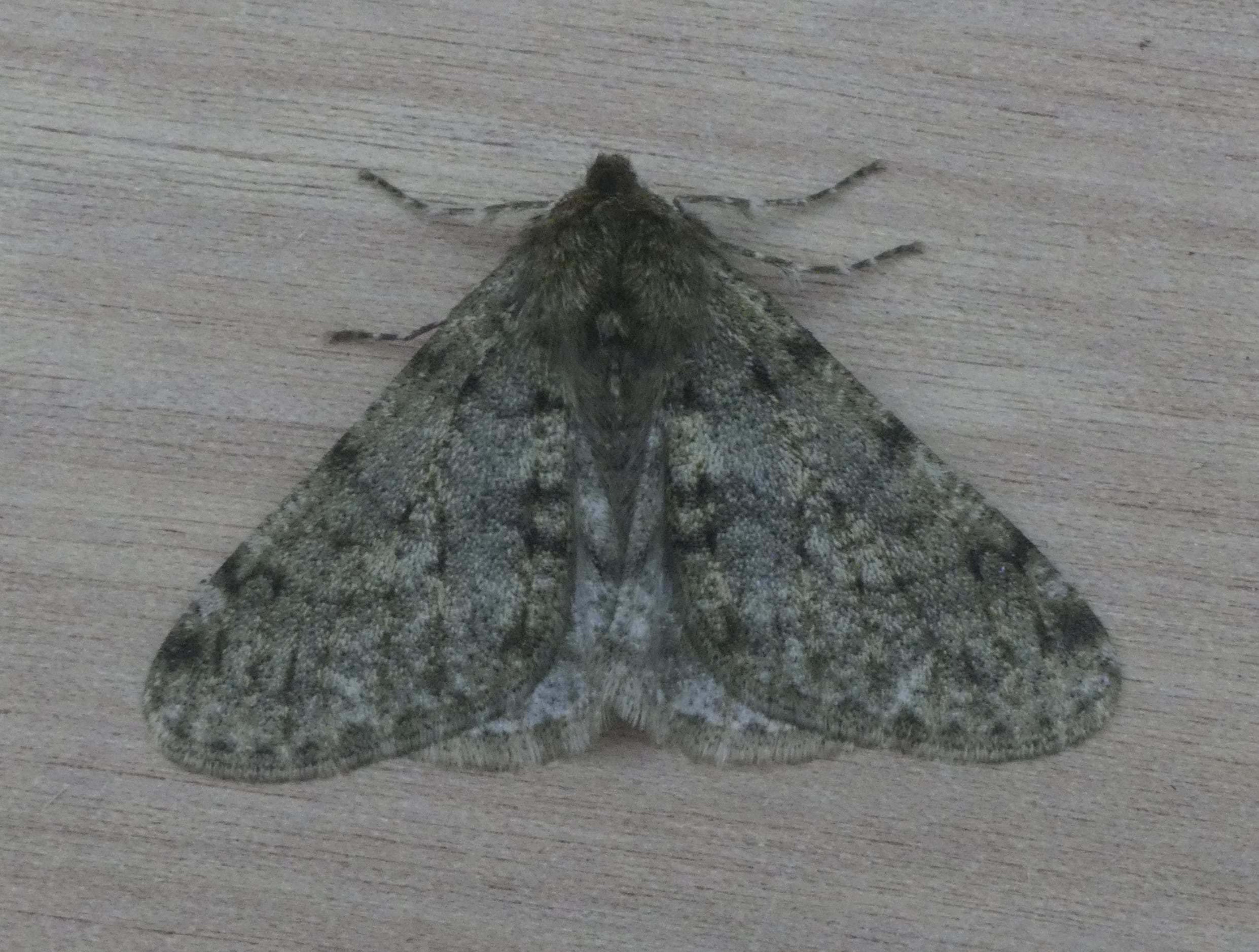
Here we have yet another moth which flies early in the year and which also has a wingless female. I don’t see large numbers of this moth, but of those I have seen the majority have been in February, with just a couple in December and three in January.
Fresh specimens of this moth give the appearance of greenish-grey colouration; you can perhaps make out a slightly greenish tinge the photo above (or perhaps it’s just my imagination!).
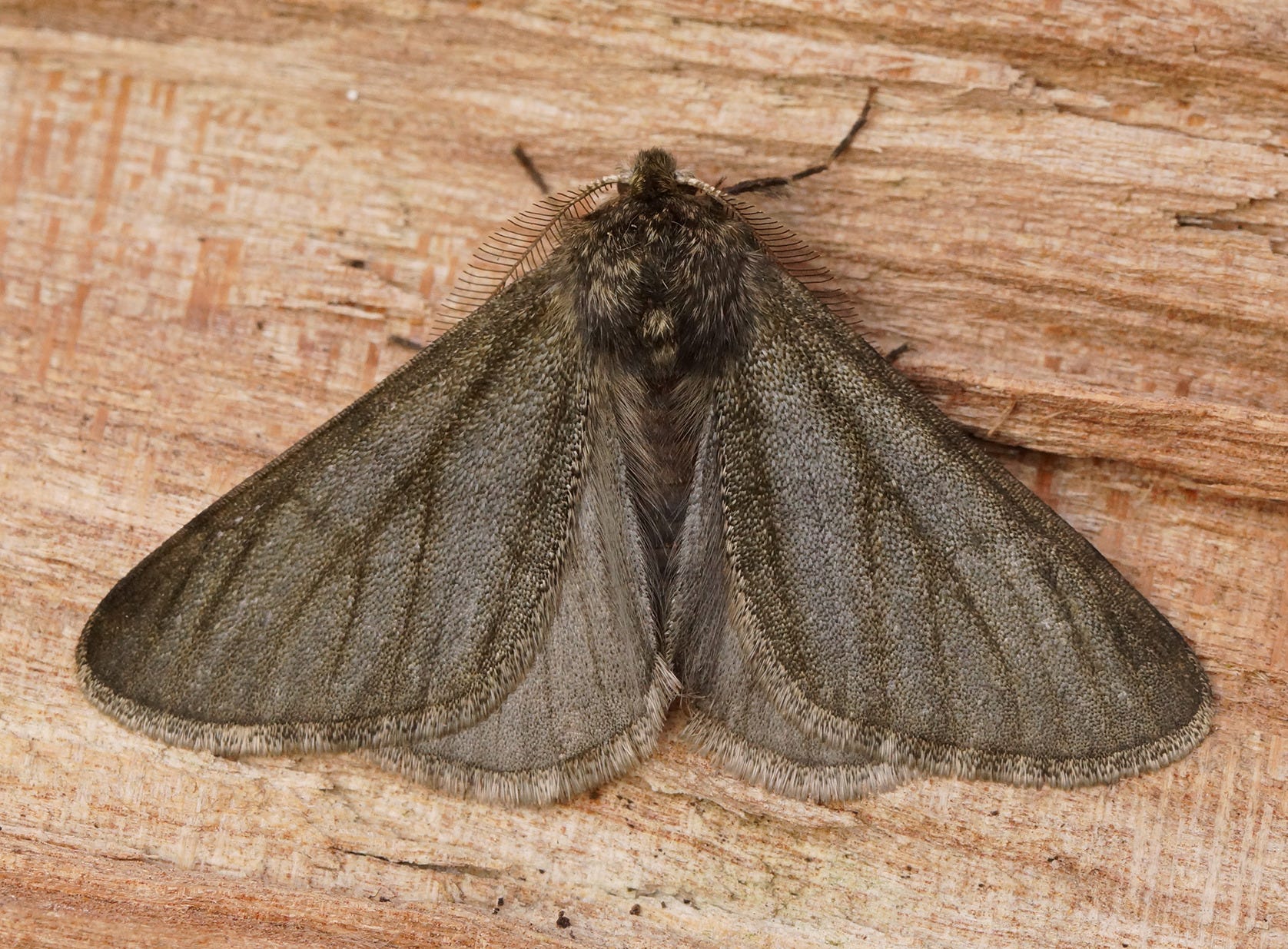
In the edition where I featured the Peppered Moth (here), I went into some detail about industrial melanism, for which that moth is famous. Well, the Pale Brindled Beauty also has a melanic form (form monacharia) that is reported to be commoner in areas affected by pollution. The Waring and Townsend Field Guide to the Moths of Great Britain and Ireland reports that in central London some 60% of the population is of the melanic form. Elsewhere in the country the melanic form is present but at a much lower frequency; Colin Pratt in his A Revised History of the Butterflies and Moths of Sussex reports that although the melanic form can be encountered throughout the county, its frequency is never much above 4% and often rather lower.
I’ve never seen the melanic form myself, but here is a photo from Cambridgeshire, courtesy of Ben Sale, one of our most experienced moth-ers:
One of my subscribers, Burhinus, who is based in West Suffolk also had a melanic individual earlier this month (this post). At the time of writing it’s labelled as an Oak Beauty but he just got his captions the wrong way round!
As a winter-flying moth, this species has several adaptations for coping with cold weather in common with some other species I have discussed previously (see here). Here’s James Lowen in Much Ado About Mothing:
Its bulbous head swells into a furry thorax-cum-winter-muff, while generously feathered antennae splay perpendicular. In his book Enjoying Moths1, Scottish lepidopterist Roy Leverton recalls discovering a Pale Brindled Beauty encased in ice after landing in a pool that subsequently froze. Leverton chipped out the moth then thawed it. At dusk, the moth flew away, apparently unharmed. The antifreeze done good.
The word ‘brindled’ is used in the common names of several British moths. It’s not a word much used in day to day speech now, so I thought I’d look into it and see what its origin is. Although the word itself has changed a bit over time, the meaning has remained stable - it means ‘having dark streaks or flecks over a grey, brown or tawny background’. In Shakespeare’s time the word was ‘brinded’:
First Witch: Thrice the brinded cat hath mew’d. Macbeth, Act 4 Scene 1.
So probably what we’d call a tabby cat today; one usually thinks of a witch’s familiar as being a black cat, but apparently tabby cats do just as well!
The change to ‘brindled’ came a bit later, possibly influenced by the existence of other adjectives ending in -led, such as grizzled, kindled, speckled etc.
The Middle English form was ‘brended’, which has the same roots as the modern German verb brennen, ‘to burn’. This suggests a meaning along the lines of ‘marked as though by burning or branding’.
In the 16th and 17th centuries the words ‘brinded’ and ‘brindled’ were mainly used of cattle, dogs and (to a lesser extent) horses. In the 18th century phrases such as “a brindled heifer, rising three years old” or “two brindled bullocks, of good size” were frequently encountered in agricultural advertisements.
It was during the 18th century that the word ‘brindled’ started to be used by lepidopterists to describe moths. A similar species to the one discussed here, the Brindled Beauty, is named as such in Moses Harris’s book The Aurelians, first published in 1766. However, that book went through several editions, the last in 1840, and I haven’t managed to work out at which stage this name was introduced (I discussed this book in more detail in the previous edition (here); if you read that discussion you’ll see where the problem lies!).
The other part of the moth’s common name, ‘Beauty’, is also worthy of comment. Just looking at the pictures above, you might be forgiven for wondering how it is justified for this species. English names for moths sometimes have a structure similar to the genus/species system in scientific names. For example, there are quite a few moths where the English name ends with ‘Pug’, all of which are quite closely related. Similarly for ‘Plume’. But the system is not applied as rigidly as it is with the scientific names, and there are exceptions … e.g. ‘Arches’; several moths include this in their name (Black Arches, Buff Arches, Dark Arches etc.) but they belong to different families. ‘Beauty’ falls somewhere in the middle … quite a few of them (about 18 in the UK) are in the Geometridae family and have similar shapes and appearance. Some of them even justify the name! However, there are a few exceptions from other families (Pine Beauty, Tree-lichen Beauty) and even a butterfly (Camberwell Beauty). So it’s never safe to assume that if two moths have the same word in their common name then they’re closely related.
The Common Quaker, Orthosia cerasi
Year total to date: 8 (first 7th February)
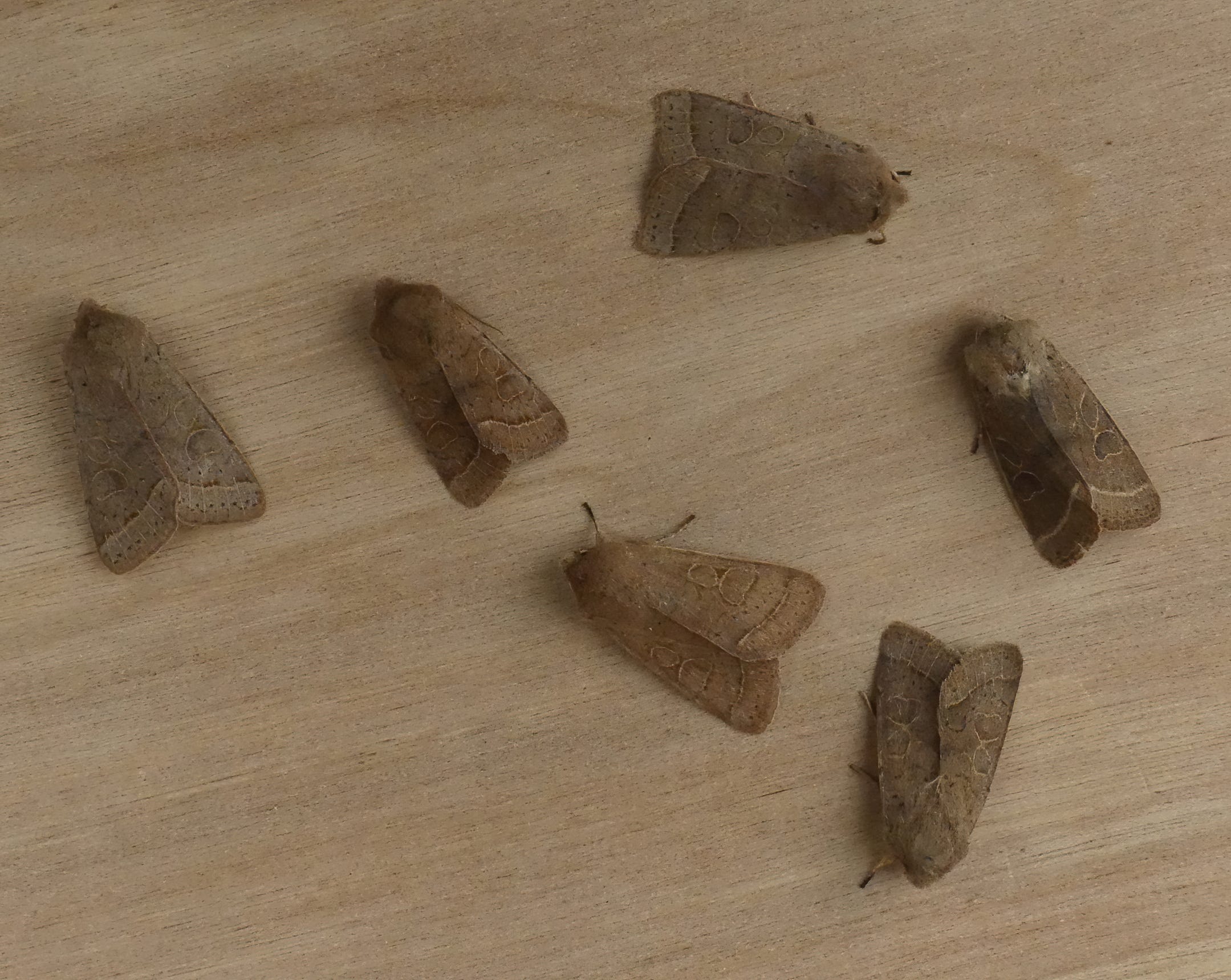
The Common Quaker is the commonest of several moths of the genus Orthosia, all of which have their flight seasons in the spring. In fact, this genus usually dominates the spring traps to such an extent that March and April are sometimes referred to by moth-ers as the Orthosia season, rather than as spring! My own records for this species showed average annual catches of around 50 from 2017 to 2023, then in 2024 it went up a bit to 87 and then in 2025 I had a total of 159, pushing this species into 7th place among the most abundant moths for the year.
The photo at the top of this section shows 6 which arrived on the same night, but that’s by no means my record for a single night, which is 27! In his book Much Ado About Mothing, James Lowey describes the Quaker moths as:
— cannon fodder for those who consider moths small, brown and boring.
But although they’re named ‘Quaker’ “in reference to the sombre clothing traditionally worn by members of that dissenting movement”2 , looked at closely they are anything but plain. Here are a couple of individual photos:


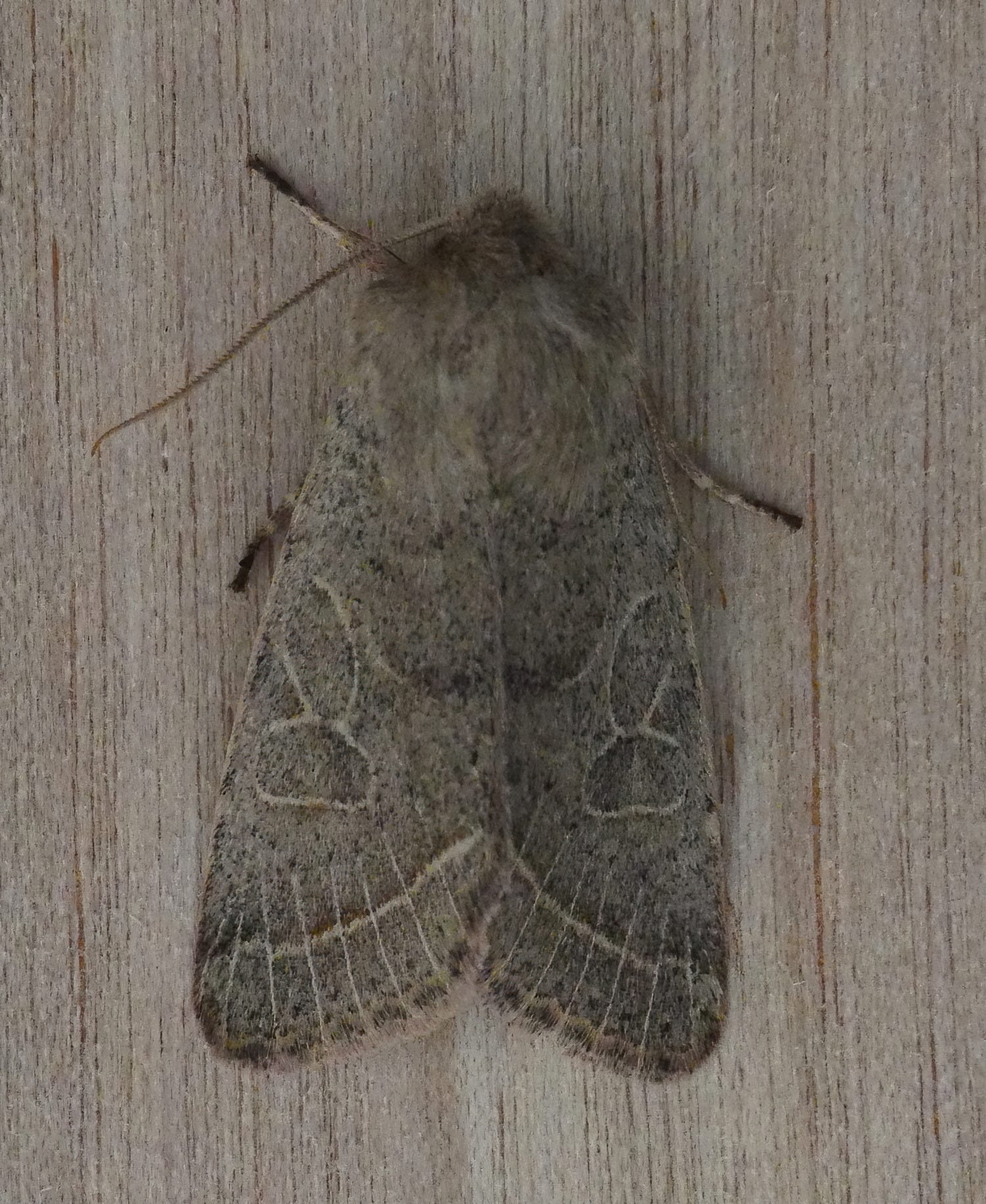
The one shown on the left here is fairly typical, while the one on the right has an unusually grey background colour. In addition to some variation in ground colour, sometimes specimens are found in which the stigmata (the two areas on the forewing surrounded by an approximately circular pale line) are touching, or even merged. This is the best example of that variation that I have a photo of:
The first Common Quaker for 2026 arrived on 7th February; this is unusually early and I only have one record of an earlier sighting (1st February in 2022). Although having said that, I do have a couple of records for December 2024. Although it does sometimes happen that a moth turns up completely out of season, having apparently misread the seasonal signs or perhaps pupated in a place which receives warmth from a compost heap or maybe a house or garden office, it is also possible that these December records are reflection of the moth’s flight season moving forwards as a result of climate change. Colin Pratt (in A Revised History of the Butterflies and Moths of Sussex) reports sightings as early as October in 2016 when the autumn was unusually warm.
The genus name Orthosia dates from 1816 and was coined by Ochsenheimer (whom I wrote about here). The link is to the Greek goddess of the hunt Artemis (roughly equivalent to Diana in the Roman pantheon). According to Herodotus, "on the coast of Byzantium there was an altar to Artemis Orthosia”. The word Orthosia comes from ὀρθός (orthos) — “straight,” “upright,” “correct,” “proper.” So “Artemis Orthosia” is not a different goddess, but Artemis in her role as the guarantor of rightness, order, and proper conduct. Moths of the genus Orthosia are famously punctual early spring fliers, so the choice of the name is possibly a metaphor for their seasonal regularity.
The species name cerasi, which means ‘of the cherry’, was allocated to this species in 1775 by Johan Christian Fabricius (1745-1808), possibly in the incorrect belief that the moth’s foodplant was cherry. Fabricius was Danish, the son of a doctor (I wrote a bit about Fabricius in an earlier post about the Wax Moth (here)). Although not wealthy, his father gave Fabricius a very free education, allowing him to follow his inclination for natural history and paying for him to study for two years, 1762-64, with Linnaeus in Uppsala. I wrote a bit about Linnaeus recently (here) and I’d like to quote a passage about this period that I came across in a paper3 by S.L. Tuxen:
His [Fabricius’s] description of the three foreign students (an American botanist, Kuhn and … two Danes) in their garret opposite Linnaeus' house being visited every morning at six by their teacher attired in a small red gown, green fur cap and smoking a long pipe, is most charming. In the summer they lived in a farm house near Hammarby and often gave parties for the family of their teacher who, himself, at the age of 55 … , now and again took part in a "Polsk4" dance "in which he surpassed all of us."
While Linnaeus’s first interest was in botany, Fabricius was primarily interested in insects (which at that time included anything with a hard external skeleton, i.e. spiders, crustaceans, centipedes etc.). Whilst Linnaeus named some 3,000 insect species, Fabricius’s total almost reaches 10,000. And whilst Linnaeus’s system for classifying insects didn’t extend much beyond how many pairs of wings they had, Fabricius based his system on the structure of the mouthparts. He also anticipated the modern approach when he wrote5 in 1803:
If we could depict, e.g., the genitalia in these animals they might be good characters, but they are still smaller than the mouthparts and I would say with Linnaeus: Genitalium disquisitio abominabilis displicet! [Investigation of the genitalia is abominable and displeasing!]"
Linnaeus and Fabricius clearly had high opinions of each other, but Linnaeus did not consider Fabricius as one of his ‘apostles’. This is most likely because Fabricius was not a field biologist; his work was based almost entirely on specimens collected by other naturalists and held in collections throughout Europe. He travelled widely, visiting all the important European national collections and many smaller collections held by individual entomologists, many of which have since disappeared without trace. He spent several summers in London, and also visited Scotland, Holland, France, Italy, Germany, Austria, Russia (St Petersburg), Switzerland, Norway and of course several parts of Denmark.
Fabricius held professorships first in Copenhagen and later in Kiel (which at that time was part of Denmark). In both places his title was ‘Professor in Natural History, Economy and Finance’, and in addition to his several books on insects he also wrote books on economics.
Although Fabricius is now regarded primarily as a systematist, he in fact regarded systematics as a route towards a better understanding of the rules of nature. He wrote: "As we would not call a man learned merely because he can read, so we would not call a man a scientist who knows nothing but the system." He was clearly aware that species evolve, and that this was in some way driven by the environment and through the preference of females to mate with the strongest males. In a book published in 1804 he wrote of “the species of the bigger monkeys from which man seems to have evolved”; clearly a passage that somehow escaped the Bishop of Oxford!
To end this edition, here is another quote from the paper by S.L. Tuxen which I cited earlier:
The life of Fabricius was strikingly different from that of Linnaeus. Linnaeus was very poor as a student and became very rich, esteemed by his king and his country, and many people came to visit the great man. But he lived all his life in Uppsala, became conceited, and was not happy in his life with a dull and difficult wife, as Fabricius tells us. In contrast, Fabricius had a protected youth and a happy marriage with an intelligent and brilliant wife, who was far ahead of her time; their life was notorious for their absent-mindedness, as Henrich Steffens6 tells us. As a professor he lived on a small salary in the outskirts of his country, got no facilities for his studies or help from his country, and was literally forced to travel to improve his studies. His duties as a professor, furthermore, included politics and political economy, etc. In this way, however, he attained a broader horizon than did his beloved teacher; he took part in discussions on nearly everything concerning the politics of his time and he was acquainted with all and sundry within his science.
Fabricius died in Kiel in March 1808, broken (his wife said) by the news of the British bombardment of Copenhagen7 in the autumn of 1807.
That’s it for this week. Now that moth numbers are (hopefully) on the up again, I’m planning to switch back to a weekly newsletter. So the next issue is scheduled for Tuesday, 10th March.
This newsletter will always remain free. However, if you feel you want to show your appreciation by making a financial contribution you can use the button below to take you to a website where you can do so. I will donate any money I receive through this route to a charity, most likely Butterfly Conservation but other more local wildlife charities might also qualify. Absolutely no obligation, but many thanks if you do.
I tried to find a second-hand copy of this book (published in 2001) so that I could quote the relevant extract directly, but the cheapest copy I could find was about £30 and one supplier was asking £160!
Peter Marren, Emperors Admirals and Chimney Sweepers.
Tuxen, S. L. (1967). “The Entomologist, J. C. Fabricius”. Annual Review of Entomology. 12 (1): 1–15. Much of the material about Fabricius in this edition of the newsletter is based on this paper.
Meaning ‘Polish’; so not necessarily implying a polka, but from the context it does appear to be something energetic!
Text translated from the German.
This is Henrik Steffens (1773-1845), a philosopher, geologist, mineralogist and poet, born in Stavanger but who taught at both Copenhagen and Kiel Universities at the same time as Fabricius. This opionion about Fabricius is presumably stated in Steffens’ 1840 autobiography, Was ich erlebte [What I experienced], but I haven’t had any success in tracking down any examples of this absent-minded behaviour!
In 1807 Denmark–Norway was pursuing a strict policy of neutrality while the Napoleonic Wars were raging across Europe. Britain, however, received intelligence that France and Russia intended to force Denmark-Norway into the Continental System, Napoleon’s economic blockade against British trade. If Napoleon gained control of the Danish–Norwegian fleet, he could threaten British naval dominance in the North Sea and the Baltic. Britain therefore launched a pre‑emptive expedition to seize or neutralise the fleet, which was lying in Copenhagen and not ready for action. British forces surrounded the city by land and sea, and when Crown Prince Frederick refused to surrender the fleet, the bombardment began. Most civilians had already been evacuated, but still almost a thousand were killed or wounded, and large areas of Copenhagen were destroyed by fire. The city eventually capitulated, and the British seized the entire Danish–Norwegian fleet — 18 ships of the line, 16 frigates, 9 brigs, and 26 gunboats — and towed it to Britain. (This was not Britain’s first attack on Copenhagen: in an earlier 1801 attack Nelson had famously put his telescope to his blind eye and declared, “I see no signal.”)
It shows the difference of living in mild south wales. My 4 traps in February produced 62 moths of 13 species. 2025 was a lot lower (& a lot colder) but 2024 was above 70 in Feb. I love Common Quakers now, but they were a bit daunting my first year of mothing - sorting them out from others. So behind on reading substacks that realised I’ve commented just before your next post is due!!
Wingless females? What do they look like?