
Moth Report #33
The Turnip, Epiphyas postvittana (aka the Light Brown Apple Moth) and the Yellow-line Quaker
Welcome to my new subscribers (indeed, to all my subscribers!). This introductory blurb (in italics) will remain much the same from post to post; please skip it if you’ve read previous posts.
This newsletter will remain free, I’ve no intention of converting it to a paid subscription. It’s aimed at readers who have a general interest in nature and natural history, but maybe don’t know very much about moths. It’s not really aimed at people who regularly run their own moth traps, but of course they’re welcome to read it (even to criticise it if they wish!).
I run a light trap in my garden in Eastbourne (Sussex, UK) and the main objective of this newsletter is to post photos of some of the moths (and occasionally, other insects) that are attracted to the light, and to say a little about them. On average I run the trap about one night in three, and the plan is to write a post once a week, featuring two or three of the moths seen in the trap within the previous couple of weeks.
In the morning I photograph any catches of special interest, then all moths and other insects caught in the trap are released (if they haven’t escaped already!).
This is my ninth year of running a garden moth trap, firstly three years in Eastbourne (2017-2019), then three in Hurstpierpoint (2020-2022), and then back in Eastbourne (2023 onwards). Hopefully, yet more house moves are off the cards for the foreseeable future!
Report for w/b 10th November
Two trapping sessions this week, the 10th (Monday) and the 13th (Thursday). Both nights were mild, but on Monday there was quite a stiff breeze; Thursday was much less windy (and even a bit milder). There was a marked difference in the catches; just 5 moths of 5 species on the Monday but Thursday produced an astonishing 94 moths of 22 species, smashing my previous November records convincingly. Previously, the maximum number of moths I’ve recorded for the whole of November was 72!
Two of the species from Thursday were new records for the year, one of which (Scarce Umber) I’ve seen only once before. There were also large numbers of several migratory species which I’ve written about before, including 18 Rusty-dot Pearls and 23 Palpita vitrealis (exceeding my previous maximum whole year total, 20).
Then on the Friday night, although I didn’t run the trap another first for the year, the Mottled Umber, turned up on the patio doors.
Let’s move on to look at some species seen recently.
The Turnip Moth, Agrotis segetum
Year total to date: 87 (latest: 13th November (5))


This is another of those moths whose caterpillars are sometimes described as ‘cutworms’, because they live under the soil surface and when they emerge to feed at night have a tendency to eat through the base of their foodplants, thus killing them completely. I’ve featured a couple of other moths with this distinction in previous reports, the Pearly Underwing and the Large Yellow Underwing.
As you’ve probably realised, this moth is an agricultural pest of turnips. It also eats lots of other plants; the most susceptible crops are lettuce, leeks and beetroot, with turnip listed as among the least susceptible (here). In the south of England the moth has two generations a year, the first flying in May-June and the second in August-September; it is the caterpillars that follow the first generation that cause the agricultural damage; those following the second generation are not so much of a problem. The caterpillars from the second generation overwinter as larvae and pupate in the spring. Research has shown that milder and drier winters lead to increased survival rates among overwintering larvae. As an agricultural pest this moth is most evident in Europe and in Africa; it seems not to have become established in the United States.
Actually it is only the older caterpillars that exhibit the ‘cutworm’ lifestyle; for the first two instars1 the caterpillars stay on the foodplant all the time, and it is at this stage that they are most vulnerable to pesticides and also to wet weather. In 1983 a paper was published which used historical weather data combined with catch records for the turnip moth to construct a model which can be used to predict the severity of the turnip cutworm investation in the coming season. This model has been programmed into the forecasting tool sponsored by the Agriculture and Horticulture Development Board (see here). The principal author of this paper was John Bowden (1924-2012), an entomologist working at Rothamsted Research Station, and the work was done in conjunction with what was then the National Vegetable Research Station (NVRS), now part of Warwick University. I visited both the NVRS and Rothamsted regularly in the 1970s during my first job as a statistician, which was at a sister research facility, the Glasshouse Crops Research Institute, Littlehampton (now, sadly, a housing estate!).
It seems to be a feature of the Turnip moth that it has occasional years when it is very abundant; in the 1983 paper mentioned above it is reported that 1949 and 1976 were such years, when quite severe damage was done to crops. My records since 2017 reflect this, since until this year the largest number I saw in a single year was 19, and most years the count didn’t get into double figures. This current year though is different; I had 57 in June alone and the current running total is 82. Most likely this is a reflection of the fact that the period when the first and second instar first generation larvae were feeding (late spring) was very dry and so their survival rate was high.
I probably shouldn’t leave this discussion without commenting on the fact that, as you can see from the pictures, the moth is quite variable in its appearance. It’s also quite similar to several other species, so identification can get a bit tricky at times! One thing that helps is hindwing colour, which is almost pure white in the males with a few thin black lines. In the females it is pearly grey. For anyone with a moth trap who wants more help in identifying the Turnip moth, NatureSpot (based in Leicestershire) has produced a video which describes the main features (here). It rather concentrates on the males though, if your specimen is female it won’t match all of the features mentioned in the video.
Epiphyas postvittana (aka the Light Brown Apple Moth)
Year total to date: 35 (latest 13th November (4))


This is another moth with a very variable appearance, but in other respects it’s quite unlike the Turnip moth discussed above. Firstly, it’s an adventive; that is, it is not a native of the UK, but was introduced accidentally (the first UK record was from Cornwall in 1936) and has since become well established across Wales, Ireland and southern and central England. So well established in fact that it’s often referred to by the initials of its common name, the LBAM, rather than by its scientific name or its full English name.
In spite of its common name, its caterpillars feed on many more plants than just apple; it’s been recorded on more than 500 different plant species, including several of commercial importance such as citrus and grape varieties, so it can justly be described as polyphagous (=eats lots of different things).
It’s native territory is Australia, where it’s a major agricultural pest, especially in the fruit- and wine-growing areas of Victoria, New South Wales, South Australia, and Tasmania. It’s also a serious pest in New Zealand, where it was first recorded in 1891. However, although it is common and widely distributed in southern parts of the UK it is not yet regarded as a major pest species here, although this could change as viticulture expands. In his book ‘Much Ado About Mothing’ (has to take the prize as the best title for a moth book!), James Lowen comments that in the UK
it is largely an urban and suburban species, less readily found in the wider countryside.
As an urban species it is more likely to feed on ornamental plants typically found in parks and gardens than on vines. It seems likely that the reason this moth has not become a pest here, compared with the antipodes, is that there are genetic differences between the populations which give them different preferences regarding their food plants. Maybe the UK population is not so oenophilic as the native population in Australia. Such a difference could easily have arisen through genetic drift, or through the founder principle; if the first specimens to arrive here were brought in on ornamental plants they are likely to be ones that preferred this type of food plant.
The worldwide distribution of this moth (here) is quite interesting. It’s missing from large parts of the world, including most of Europe, but is found in the Azores and Madeira (but not the Canaries) and also in Hawaii and California. The first record from California was in 2007, where it was regarded as a potentially invasive species and massive efforts were made to prevent its spread. Over 50,000 pheromone traps were deployed, together with aerial spraying campaigns, but after four years or so these attempts were abandoned. Subsequently it has not turned out to be a major pest of vineyards, and behaves more like the UK population, but (as here) it is closely monitored in case it shows signs of reverting to its more destructive tastes.
More about variation, etc.
The four colour forms shown above are not the complete repertoir that this moth displays (on the link about about the worldwide distribution you can click on ‘gallery’ to see more examples). To complicate matters further there is another moth, also quite common in the UK (Clepsis consimilana) which can easily be mistaken for some of the colour forms of the LBAM. Fortunately there’s an easy way to tell the difference (most of the time); the palps. I wrote a bit about palps in an earlier report (here); these are sensory organs attached to the head. In the LBAM they are much longer than in Clepsis consimilana, and stick out horizontally in front of the head. They can be seen in the photos above (except for the one bottom left, in which they are completely missing).
One of the unusual features of this moth is that the adults can be found in any month of the year. I see it most often in August, but I have several records of it from January and February. So it seems that the moth is continuously brooded in the UK, with multiple overlapping generations. Larval development slows in the winter; the caterpillars live in loosely spun leaves of the host plants, feeding intermittently when temperatures allow.
The species name postvittana is taken from the Latin post- (‘after’ or ‘behind’) and vitta (‘band’, ‘stripe’ or ‘ribbon’) and presumaby relates to the banded brown colouration of the wing extremities which can be seen in some of the colour forms. The name was given to this moth in 1863 by Francis Walker (1809-1874). He was a British entomologist who was contracted by the British Museum to catalogue their collection of insects (excluding the beetles).
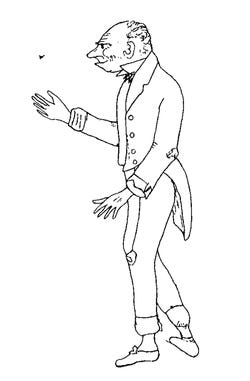
Walker was born into a wealthy Quaker family and spent part of his childhood in Switzerland, where (together with an older brother) he was collecting butterflies at the age of nine. During this time the family was visited by, among others, Lord Byron. He became one of the most prolific entomologists of the 19th century, describing tens of thousands of species and playing a central role in organizing the museum’s insect collection. Many of these insects came from collections made in the British colonies, including material from Australia (which included the LBAM specimen he named). Some of the insects he described had been collected during the voyage of the Beagle.
Walker later attracted a fair amount of criticism for being a somewhat careless taxonomist, naming species twice, giving names to species which others had already described, and giving insufficient diagnostic detail. One of the most scathing obituaries I’ve ever read was written about him in The Entomologist’s Monthly Magazine in 1874 (available online here). Unsurprisingly, it’s unsigned.
However, most taxonomists of the time made similar mistakes, and it is due to the enormous volume of Walker’s output that he appears to have made more mistakes than most. Another obituary (available here), this time signed, was much more detailed and complimentary. Today he is regarded as having made an enormous and positive contribution to insect taxonomy.
The Yellow-line Quaker, Agrochola macilenta
Year total to date: 1 (4th November)
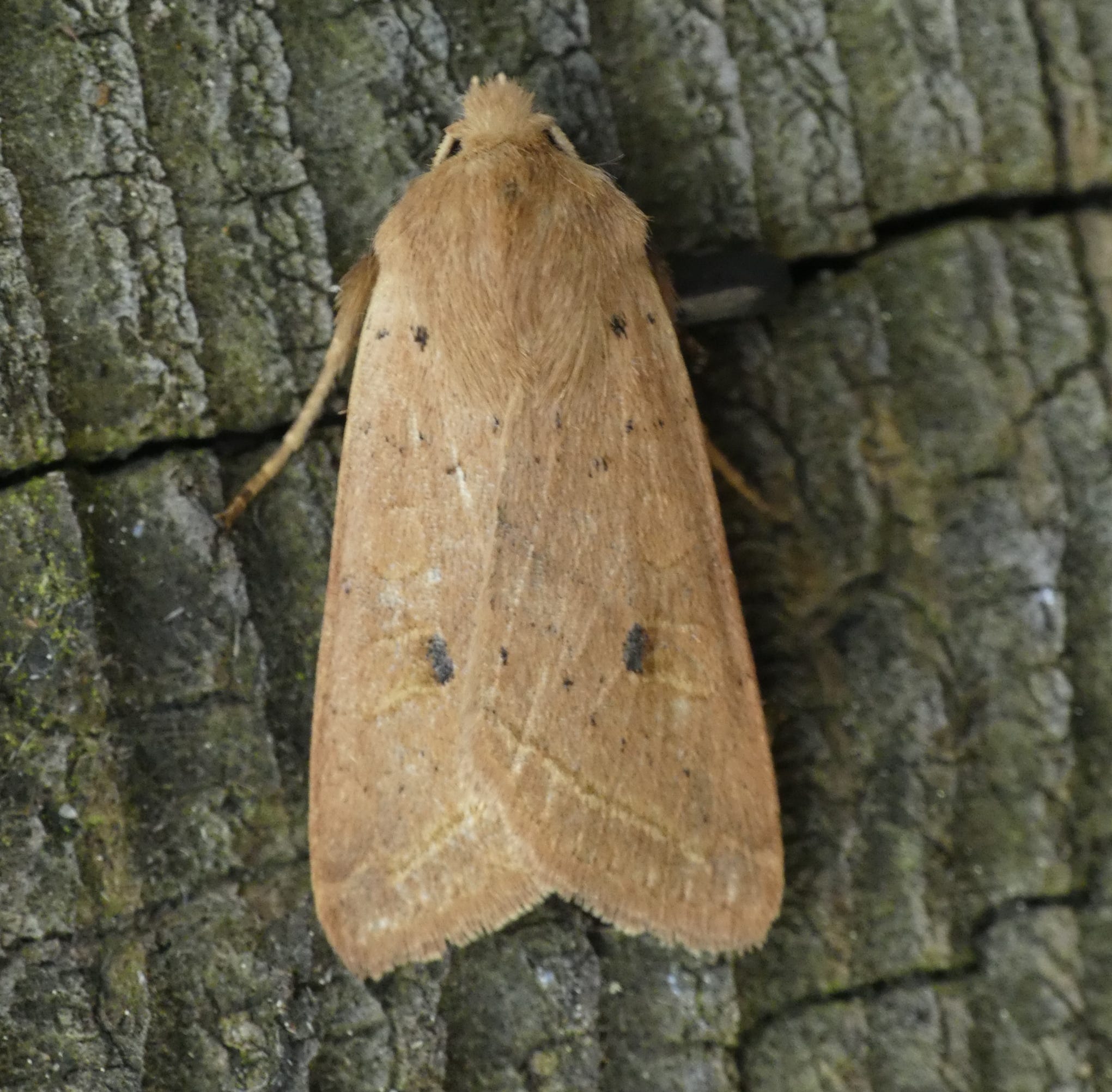
There are several moths with ‘Quaker’ in their name, some of which are spring moths and others are autumn moths. This one, of course, is one of the latter. The yellow line is the diagonal line near the end of the wing, which runs right alongside (and below, in this orientation) a darker line which is grey-brown in this example, but is often red and sometimes much more prominent than the yellow line. And that can be confusing because there’s also a moth called the Red-line Quaker! But that’s usually a much darker moth, and it doesn’t have the black dots at the base of the wing (the top, in this orientation).
Neither of these moths has been a freqent visitor to my trap; I’ve never had more than seven of either in a single year, more usually it’s between 0 and 2. In my previous Eastbourne garden, the Yellow-line was commoner than the Red-line; indeed I saw only one Red-line in the three years I was there. But in Hurstpierpoint, and back in Eastbourne again the Red-line has been commoner than the Yellow-line; indeed this is the first Yellow-line I’ve seen since 2021. It’s hard to say whether that indicates a real change in the species’ abundances, or whether it’s just due to the different gardens involved.
This moth is in the same genus (Agrochola) as the Brick, which I covered last week (here), but I didn’t discuss its meaning. It has Greek roots, agros (ἀγρός) ‘field’ or ‘rural land’, and chole (χολή), ‘bile’ or ‘gall’. So, a moth of the fields which is the colour of bile; not the kindest of names to lumber a moth with! The ‘chole’ bit is the same root as in ‘cholera’, for example. The species name, macilenta, means ‘lean’ or ‘thin’. The moth is perhaps marginally sleeker than the Brick, but also it could just mean these moths are a bit thin on markings. The name Quaker itself is said to relate to the relatively plain appearance of these moths. The species name was assigned by Jacob Hübner, whom I wrote about earlier (here and here), in 1809. He is also responsible for the (bilious) genus name.
That’s it for this week. The next issue is scheduled for Tuesday, 25th November.
An instar is the period between moults for a caterpillar. Usually a caterpillar will moult five times during its growth, so there are six instars, egg to first moult, first to second moult, … fifth moult to pupation.
Hi Dennis
Re LBAM, thought you might be interested in this, concerning its costal folds.
https://www.flickr.com/photos/149980226@N06/48683273526/in/album-72157708542555825
CEJ
Awesome!!!